
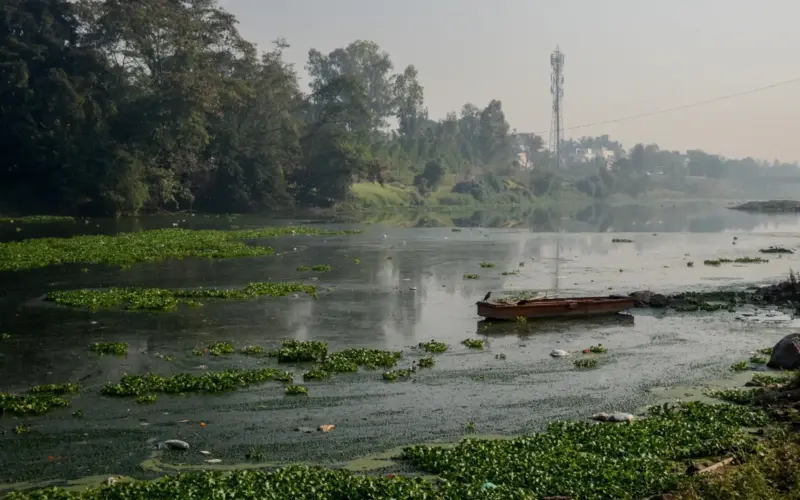

National Green Tribunal (NGT), Western Zone Bench, has ruled that the controversial bio-enzyme "Draynzyme" cannot be used in rivers or natural water bodies without long-term scientific assessment, dealing a major setback to the Pune Municipal Corporation's (PMC) river-cleaning experiment in the city.
The tribunal was hearing a matter arising from reports that PMC had sprayed the bio-enzyme in the Ramnadi at Bavdhan and later used drones to spray insecticide along stretches of the Mula-Mutha river at Keshav Nagar, Kharadi and Mundhwa, allegedly without adequate scientific validation.
The bench of Justice Dinesh Kumar Singh and Expert Member Dr Sujit Kumar Bajpayee observed that introducing any foreign substance into an aquatic ecosystem must be backed by proper scientific testing before being deployed in natural water bodies.
A report submitted by the Central Pollution Control Board (CPCB) stated that while acute toxicity studies by the Indian Institute of Toxicology Research (IITR) found no immediate adverse impact on aquatic life, the product could not be declared safe for rivers because long-term ecological studies are still pending**.
According to the tribunal, the product appears suitable only for in-situ bioremediation in low-flow wastewater drains and sewer lines, where regular monitoring and sludge removal can be carried out. However, the bench made it clear that its use in rivers and rivulets is not recommended at present.
The NGT directed the CPCB to complete a detailed long-term study within one year to determine whether Draynzyme can safely be used for restoration of natural water bodies in the future.
"As of now, it can be used only for sewerage cleaning," the tribunal said in its order.
The tribunal also rejected an application filed by QuinQuent Industries Pvt Ltd, the manufacturer and supplier of Draynzyme, seeking to become a party in the proceedings. The bench said the company could independently conduct studies if it wished, but there was no need to formally implead it at this stage.
The ruling comes as a significant reminder that urban river restoration cannot be carried out through trial-and-error methods, especially when the long-term impact on fragile aquatic ecosystems remains uncertain.