




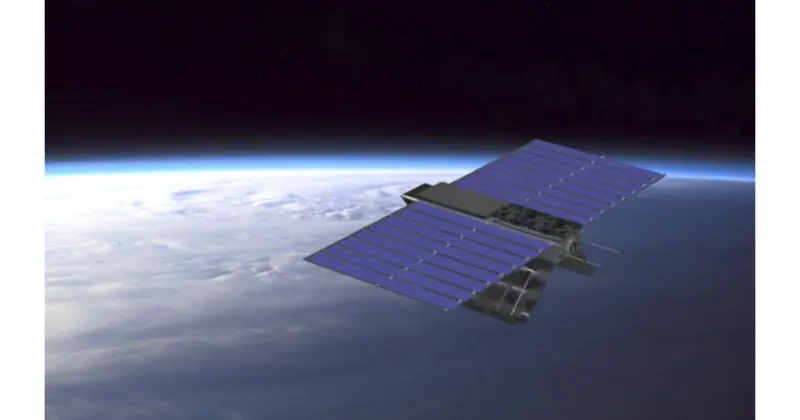

Orbital data centres are emerging as the next big frontier for artificial intelligence, promising to process data in space rather than sending everything back to Earth.
Orbital data centres place high-performance computing hardware on satellites or dedicated platforms so that imagery and sensor readings can be analysed in orbit. Instead of downlinking every frame, AI models on board select, compress and prioritise only the most valuable data, easing bandwidth bottlenecks and cutting delays. This shift is especially attractive for defence, disaster response, climate monitoring and agriculture, where minutes can shape critical decisions on the ground.
Companies from Hewlett Packard Enterprise (HPE) to Indian startups such as Digantara, Pixxel, Skyroot Aerospace, Dhruva Space and SatSure are racing to build this space-based edge computing layer. HPE's Spaceborne Computer-2, operating on the International Space Station, uses commercial servers hardened for orbit to run AI and high-performance computing experiments close to where data is generated.
Digantara plans a 15-satellite constellation for space domain awareness by 2027, using edge computing to reduce "downlink and information latency" and enable autonomous collision avoidance through inter-satellite links. Pixxel's Firefly hyperspectral constellation, now six satellites strong, combines dense spectral imaging with in-orbit filtering and compression to decide which packets must be sent first. Dhruva Space stresses that compute in orbit must fit into the full mission architecture, balancing power, thermal and reliability constraints against the need for sovereignty over the entire data pipeline.
A broader wave of players, including Axiom Space and NVIDIA partners, is also testing orbital data centres with GPUs and AI accelerators to run real-time analytics in low Earth orbit. These platforms aim to support everything from autonomous spacecraft operations to predictive maintenance and astronaut health monitoring, as missions move deeper into space.
Despite these advances, industry leaders caution that orbital data centres will complement, not replace, terrestrial cloud infrastructure. Massive workloads such as large-scale remote sensing, disaster modelling and AI training will still need aggregation and heavy processing on the ground, using space mainly for triage and first-order decisions.
For now, orbital data centres remain an ambitious, evolving layer in a distributed AI stack: satellites act less as passive data couriers and more as autonomous, decision-making nodes. If engineers can solve challenges around power, radiation and reliability, space-based computing is likely to become a critical extension of Earth's data centres, reshaping how quickly and securely we see our planet, and beyond.