




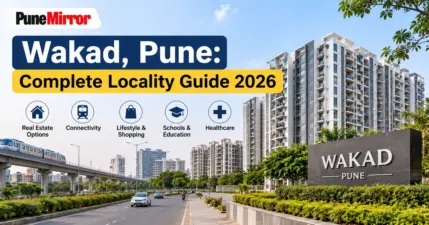

Property prices, connectivity, schools, healthcare, neighbourhoods, rentals, infrastructure and what different budgets can buy
Wakad has evolved from a relatively peripheral residential area into one of the most important residential markets in western Pune.
Its location explains much of that transformation. Wakad sits close to Hinjewadi's employment corridor, connects directly with the Mumbai-Bengaluru Highway, and provides access towards Baner, Balewadi, Pimple Saudagar, Tathawade and Punawale.
But Wakad is not one uniform neighbourhood.
Kaspate Wasti, Shankar Kalat Nagar, Bhumkar Nagar, Park Street, Bhumkar Chowk, Datta Mandir Road and the areas around Wakad Bridge have different characteristics, road conditions, building ages, price points and commuting patterns.
For a homebuyer, therefore, the more useful question is not simply "Is Wakad a good place to buy?"
The better question is:
Which part of Wakad, at what price, for what type of home and for which daily commute?
That is the purpose of this PTM locality guide.
Property prices are portal-based asking/market datasets and should not be treated as registered transaction values. Housing.com currently reports an average Wakad price of about ₹8,774/sq ft, while Magicbricks' Q3 2026 data reports an average of about ₹9,589/sq ft for multistorey apartments.
Wakad lies in western Pune, within the Pimpri-Chinchwad urban region, and is positioned strategically between the Pune city side and the Hinjewadi employment corridor.
Its surrounding geography is one of its biggest advantages.
To the west and southwest are Hinjewadi, Tathawade and Punawale.
Towards the east and southeast are Pimple Saudagar and Thergaon.
Towards the south and southwest are Balewadi and the Baner side.
The Mumbai-Bengaluru Highway provides a major regional connection, while roads through Wakad connect residential neighbourhoods with Hinjewadi and the western Pune employment belt.
This makes Wakad particularly relevant to people whose daily lives involve more than one part of western Pune.
One of the biggest mistakes a buyer can make is treating all of Wakad as the same.
The locality contains several distinct residential pockets.
Kaspate Wasti is one of the more established residential pockets of Wakad.
It has a mature residential ecosystem, with apartment societies, local shops, restaurants, schools and everyday services.
The area is particularly useful for buyers who want an established neighbourhood rather than a newly developing peripheral pocket.
Because of this maturity, individual buildings can vary substantially in age, construction quality, parking arrangements and maintenance.
A buyer should therefore examine the society and building rather than rely solely on the locality name.
Shankar Kalat Nagar has developed into another significant residential pocket.
It is connected towards the highway and wider Wakad network and contains a mixture of established housing societies, newer developments and commercial activity.
Healthcare facilities are also accessible from this part of Wakad.
For a buyer, the important issue here is the exact road frontage and internal access. Two properties carrying a Wakad address can have very different daily commuting experiences.
Bhumkar Chowk is one of Wakad's important movement points.
The area has experienced substantial residential development because of its proximity to the highway, Hinjewadi side and newer western Pune growth corridors.
Bhumkar Nagar has become an important apartment market, but traffic conditions around major junctions should be considered carefully before buying.
For someone who drives towards Hinjewadi every day, a property that looks close on a map may still involve substantial peak-hour delays.
Some of Wakad's newer and more amenity-oriented developments are concentrated around pockets such as Park Street.
Housing.com currently shows Park Street at a higher average listed rate than several other Wakad sub-areas, illustrating why a single Wakad-wide average can hide substantial internal variation.
These pockets can offer newer buildings and stronger amenity packages, but buyers should carefully compare the total purchase cost rather than only the quoted rate per square foot.
Datta Mandir Road is another established residential and commercial corridor.
The area contains housing societies, restaurants, schools and everyday retail.
Its position makes it relevant for residents travelling towards Hinjewadi as well as towards the Aundh-Wakad side.
Again, the individual road and building matter.
A property directly facing a busy road can have a very different noise, dust and traffic experience from one inside a residential society.
Wakad's development can be understood through four major forces.
The growth of Rajiv Gandhi Infotech Park created a large employment ecosystem west of Pune.
Wakad became one of the residential areas from which employees could access Hinjewadi while still remaining connected to the wider Pune metropolitan region.
PMRDA itself describes Metro Line 3 as a project intended partly to address traffic problems around Hinjewadi and nearby areas.
The highway gives Wakad regional connectivity towards Mumbai, Pimpri-Chinchwad and the Bengaluru-bound corridor.
As Baner, Balewadi and Hinjewadi expanded, Wakad increasingly became part of a continuous western Pune urban belt rather than an isolated suburb.
Large numbers of apartment projects have transformed the locality into a substantial residential market.
The result is a locality where end-users, investors, renters and IT professionals all participate in the market.
Wakad's road connectivity is extensive.
But the same roads that make it accessible also carry enormous volumes of traffic.
Important routes include:
The Wakad-Hinjewadi connection is particularly important for the large population commuting to the IT corridor.
This produces a paradox:
Wakad can be geographically close to your workplace but still involve a difficult peak-hour commute.
Therefore, property buyers should test the actual journey during working hours rather than evaluating connectivity using a Sunday afternoon drive.
Metro Line 3 is one of the most important infrastructure projects for the western Pune region.
PMRDA describes the Hinjewadi-Shivajinagar corridor as a 23.203-km elevated metro project with 23 stations. The project is specifically intended to improve public transport connectivity to Hinjewadi and surrounding areas.
The corridor passes through the western Pune growth belt, including areas around Hinjewadi, Wakad and Balewadi.
As of the latest 2026 reporting, portions of the line have received safety clearance, but the entire corridor should not yet be described as fully operational. The remaining stations and commissioning process are still relevant to buyers.
For residents, the significance is not simply that a metro station exists.
The larger question is whether the system provides a practical alternative to road travel.
If it does, the benefit could be particularly relevant to people travelling between western Pune employment centres and the city side.
However, buyers should not pay a premium today solely on the assumption that future infrastructure will automatically produce a particular property return.
Infrastructure should be treated as one factor in a property decision, not as a guaranteed appreciation formula.
For many residents, the employment ecosystem is the primary reason for choosing Wakad.
Hinjewadi's IT and business ecosystem has created a large residential catchment extending through Wakad, Tathawade, Punawale, Balewadi and other western Pune areas.
This has also created a substantial rental market.
The advantage for an employee is obvious: living closer to the western employment corridor can reduce the distance that needs to be travelled every working day.
But buyers should distinguish between distance and actual travel time.
The latter depends on:
Wakad has developed a substantial education ecosystem.
Among the established schools is Akshara International School, whose Wakad campus offers CBSE education through Class XII. The school's official information lists its Wakad campus at S. No. 109 and its current affiliation number as 1130266.
Another established institution is Wisdom World School Wakad, which follows the ICSE curriculum. Its Wakad campus is located near Kalewadi Chowk.
is another school option in the locality.
Parents should not select a property merely because a school is "nearby." The actual school commute during morning traffic, transport routes, admission availability, curriculum and fee structure should all be examined.
Wakad has developed a significant healthcare ecosystem, with hospitals and speciality facilities serving both Wakad and neighbouring western Pune communities.
Examples include:
For families buying a long-term home, healthcare access should be evaluated at two levels: emergency access to a nearby facility and access to larger tertiary-care hospitals elsewhere in Pune.
Wakad has moved well beyond being simply a residential suburb.
The locality now contains a large ecosystem of restaurants, cafes, supermarkets, salons, fitness centres, retail stores and commercial developments.
The dining market is particularly active around the main residential and commercial roads.
Examples include:
The presence of this commercial ecosystem is important because it means residents can meet many daily needs within or close to Wakad rather than travelling into central Pune.
Property prices vary significantly depending on the exact pocket, project, age of building, floor, view, amenities, carpet area and developer.
Current portal datasets illustrate the spread.
Housing.com currently reports an average Wakad price of approximately ₹8,774 per sq ft, with its displayed range extending from about ₹3,584 to ₹18,571 per sq ft. It also shows significant variation between micro-markets such as Kaspate Wasti, Bhumkar Nagar, Park Street and others.
Magicbricks' Q3 2026 dataset reports an average multistorey apartment price of approximately ₹9,589 per sq ft, with a displayed locality range of roughly ₹7,721 to ₹11,457 per sq ft. Its BHK-specific data shows 2 BHK apartments around ₹7,400-₹11,100 per sq ft and 3 BHK apartments around ₹8,100-₹12,200 per sq ft.
These figures should be used as market indicators, not as a valuation of any particular apartment.
The most useful way to think about Wakad is through budget bands rather than one headline price.
| Approx. budget | What a buyer may encounter |
|---|---|
| ₹50-75 lakh | Smaller apartments, older resale stock and selected smaller/newer units depending on exact location |
| ₹75 lakh-₹1 crore | Greater availability of 2 BHK options, particularly depending on age, carpet area and micro-location |
| ₹1-1.5 crore | Larger/newer 2 BHKs and a broader range of 3 BHK properties |
| ₹1.5-2 crore | Larger 3 BHKs, newer projects and premium developments |
| ₹2-3 crore | Larger premium apartments and selected luxury inventory |
| ₹3 crore+ | Large-format/premium homes, where available |
These are search bands, not guarantees. Registration charges, GST where applicable, parking, floor-rise charges, maintenance deposits, interiors and other costs can materially change the total acquisition cost.
A ₹1 crore budget should therefore not be interpreted as "a ₹1 crore flat at ₹10,000/sq ft." Carpet area, loading, taxes and other charges all matter.
Wakad has a substantial rental market because of its proximity to Hinjewadi and the wider western Pune employment ecosystem.
Magicbricks' Pune Rental Index for January-March 2026 puts the average Wakad rent at approximately:
2 BHK: ₹29,900 per month
3 BHK: ₹42,300 per month
These are locality-level averages from the rental index, not guaranteed asking rents for every property.
Current listings show a wider range. For example, 2 BHK properties can be found around ₹26,000-₹38,000 in many listings, while 3 BHK listings commonly extend from roughly ₹35,000 to ₹60,000 depending on furnishing, size and project.
For an investor, this makes rental analysis particularly important.
The correct calculation is not simply:
Purchase price ÷ rent.
A buyer should calculate:
Annual rent - maintenance - property tax - vacancy - brokerage/tenant turnover - repairs
and compare that with the actual all-in acquisition cost.
Wakad's urbanisation has happened rapidly.
That has produced a familiar western Pune problem: private development has sometimes moved faster than supporting infrastructure.
A buyer should therefore examine:
A beautiful apartment tower does not compensate for an inconvenient 20-minute journey from the society gate to the main road every morning.
Traffic is one of the most important practical considerations in Wakad.
The locality is connected to several major employment and transport corridors, which means enormous volumes of vehicles pass through the same junctions during peak hours.
The Hinjewadi connection is especially important.
This is why PTM recommends a simple test for every serious buyer:
Visit the property twice.
Once on a weekday morning.
Once on a weekday evening.
Then drive the actual route you expect to use.
Do not evaluate a Wakad property purely from Google Maps' off-peak travel time.
Several infrastructure developments are relevant to Wakad and its surrounding employment belt.
The most significant is Metro Line 3.
PMRDA's published project data records the corridor at 23.203 km and 23 stations, while its progress report recorded approximately 94.58% physical progress at the beginning of 2026.
More recently, sections have moved through safety-clearance stages, although full corridor commissioning remains a separate milestone.
A ₹426-crore initiative for last-mile connectivity around the Hinjewadi IT corridor has also been reported, aimed at improving connections between the metro system and nearby IT employment areas.
For Wakad residents, these projects matter because the locality's future mobility is closely connected to the larger Hinjewadi-Balewadi-Baner-Shivajinagar transport network.
Wakad has a large inventory of residential projects.
That makes project-level due diligence essential.
Before paying a booking amount, a buyer should check the project's MahaRERA registration and examine:
The important principle is simple:
A locality can be attractive while an individual project may still require extensive due diligence.
The reverse is also possible.
Wakad offers both.
Potential advantages:
But the buyer must examine:
Potential advantages:
But check:
Wakad may be particularly relevant for:
IT professionals working in Hinjewadi
The proximity to the western employment corridor is one of the locality's defining characteristics.
Families wanting established residential infrastructure
Several parts of Wakad have developed mature schools, healthcare, retail and residential ecosystems.
Buyers wanting western Pune connectivity
Wakad provides access towards Baner, Balewadi, Hinjewadi, Pimple Saudagar, Tathawade and the highway.
Renters
The employment ecosystem creates a substantial tenant market.
Investors
The rental market and large residential population make Wakad relevant for investment analysis, although returns need to be calculated project by project rather than assumed from locality-level growth.
A buyer whose primary workplace is in central Pune may want to compare Wakad with Baner, Aundh or Balewadi.
Someone working deep inside Hinjewadi may compare Wakad with Hinjewadi, Tathawade or Punawale.
Someone looking for a larger home at a lower entry price may examine newer western Pune markets.
Someone wanting an established premium residential environment may compare specific Wakad pockets with Baner and Balewadi.
There is no substitute for matching the locality to the buyer's actual daily movement.
This table should not be interpreted as a ranking. The three localities have overlapping but different characteristics, and the right choice depends on the buyer's workplace, budget, home requirement and preferred lifestyle.
Before purchasing a home in Wakad, ask these questions:
1. Where exactly is the property?
"Wakad" is too broad. Identify the exact pocket.
2. What is the weekday morning commute?
Test it yourself.
3. What is the evening commute?
The same road can behave very differently at 6 pm.
4. What is the actual carpet area?
Do not compare apartments only on quoted super built-up area.
5. What is the all-in price?
Include parking, taxes, registration, maintenance deposits, interiors and other charges.
6. Is the project registered with MahaRERA?
Verify the registration and project documentation.
7. What is being constructed around the property?
An open view today may become another building tomorrow.
8. How old is the building?
For resale, inspect maintenance and society records.
9. How reliable is water supply?
Ask residents, not only the salesperson.
10. How is parking managed?
This can become a major issue in dense apartment markets.
11. How far is the school actually?
Check the morning school commute.
12. How far is healthcare?
Consider both routine care and emergency access.
Locality: Wakad, Pune
Primary character: Large western Pune residential and mixed-use market
Major employment influence: Hinjewadi IT corridor
Major transport influence: Mumbai-Bengaluru Highway
Metro: Pune Metro Line 3
Current indicative apartment price: Approximately ₹8,774/sq ft on Housing.com and ₹9,589/sq ft on Magicbricks, based on their respective current datasets.
Indicative 2 BHK rent: Approximately ₹29,900/month in Magicbricks' Q1 2026 locality rental index.
Indicative 3 BHK rent: Approximately ₹42,300/month in the same dataset.
Key micro-markets: Kaspate Wasti, Shankar Kalat Nagar, Bhumkar Nagar, Park Street, Datta Mandir Road, Bhumkar Chowk and surrounding pockets.
Major buyer consideration: Traffic and exact micro-location.
Major infrastructure consideration: Metro Line 3 and the wider Hinjewadi mobility network.
Major due-diligence consideration: Project-specific MahaRERA and title/document verification.
Wakad's story is ultimately a story of location meeting employment.
The growth of Hinjewadi created employment. The highway created regional connectivity. Residential development filled the gap between the two. Schools, hospitals, restaurants and retail then followed the population.
That has made Wakad one of western Pune's most significant residential markets.
But Wakad also demonstrates why locality-level property research needs to go deeper than a headline price.
A ₹90 lakh apartment in one part of Wakad and a ₹1.4 crore apartment in another may provide completely different experiences.
The difference can come from the road outside the society, the age of the building, the carpet area, the traffic bottleneck, the school commute, the quality of construction, the surrounding development and the actual distance to the workplace.
For a Wakad buyer, the decision should therefore be made at the level of the specific property, not merely the locality.
That is where PTM's locality research can become genuinely useful: helping a buyer move from "I want to buy in Wakad" to "I know which pocket, what budget, what property type and what questions I need to ask."
This guide combines current property-market datasets, official infrastructure information, school information and local-market research available during 2026.
Property prices are based primarily on current portal datasets from Housing.com and Magicbricks. These are indicative market/asking datasets and are not substitutes for registered transaction data.
Metro information has been checked against PMRDA's published project information and current 2026 reporting on safety clearances and commissioning.
School information has been checked against official school websites and, where available, CBSE affiliation information.
PTM recommends that buyers independently verify title, MahaRERA records, sanctioned plans, possession status, taxes, charges and other legal documentation before making a property purchase.
Last reviewed: October 2026
What Can You Buy in Pune for ₹75 Lakh, ₹1 Crore, ₹1.5 Crore, ₹2 Crore, ₹3 Crore, and ₹5 Crore?