





What will an ice-free habitat mean for the wildlife that relies on it?
- Arctic Ocean could, in coming years, contain no ice for part of the summer.
- US is in a 'megadrought', worse than all but one recorded since 800 AD.
- Experiment sheds light on why universe has more matter than antimatter.
- Olive oil prices may rise due to Xylella bacterium, costing producers billions.
1. Ice free North Pole
The Arctic Ocean will "very likely" become "practically sea-ice free" in summers before 2050, according to research published in the journal Geophysical Research Letters.
The team, led by the University of Hamburg, used the latest generation of climate modelling techniques to make the discovery: that the Arctic Ocean - which covers the North Pole - could in future melt completely during the month of September.
"This really surprised us," said Dirk Notz, who headed-up the research. The scientists say the extent to which sea ice disappears will depend on the success of measures to tackle climate change.
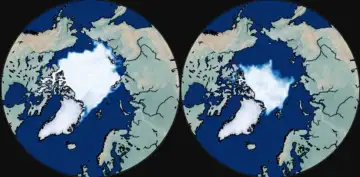 Sea ice is melting: in September 1979 (left) and in September 2019 (right).Image: Dirk Notz, University of Hamburg
 2. US air pollution getting worse
Almost half of the United States' population now lives in areas with unhealthy levels of air pollution, and the air they breathe is getting worse - says the latest annual State of the Air report from the American Lung Association.
Dramatic falls in pollution in the half-century since the introduction of the Clean Air Act are being reversed and wildfires could be partly to blame.
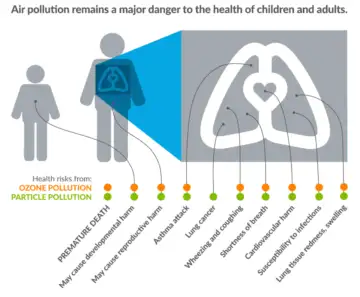 Air pollution is a growing problem in the United States.Image: ALA
 Between 2016-18 more cities suffered from greater numbers of days when ground-level ozone, colloquially known as 'smog', reached unhealthy levels - with Los Angeles the worst affected. Year-round levels of particle pollution also increased in many cities.
The association says US Clean Air Act "must remain intact and enforced" to try and tackle the problem.
3. US 'megadrought' is already here
There's a drought going on in the western US at the moment, but the millions of Americans living through it might not always realize.
In fact researchers call it a 'megadrought' - a long period of very low rainfall. It started in the year 2000 and it hasn't really stopped since.
Dr Park Williams, from Columbia University in New York said the drought is worse than three of the four megadroughts ever recorded - which go back to 800 AD.
"It is essentially tied with the worst two decades of the worst of the megadroughts," he said.
4. Antimatter puzzle closer to solution
Why are we here? The short answer, particle physicists explain, is because there is matter in the universe - and we are made of matter. But it nearly didn't happen.
For years scientists have wondered why there is more matter in the universe than antimatter, opposite particles which can annihilate matter.
Now a pioneering experiment in Japan is bringing the mystery a step closer to being solved.
The T2K project, run underground at the Super-Kamiokande neutrino observatory, has detected a mismatch in the way neutrinos and antineutrinos oscillate.
And a theory called leptogenesis makes a link between the supremacy of matter to a mismatch in the oscillation of neutrinos. Got it?
5. Prepare to pay more for your olive oil
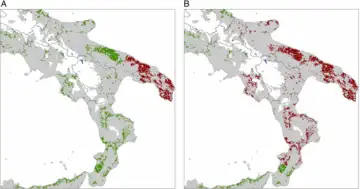 Map showing spread of Xylella bacterium (red) in Italy after 5 (A) and 50 years (B).Image: Kevin Schneider/PNAS
 A deadly pathogen could wreak havoc on olive tree plantations in Europe, potentially costing more than $21 billion and pushing up prices for consumers.
It's called Xylella fastidiosa and it has already devastated many trees in Italy.
There is no cure and it can infect other tree crops such as almonds and cherries. Affected plants have to be destroyed.
However, researchers say the environmental and economic cost can be curbed if key steps are taken: slow the rate of infection and use plant varieties resistant to the pathogen.
Harry Kretchmer, Senior Writer, Formative Content
This article was first published in World Economic Forum.
The views expressed in this article are those of the author alone and not the World Economic Forum.