





The Gauhati high court observed that merely producing a number of documents does not automatically establish citizenship unless they are legally admissible and capable of proving the person's linkage to Indian ancestors.
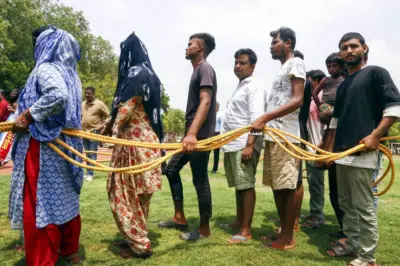
Kindly note the image has been published only for representational purposes.Photograph: ANI Photo
Key Points
- The Gauhati high court upheld a Foreigners' Tribunal order declaring Assam resident Aminul Hoque a foreigner.
- The court ruled that producing multiple documents alone does not legally establish Indian citizenship claims.
- Under Section 9 of the Foreigners Act, the burden of proving citizenship rests on the petitioner.
- The high court rejected reliance on an uncertified 1951 NRC extract and oral testimony.
- The high court found no legal or factual error in the tribunal's assessment of evidence.
The Gauhati high court has upheld a Foreigners' Tribunal order declaring an Assam resident a foreigner, ruling that despite producing 15 documents in support of his claim, he failed to legally establish that he is an Indian citizen.
A division bench comprising Justice Kalyan Rai Surana and Justice Shamima Jahan dismissed the writ petition filed by Aminul Hoque, observing that the documents relied upon were either inadmissible in evidence or insufficient to discharge the statutory burden placed on him under the law.
Tribunal order challenged
The Foreigners' Tribunal No. 4 at Guwahati had, on February 28, 2019, declared Hoque, a daily wage labourer, to be a foreigner. Challenging the tribunal's opinion, he approached the high court, contending that he had produced adequate documentary evidence to prove his Indian citizenship.
Among the documents placed before the tribunal were his PAN card, electoral rolls, voter identity cards, a computer-generated copy of the 1951 National Register of Citizens (NRC) showing the names of his father and grandparents, and the original sale deed of a plot of land purchased in 1973.
Burden of proof lies on petitioner
In its judgment delivered on Tuesday, the high court reiterated that under Section 9 of the Foreigners Act, 1946, the burden of proving citizenship lies on the person facing proceedings before a Foreigners' Tribunal.
The court observed that merely producing a number of documents does not automatically establish citizenship unless they are legally admissible and capable of proving the person's linkage to Indian ancestors.
The court held that although Hoque had exhibited 15 documents before the tribunal, they did not help him discharge the statutory burden of proving that he was not a foreigner.
Oral testimony not sufficient
The petitioner's father had appeared before the tribunal and identified Hoque as his son. However, the high court ruled that a written statement and oral testimony alone are insufficient in proceedings under the Foreigners Act.
The court observed that the relevant facts must be proved through documentary evidence that is both admissible and legally relevant.
NRC extract lacked legal certification
The court also found that the computer-generated copy of the 1951 NRC relied upon by the petitioner could not be accepted as valid evidence because it was not accompanied by the mandatory certificate required under Section 65B of the Indian Evidence Act, 1872.
Referring to an earlier judgment, the court observed that an NRC extract cannot by itself establish domicile unless it satisfies the legal requirements governing electronic records.
Land deed failed to establish lineage
The high court also agreed with the tribunal's rejection of a 1973 land sale deed executed in the name of the petitioner's projected grandfather.
According to the court, there was no explanation regarding the present status of the property or why it had not devolved upon the grandfather's legal heirs, making the document insufficient to establish the petitioner's claimed lineage.
No error in tribunal's findings
Concluding that the petitioner had failed to demonstrate any legal or factual error in the tribunal's appreciation of the evidence, the high court refused to interfere with its opinion.
Holding that the tribunal's findings were neither perverse nor contrary to law, the Bench dismissed the writ petition, thereby affirming the declaration that Aminul Hoque is a foreigner under the provisions of the Foreigners Act, 1946.
Feature Presentation: Aslam Hunani/Rediff