

After days of intense activity, this phase is about staying sharp and ready for the last critical steps.
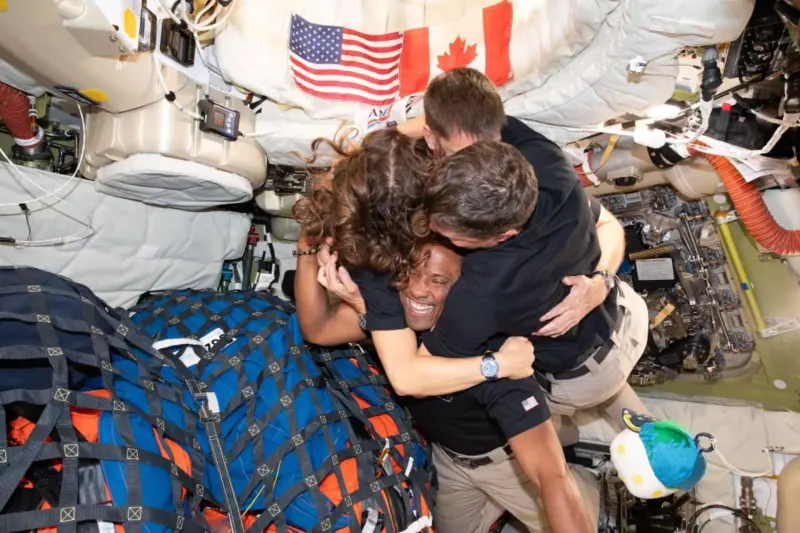
IMAGE: Artemis II crew members Christina Koch, Jeremy Hansen, Reid Wiseman and Victor Glover share a happy moment inside Orion as they head back to Earth after circling the Moon.
Photograph: Kind courtesy NASA
Key Points
- Artemis II crew is on return trajectory after completing a successful journey around the Moon.
- Spacecraft exited the Moon's gravitational influence, marking the official transition to its Earth-bound journey.
- Flight Day 9 served as the final full day in space before re-entry preparations conclude.
- Splashdown is scheduled in the Pacific Ocean, aiming for a safe mission completion on April 10.
- Astronauts underwent nearly three years of training, enabling smooth execution of this complex deep-space mission.
After days in deep space and a journey around the Moon, the Artemis II astronauts are finally on their way home.
Flight Day 9 was not just another day in orbit -- it was their last full day before returning to Earth, bringing an extraordinary mission close to a safe finish.
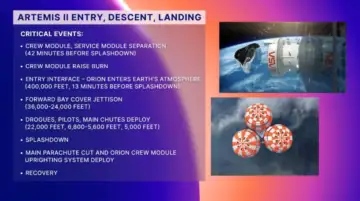
IMAGE: Infographic showing Artemis II's entry, descent and landing milestones presented during a NASA briefing at the Johnson Space Center on April 8, 2026. Photograph: Kind courtesy NASA
Turning back toward Earth
With the Moon behind it, the mission entered its return phase.
Having flown past the far side of the Moon on April 6, the crew began their journey home soon after.
By April 7, they had crossed out of the Moon's gravitational pull -- leaving lunar space and heading back to Earth.
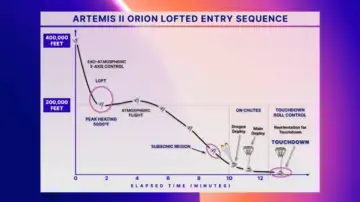
IMAGE: Graphic illustrating the Orion spacecraft's lofted entry sequence as shared during the Artemis II mission briefing in Houston. Photograph: Kind courtesy NASA
A long journey, now nearing its end
The vastness of space still surrounds Orion, but Earth is getting closer with every passing hour.
It's a recod journey that that no human has travelled that farther in space.
The final full day in space
Flight Day 9 was about preparation and patience.
The astronauts went through their final checks, making sure everything is in place for re-entry.
After days of intense activity, this phase is about staying alert and prepared for the final critical steps.
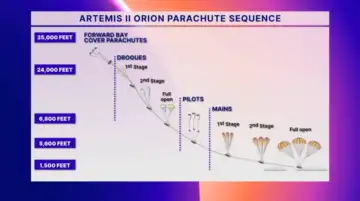
IMAGE: Infographic detailing the Orion parachute deployment sequence ahead of splashdown in the Pacific Ocean. Photograph: Kind courtesy NASA
The moment everyone is waiting for
If all goes as planned, the mission will end with a splashdown in the Pacific Ocean on April 11, 5:37 IST.
It will be the first time this crew returns from such a deep-space mission -- an emotional and historic moment for everyone watching back on Earth.
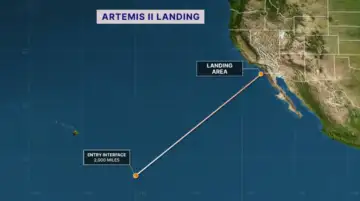
IMAGE: Ground track map showing Orion's trajectory and parachute sequence leading to its planned splashdown zone. Photograph: Kind courtesy NASA
Years of work behind a single journey
This mission didn't begin with launch -- it started years ago.
The Fantastic Four -- NASA astronauts Reid Wiseman, Victor Glover, and Christina Koch, and CSA (Canadian Space Agency) astronaut Jeremy Hansen -- were selected in April 2023 and trained together for nearly three years.
Every process, simulation and the rigorous every-day drill has led to this special moment.

IMAGE: US Navy MH-60 Seahawks arrive on USS John P Murtha for recovery training operations ahead of Artemis II splashdown off California. Photograph: Kind courtesy Bill Ingalls/NASA
More than just a mission
Artemis II is not just about going to the Moon and back. It's about proving that humans are ready to venture deeper into space once again.
What the crew has done will help shape future missions -- and perhaps one day, human journeys even farther beyond.
Feature Presentation: Ashish Narsale/Rediff