

The outcome of the assembly elections will not only determine AIUDF's immediate relevance but could also shape its long-term role in Assam's political landscape.
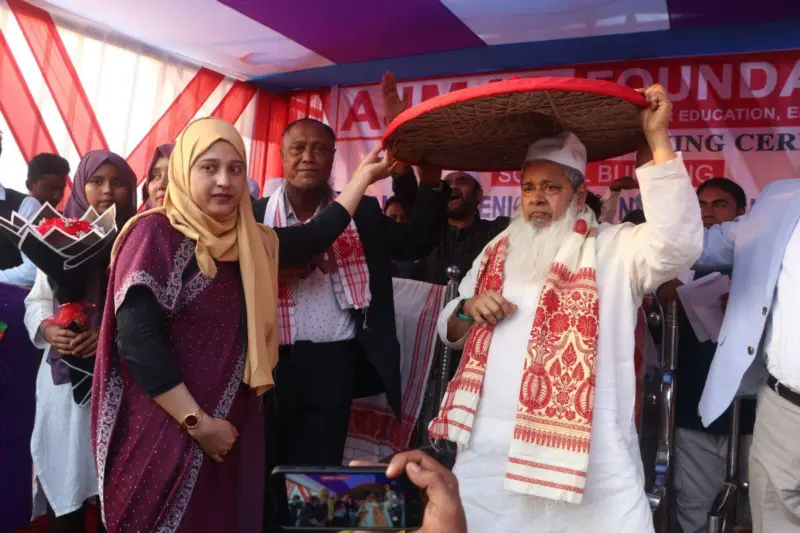
IMAGE: All India United Democratic Front MP Badruddin Ajmal felicitated at a party function. Photograph: Kind courtesy Ajmal Foundation/Facebook
Key Points
- AIUDF faces a critical electoral test after setbacks in the 2021 assembly and 2024 Lok Sabha polls.
- Badruddin Ajmal's heavy defeat in Dhubri signals erosion of the party's core support base.
- Congress has ended its alliance with AIUDF to regain Assamese support, especially in Upper Assam.
- Delimitation has reduced Muslim-majority seats from 45 to 22, impacting AIUDF's prospects.
- BJP has not fielded any Muslim candidates; ally AGP has fielded 13 in minority-dominated areas.
- Outcome will determine AIUDF's future relevance in Assam politics.
Ajmal-led party battles loss of ground, credibility among key voter base
The All India United Democratic Front (AIUDF), led by perfume baron-turned-politician Badruddin Ajmal, faces one of its toughest electoral tests in Thursday's Assam assembly elections, with the party struggling to regain lost ground after consecutive setbacks in recent polls.
Formed in 2005 in the aftermath of the Supreme Court striking down the IMDT Act 1983, the AIUDF had emerged as a key political voice for Bengali-speaking Muslims in Assam.
Over the years, it built a strong base in Lower Assam and parts of the Barak Valley, positioning itself as a decisive player in state politics.
Setbacks dent AIUDF's political standing
The AIUDF's recent electoral performance, however, has raised serious questions about its future trajectory.
After a disappointing showing in the 2021 assembly elections, the AIUDF suffered a major blow in the 2024 Lok Sabha polls, where Ajmal was defeated by Congress leader Rakibul Hussain by a margin exceeding 10 lakh (1 million) votes in Dhubri -- a constituency long considered his stronghold.
The scale of the defeat has been widely interpreted as a sign of shifting voter loyalties, particularly among Bengali-speaking Muslims who had once rallied behind the party.
Congress-AIUDF split reshapes political equations
The Congress, which had tied up with the AIUDF in the 2021 assembly elections, faced a backlash in Upper Assam -- considered the bastion of Assamese people.
The region, which had given the Congress under Tarun Gogoi three consecutive mandates between 2001 and 2016, largely shifted away from the party during the alliance phase.
In 2021, the Congress-led alliance managed to win only 12 seats in Upper Assam, compared to the National Democratic Alliance's 43 seats.
Learning from the setback, the Congress decided to end its honeymoon with the AIUDF and contest the elections independently, aiming to regain the confidence of Assamese voters.
A similar approach in the 2024 Lok Sabha elections helped the party make inroads into AIUDF's support base.
The impact was evident, with Ajmal's party reportedly failing to secure a lead in even a single Muslim-majority assembly segment during the parliamentary polls.
Battle to regain minority confidence. AIUDF seeks to reconnect with core support base
For AIUDF, the immediate challenge lies in restoring confidence among its traditional support base.
Political observers note that a section of minority voters appears to have shifted towards the Congress, viewing it as a more viable force to counter the BJP.
At the same time, the Congress's strategy is seen as an attempt to balance competing narratives -- consolidating minority votes while also addressing concerns among Assamese voters over identity and land rights.
Observers say this approach seeks to counter the Bharatiya Janata Party's 'Miya vs indigenous' rhetoric, which the BJP is invoking among Assamese communities, by highlighting concerns over demographic changes and the potential loss of land and other rights, including political rights.
Delimitation redraws political equations
Adding to AIUDF's challenges is the impact of the recent delimitation exercise.
The number of assembly constituencies with a Muslim majority has come down drastically from 45 to 22, significantly altering the electoral landscape for the party.
This reduction is expected to directly affect AIUDF's prospects, limiting its traditional areas of influence and making electoral success more difficult.
Echoes of the past: Will AIUDF go the UMF way?
A question doing the rounds in political circles is whether the AIUDF could eventually go the way of the United Minorities Front (UMF), a party that once represented similar interests.
Formed in 1985 in the aftermath of the Assam Accord, the UMF had emerged to protect the interests of Bengali-speaking and Muslim minorities.
The party won 11 seats in the 1985 assembly elections but gradually weakened over time and eventually faded into political oblivion.
Observers say the comparison, while not exact, reflects concerns over whether AIUDF can sustain its relevance in a rapidly shifting political landscape.
BJP strategy and shifting alliances
The ruling BJP has chosen not to field a single Muslim candidate in the elections, including from among indigenous Assamese Muslims.
In contrast, its ally, the Asom Gana Parishad (AGP), has fielded 13 minority candidates, primarily in Muslim-concentrated areas -- a move seen as a calibrated strategy.
High stakes for Ajmal and AIUDF
With its political space shrinking and competition intensifying, the stakes are particularly high for Badruddin Ajmal and his party.
The outcome of the assembly elections will not only determine AIUDF's immediate relevance but could also shape its long-term role in Assam's political landscape.
A defining moment
As Assam heads to the polls, AIUDF finds itself at a crossroads.
Once a formidable force representing minority interests, the party must now navigate electoral setbacks, changing demographics, the redrawing of constituencies, and evolving voter preferences.
Whether it can reinvent itself and reclaim its base remains one of the key questions of this election.
Feature Presentation: Aslam Hunani/Rediff