

'The BJP's tally may dip, but the NDA is likely to retain power.'
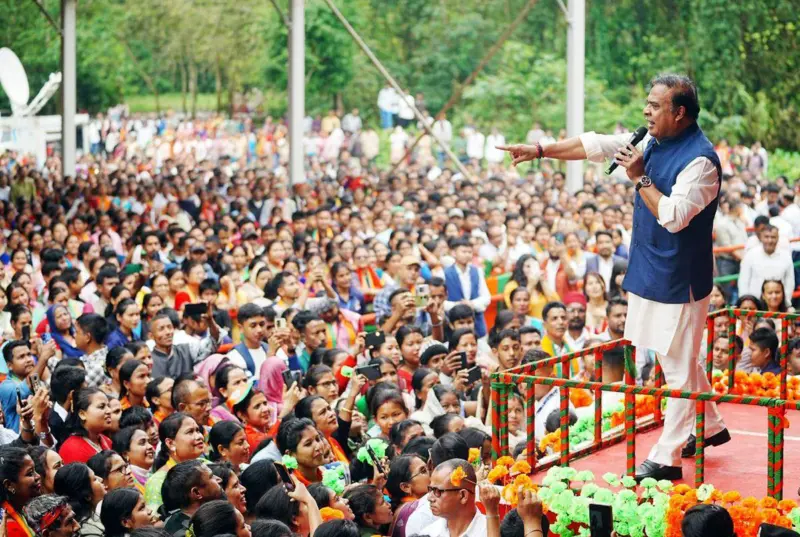
IMAGE: Assam Chief Minister Himanta Biswa Sarma at an election rally for the Assam assembly elections, April 7, 2026. Photograph: @himantabiswa X/ANI Photo
Key Points
- Since 1985, Assam's politics has broadly moved through three phases: The rise of regional forces, a prolonged period of Congress dominance, and the consolidation of the BJP-led alliance.
- Under Tarun Gogoi, the Congress ruled Assam for 15 consecutive years, bringing political stability and consolidating key voter bases.
- The 2016 election marked a watershed moment as the Bharatiya Janata Party surged from the margins to power.
A historic single-phase election
Today, April 9, more than 24.9 million voters across Assam's 126 assembly constituencies will cast their ballots in a single phase -- a first for a state that has traditionally voted in multiple rounds.
The high-stakes contest will determine whether the Bharatiya Janata Party-led National Democratic Alliance secures a third consecutive term, or if the Congress, led by Gaurav Gogoi, can stage a comeback and halt what has been one of the most dramatic political shifts in the region over the past decade.
A decade of political churn
Assam's political landscape has undergone significant changes in recent years -- from the fall of the Congress in 2016 to leadership transitions within the BJP.
The end of Tarun Gogoi's long tenure marked a turning point, followed by the BJP's rise to power under Sarbananda Sonowal. In 2021, the party replaced Sonowal with Himanta Biswa Sarma, signalling a shift in both leadership and political messaging.
Three phases of Assam politics
Since 1985, Assam's politics has broadly moved through three phases: The rise of regional forces, a prolonged period of Congress dominance, and the consolidation of the BJP-led alliance.
The 1985 election, held in the aftermath of the Assam Accord, saw the emergence of the Asom Gana Parishad (AGP), which swept to power on the strength of the anti-foreigner movement. It was the first time a regional party dislodged the Congress in the State.
Despite its strong start, the AGP struggled with internal divisions and governance challenges. Its first tenure (1985-1990) ended with President's Rule, and the party was later weakened by splits in 1991 and 2005.
Although it returned to power in 1996, the AGP gradually lost ground, paving the way for the Congress to re-establish dominance.
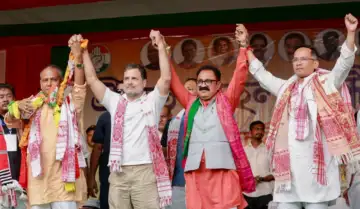
IMAGE: Congress leader Rahul Gandhi at an election rally in Kamrup, April 5,2026. Photograph: AICC/ANI Photo
The Congress era under Tarun Gogoi
Under Tarun Gogoi, the Congress ruled Assam for 15 consecutive years, bringing political stability and consolidating key voter bases.
The emergence of the All India United Democratic Front in 2006 posed a challenge, but the Congress retained its hold through the 2011 elections.
The 2016 election marked a watershed moment as the Bharatiya Janata Party surged from the margins to power.
From just 10 seats in 1991, the BJP rose to win 60 seats in 2016. A key factor was its alliance with the AGP and the Bodoland People's Front (BPF), which helped consolidate the 'indigenous' vote.
The party also foregrounded the slogan of jati, mati, bheti -- identity, land and homeland -- as a central campaign theme.
The Sarma factor
A crucial turning point came in 2015 when Himanta Biswa Sarma defected from the Congress to the BJP.
His entry brought organisational strength and electoral strategy to the BJP's campaign, playing a key role in its 2016 victory. The party later elevated him to chief minister in 2021, further consolidating its position in the state.
When vote share doesn't tell the full story
Assam's elections have often shown a disconnect between vote share and seat share.
In 2016, the Congress actually secured a higher vote share (30.96%) than the BJP (29.51%). Yet, the BJP's effective alliance-building enabled it to win 60 seats -- more than double the Congress tally of 26.
This underlined the importance of coalition arithmetic in the state's electoral outcomes.
Rarely a close contest
Assam's recent political history has rarely produced close finishes, with wide seat gaps between the leading and second-placed parties.
The closest contest in the last eight elections came in 1996, when the Asom Gana Parishad secured 59 seats against the Congress's 34 -- a reminder that decisive mandates, rather than tight races, have largely defined the state's electoral outcomes.
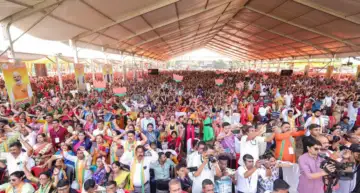
IMAGE: People gather for Union Home Minister Amit Shah's election rally in Silchar, April 7, 2026. Photograph: @AmitShah X/ANI Photo
Identity politics at the core
The question of identity -- who belongs in Assam -- has remained central to every election.
It powered the rise of the AGP, shaped the Congress years, and has been a defining theme in the BJP's politics. The BJP has faced flak for its handling of issues such as the National Register of Citizens (NRC) and the Citizenship (Amendment) Act, 2019 (CAA), which critics say have sharpened social divisions.
An unresolved question
As Assam heads into another election, key issues remain unresolved. The NRC process is still incomplete, and the implementation of the CAA continues to be debated.
What has changed, however, is the framing of the issue. The BJP has shifted the discourse from a regional grievance to a broader national narrative, absorbing much of the AGP's traditional support base and leaving it as a junior partner in the alliance.
What observers say
Political observers say the contest, while intense, may ultimately hinge on how effectively each side converts its narrative into votes.
Jayanta Krishna Sarmah, a political science academic at Gauhati University, said the BJP's governance plank continues to play a key role.
"BJP's welfare outreach and development initiatives have helped consolidate support, even as the Opposition has tried to foreground issues such as justice for Zubeen Garg and a broader 'save democracy' narrative," he said.
Sarmah added that a crucial segment could be voters who remain outside both welfare networks and party structures.
"These undecided voters can prove decisive in a closely contested battle," he noted.
Echoing a similar view, senior journalist Anup Sharma said that while the contest may tighten, it may not necessarily lead to a change in power.
"The BJP's tally may dip, but the NDA is likely to retain power," he said.
Another turning point ahead
With a single-phase election and high political stakes, Assam stands at yet another turning point.
Whether the BJP secures a third term or the Congress stages a comeback, the verdict will shape not just the state's immediate future, but also the next phase of its evolving political story.
Feature Presentation: Aslam Hunani/Rediff