





For India, the goal is not simply to host another grand diplomatic gathering. It is to prove that a diverse coalition of emerging powers can still deliver.
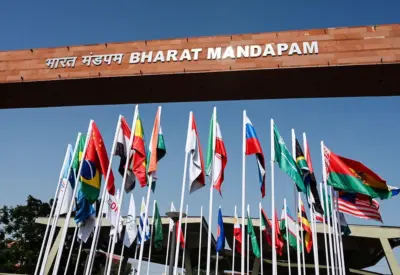
IMAGE: A view of the national flags of countries participating in the 18th BRICS Summit hoisted outside the Bharat Mandapam in New Delhi. Photograph: ANI Photo
Key Points
- India's BRICS presidency faces a test of strategic autonomy, Global South leadership and practical multilateral cooperation.
- BRICS expansion has increased its economic heft while making consensus harder amid divergent geopolitical and economic interests.
- India is pushing trade, investment, technology partnerships, resilient supply chains and efficient cross-border payment mechanisms.
- Internal divisions, including tensions involving China, Iran and the UAE, could constrain India's efforts to build consensus.
- India's presidency will ultimately be judged by tangible gains in trade, investment, finance, technology and energy cooperation.
The 18th BRICS Summit at Bharat Mandapam on September 12 and 13 brings India to the centre of a diplomatic gathering shaped by geopolitical rivalry, trade tensions, armed conflicts and growing uncertainty over the global economic order.
Yet for India, the summit is about more than marking the end of its year-long presidency.
It is a test of whether New Delhi can turn its vision of strategic autonomy, a stronger Global South voice and practical multilateralism into tangible economic and diplomatic gains -- and give direction to a grouping that has evolved from four emerging economies into a far broader coalition stretching across Asia, Africa, the Gulf, Latin America and Eurasia.
For India, the summit is more than the finale to a year of chairmanship.
It is a test of whether New Delhi can turn its familiar foreign-policy themes -- strategic autonomy, a stronger Global South and practical multilateralism -- into results that extend beyond summit communiques.
India assumed the BRICS chair on January 1, its fourth stint after leading the grouping in 2012, 2016 and 2021.
The 2026 presidency also comes two decades after BRICS first emerged as a platform for major emerging economies.
Under the theme 'Building for Resilience, Innovation, Cooperation and Sustainability', New Delhi has sought to give the presidency a distinctly developmental and people-centred character, with Prime Minister Narendra Modi promoting a 'Humanity First' approach.
More than 350 meetings and high-level engagements have been held in over 25 Indian cities, covering security, trade, finance, technology, energy and cultural ties.
But the BRICS India inherited is a very different animal from the original grouping of Brazil, Russia, India and China.
South Africa joined in 2010, followed by Egypt, Ethiopia, Iran, the United Arab Emirates, Indonesia and Saudi Arabia.
The expansion has given BRICS greater economic heft and geographical reach. It has also made the business of consensus considerably harder.
Its members have sharply different economic interests, foreign-policy priorities and views of the international order.
Some see BRICS as a vehicle to challenge Western dominance; India has been careful to resist turning it into an anti-Western alliance.
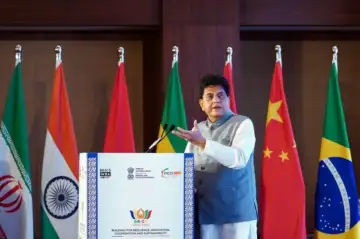
IMAGE: Commerce and Industry Minister Piyush Goyal addresses the BRICS Women's Business Alliance Women-Led Development Summit 2026 in New Delhi, September 9, 2026. Photograph: Ritik Sharma/ANI Photo
That distinction matters to New Delhi. India wants BRICS to remain a platform for emerging and developing economies while retaining close partnerships with the United States, Europe, Russia, China and the Gulf.
Strategic autonomy, in this formulation, means keeping multiple doors open rather than choosing one camp.
The Global South will consequently be central to India's message.
Reform of institutions such as the International Monetary Fund and World Bank, climate finance, digital governance and a greater voice for developing countries are expected to feature prominently.
India has long argued that the architecture of global governance no longer reflects the distribution of economic and political power.
BRICS offers another vehicle for pressing that case -- but without necessarily creating a parallel system to replace the existing one.
The harder question is whether the enlarged grouping can agree on anything substantial.
The economic opportunity is considerable. The Federation of Indian Export Organisations has argued that BRICS should move beyond strategic dialogue towards measurable gains in trade, investment, technology and supply-chain resilience.
FIEO President S C Ralhan has said BRICS should 'move beyond strategic dialogue to measurable commercial outcomes', highlighting market access, investment, technology partnerships, resilient supply chains and efficient payment mechanisms.
BRICS economies account for around 26 per cent of global trade, according to FIEO estimates.
For Indian companies, the potential extends across engineering goods, pharmaceuticals, chemicals, textiles, automobiles and components, electronics, food and agriculture, renewable energy, healthcare and digital services.
But the larger prize may be integration into emerging production networks rather than simply selling more goods.
'Trade and investment must move together,' Ralhan has argued, calling for co-production, joint ventures and technology transfer.
That agenda fits neatly with India's ambition to become a more important manufacturing and sourcing hub as companies diversify supply chains amid geopolitical uncertainty.
Combining India's manufacturing base, workforce and digital infrastructure with the capital, resources, technology and markets of BRICS partners could create more resilient value chains.
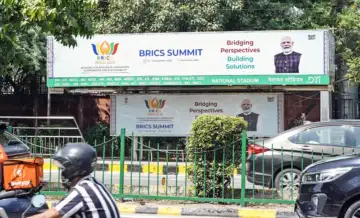
IMAGE: Preparations ahead of the 18th BRICS Summit 2026 in New Delhi. Photograph: PIB Photo Gallery/ANI Photo
Payments are another practical test. India has championed digital public infrastructure, particularly the Unified Payments Interface, and is expected to push cooperation on digital payments, fintech, local currencies and alternative payment mechanisms.
For exporters, this is less about geopolitics than basic commercial certainty.
'Payment uncertainty can itself become a trade barrier,' Ralhan said, arguing that transparent and efficient payment systems could lower transaction costs and encourage smaller businesses to enter new markets.
Technology offers another area where India has considerable diplomatic capital.
Cross-border digital payments, central bank digital currencies, artificial intelligence, data governance and digital public infrastructure could provide practical areas of cooperation among economies whose political systems differ widely.
Energy Goals Face BRICS Divisions
Energy and climate will also test the presidency. India must reconcile its clean-energy ambitions with the needs of a rapidly growing economy that still requires reliable and affordable energy.
A BRICS energy ministers' meeting in Gurugram in June discussed cooperation on global energy challenges, while India launched a BRICS Digital Centre of Excellence for Smart Grids and Energy Storage.
Yet the most immediate threat to India's ambitions may be internal divisions.
BRICS is not a strategic alliance, and its members do not share a common view of the West or of the future global order.
Russia and Iran, for instance, have far more adversarial relationships with Western powers than India does.
The China factor adds another complication. India and China remain strategic competitors, yet both have an interest in keeping BRICS relevant.
New Delhi's ability to separate areas of economic cooperation from strategic rivalry will be crucial.
The difficulties were already apparent at the BRICS foreign ministers' meeting in New Delhi in May, when tensions involving Iran and the UAE contributed to divisions and prevented the adoption of a joint communique.
India instead issued a chair's statement acknowledging differences.
For New Delhi, the episode was a warning. It cannot eliminate rivalries within BRICS; it can only prevent them from paralysing the organisation.
That is particularly important given India's own interests in maintaining productive relations with both Tehran and Abu Dhabi.
The New Development Bank could offer a more practical route forward, particularly through greater local-currency lending for infrastructure and sustainable development.
Cooperation on critical minerals, food, energy and manufacturing supply chains could similarly move BRICS from political declarations towards economic statecraft.
Businesses want still more: faster customs clearance, fewer non-tariff barriers, regulatory transparency, mutual recognition of standards, better logistics, digital trade documentation and easier cross-border payments.
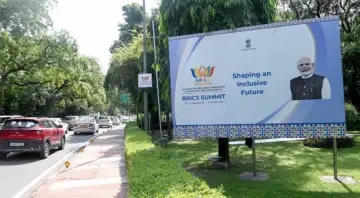
IMAGE: Glimpses of preparations ahead of the BRICS Leaders Summit 2026. Photograph: PIB Photo Gallery/ANI Photo
FIEO has also called for stronger business-to-business engagement through buyer-seller meetings, investment matchmaking, technology partnerships, joint ventures and regular business delegations.
'The real test of BRICS will be whether its benefits reach manufacturers, exporters, startups and MSMEs,' Ralhan said. 'Political goodwill has to travel from summit tables to shop floors.'
That may be the most useful yardstick for India's presidency.
New Delhi has spent a year building diplomatic momentum. The real measure of success will be whether that effort produces more trade, investment, technology partnerships, development finance, energy cooperation and resilient supply chains.
The summit itself will also be a showcase of India's ability to stage major international events.
Delhi has undertaken extensive preparations around key roads, hotels and venues, including sanitation, streetscape and security measures, ahead of the arrival of foreign leaders.
The gathering is expected to rank among India's biggest multilateral diplomatic events since the 2023 G20 summit.
New Global Order
Ultimately, India's BRICS moment is about the kind of global order New Delhi wants to help shape.
It does not want to preserve the Western-led system unchanged. Nor does it want BRICS to become a rival geopolitical bloc.
Its proposition is more complicated: Reform global institutions, strengthen the voice of the Global South, retain strategic autonomy and find practical cooperation among countries that do not always agree.
The September 12-13 summit will show whether that balancing act can survive the realities of an expanded BRICS.
For India, the goal is not simply to host another grand diplomatic gathering. It is to prove that a diverse coalition of emerging powers can still deliver -- and that strategic autonomy can be made to work not merely as a foreign-policy slogan, but as an instrument of economic and diplomatic influence.
Feature Presentation: Aslam Hunani/Rediff