

The Dhurandhar movies will undoubtedly shape the minds of the audience much more than news reports, court investigations, books and documentaries.
But it is worth remembering that Pakistan's irridentist claims against India's national security have succeeded due to strategic planning, diplomacy, and the unsung heroines and heroes across government agencies, not due to a single maverick leader, points out Shweta Desai.
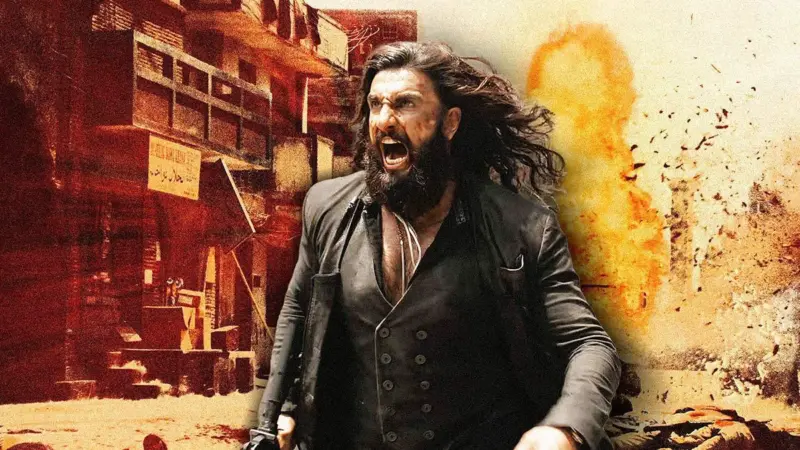
IMAGE: Ranveer Singh in Dhurandhar The Revenge. Photograph: Kind courtesy Mustafa Ahmed/Instagram
Key Points
- Dhurandhar blends real terror incidents with fictional narratives, creating confusion over historical accuracy and misrepresenting sensitive geopolitical realities.
- The film's portrayal of Baloch leaders collaborating with the ISI has triggered a backlash and legal action from communities and activists.
- Several real events, including the Kulbhushan Jadhav case and the Pathankot attack, are omitted, shaping a selective political narrative.
As recently as 2025, the Indian government categorically rejected Pakistan's 'baseless' allegations of R&AW agents stoking unrest in Balochistan as a diversionary tactic to move the focus from Islamabad's involvement in cross-border terrorism in Kashmir.
Rumours of the Tehreek-e-Taliban Pakistan (TTP) militant group serving as a proxy of New Delhi and waging a jihadi insurgency against the Pakistan army were also dismissed as concocted false narratives.
It was, therefore, wild to see the assertions about India's covert involvement in Pakistan being boldly echoed in Dhurandhar: The Revenge, with no censorship and such swagger as if Prime Minister Narendra Modi himself was thumbing a nose at Rawalpindi's haughty military generals.
Ranveer Singh's onscreen character Hamza Ali Mazari, for instance, plays a patriotic Baloch who infiltrates Karachi's deadly gang network to pass intelligence to Indian agencies.
When Hamza plans the killing of top cop 'SP Aslam Chaudhry' (Sanjay Dutt), he enlists the support of a willing Baloch suicide bomber to do the job.
As it happened in reality, the controversial Sindh police officer Aslam Khan was indeed killed in a 2014 suicide car bombing on the Lyari Expressway in Karachi, and the TTP claimed (external link) responsibility for his death.
Director Aditya Dhar cleverly engages the strategy of implausible deniability, knowing well that it would be foolhardy for Pakistan to deny or reject any inferences to these dramatised claims.
The film also spotlights the brutally suppressed Balochistan's insurgency against the Pakistani State for an independent homeland and atrocities against the Baloch people, including enforced disappearances, mass killings (graves), and extra-judicial encounters.
Its misleading portrayal of the Baloch people, though, has drawn outrage from the community for defaming their patriotic reputation.
Ironically, the
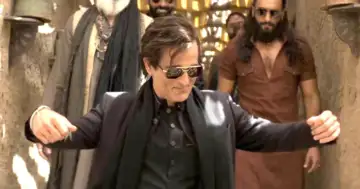
IMAGE: Akshaye Khanna in Dhurandhar.
Facts, Distortions and BJP Connection
Dhar presents his two-part epic drama as a 'fictional work inspired by real-life events', without fully disclosing which parts and characters are real or dramatised.
The movie's gripping pace and cliff-hanging twists eventually lull the audience's interest, who are no longer interested in deciphering the truth; the historical cinematic fiction is accepted as a close mirror to the real-life actions. Not everything shown in the movies is a lie.
Dhar generously borrows from journalistic descriptions to depict chilling details of the IC-814 hijacking (1999), planning of the 26/11 attacks (2008), and the fake Indian currency operation (2010).
The reality of Lyari's dark underworld and the powerplay between gangsters, mafia, and tribal lords vying to control Karachi also closely mirrors news reports and UN records documenting Pakistan's nefarious hand in global terror.
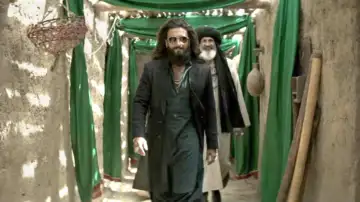
IMAGE: Ranveer Singh in Dhurandhar The Revenge.
The rigorous research by Colonel (retd) Bhupinder Shahi, also a BJP leader (external link) in charge of Mohali district, who served as a military consultant on the films, has helped greatly to recreate authentic scenarios on screen.
Colonel Shahi's background in defence and his father's as an Indian undercover agent helped to draw on real-life experiences. The army veteran also revealed liaising (external link) with the ministry of defence and the ministry of home affairs and procuring crucial data to ensure the movies maintain a high level of authenticity.
The MHA and MoD zealously guard information and avoid public disclosure of historical records in the guise of protecting national security and intelligence as 'classified' under the Official Secrets Act 1923.
It has dismissed routine RTI (external link) inquiries or concerns on digital surveillance (external link) of citizens, citing restrictions under Section 8(1)(a), which exempts disclosure of information that could affect the sovereignty and integrity of India.

IMAGE: Mustafa Ahmed and Ranveer Singh in Dhurandhar The Revenge. Photograph: Kind courtesy Mustafa Ahmed/Instagram
Dhurandhar's makers certainly did not face these issues in accessing official information to fine-tune their script.
To its credit, the film faithfully attempts to reconstruct the targeted killings of Pakistan's criminal elements involved in planning attacks on Indian cities.
But the BJP imprint becomes apparent when it involves wilful blindness to the events which expose the murky politics of those in power.
During the timeline when Hamza's character is shown to be in Pakistan (2002-2023), authorities arrested Kulbhushan Jadhav, a 49-year-old retired Indian Navy officer, on espionage charges in a border town of Balochistan.
The Pakistan military released videos of Jadhav's Indian passport and admissions to funding the Baloch Students Organisation, even as Delhi struggled to frame a counter-response.
Weeks later, Modi referenced Balochistan in his Independence Day address, suggesting that his government was willing to raise the stakes for Pakistan.
Baloch separatist leaders such as Naela Quadri and Brahmdagh Bugti hailed Modi as a hero and arrived in Delhi to seek the government's help in forming Balochistan's government-in-exile.
Beyond Modi's public posturing, the government began to develop cold feet, and the Balochistan cause was put on the backburner.
The Modi government has continued to maintain ambiguous silence on the topic, despite pleas of solidarity from the Baloch separatists to recognise the province as an independent Republic of Balochistan.
The uncomfortable truths of Jadhav's prolonged ordeal in an undisclosed Pakistani prison and the tales of other alleged Indian spies, such as the late, Urdu-speaking female diplomat arrested in 2010 in Islamabad, or the brutal death of Sarabjit Singh in Lahore jail, do not make it to the movie's script.
Nor do any references to Modi's 2015 surprise visit to Pakistan on then prime minister Nawaz Sharif's birthday and the attack on Pathankot airbase by Jaish-e-Mohammed killing seven security personnel.
These debacles remain documented in print archives, not on screen in Dhurandhar.
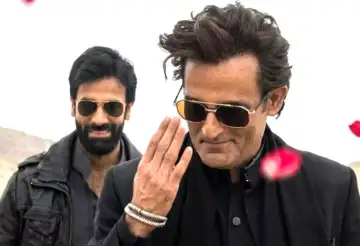
IMAGE: Akshaye Khanna in Dhurandhar.
Setting new narratives
Dhar's narrative framing is powerfully persuasive, precisely because it chooses to follow only the winning arc of the Modi government and deliberate over the weaknesses of its predecessors.
India's greatest success against Pakistan's terrorism has come through strategic diplomacy to isolate Pakistan internationally and target sources of terror funding.
From 2008 onwards, diplomats and police officials worked in tandem to produce credible evidence proving the involvement of Pakistani non-State actors in attacks in India, and enlist the US and the UN agencies to sanction Pakistani militants and terror financiers.
India's grouping in the Paris-based Financial Action Task Force placed Pakistan on the grey list (2008-2018), hurting its economy with reduced foreign investment and tighter scrutiny of international transactions.
But these boring truths are not as appealing as Ranveer's Hamza breaking the fourth wall with his intense cry, 'ghar me ghus ke maarenge.'
It becomes apparent when Dhurandhar plays into the BJP's hardline narrative, advocating a violent tit for tat revenge, or, as supporters of the Doval doctrine would say, making Pakistan pay the price by hurting it where it hurts the most.
The perils of retaliatory escalation by a nuclear-armed Pakistan military, as usual, are lost in the action.
The sequel goes one step ahead, with spin doctors as scriptwriters, to locate the BJP's popular leader, Uttar Pradesh Chief Minister Adityanath, in its hall of fame of macho leaders.
It modifies the actual timelines to include the killing of Atif Ahmed, modelled on the controversial encounter of gangster-politician Samajwadi Party leader Atiq Ahmed.
Ahmed was accused of weapons smuggling and had links (external link) with Pakistan's ISI and Lashkar-e-Tayiba. These claims emerged in 2023, shortly before he was murdered.
Whereas the movie shows the event happening right after the 2016 demonetisation. Under the Yogi government, over 266 (external link) persons have been killed in police encounters and over 10,990 accused injured, but the state government has defended them as a zero-tolerance policy against political criminals.
Without naming Yogi, Dhurandhar's characters suggest the need for strong leadership in UP to prevent Pakistan from flooding counterfeit currency from Nepal to India.
Even when much of the film's storyline is focused on exposing Pakistan's nefarious plans, its counter-messaging drives home the domestic agenda of Hindu pride, Hindu identity and Hindu nationalism, which, compared to Pakistan, stands superior to the enemy's Islamist jihadi extremism.
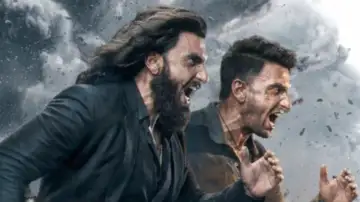
IMAGE: Ranveer Singh in Dhurandhar The Revenge.
Scenes of NSA Ajay Sanyal -- modelled as a taller version of current NSA Ajit Doval -- greeting with a 'Namaskar' on a call with an ISI major, conducting hawan and intimidating Pakistani terrorists to mouth 'Bharat Mata ki Jai', are deliberate interjections to show the shift in power from pseudo-secular Congress to the Hindu nationalist Modi government.
The Pakistani military, too, is projected as Hindu haters and butchers who swear by the doctrine to 'bleed India with a thousand cuts'.
The reference to butchers emerges again to entrench anti-Hindu tropes against a section of Indian Muslims working hand-in-glove with the ISI.
In the past, Bollywood movies on the themes of spy, espionage drama involving Pakistan, have also delivered messages of nationalism and bashing Pakistan.
The main leads were played by Muslim actors such as Salman Khan, Shah Rukh Khan and Saif Ali Khan, thrashing Pakistan's nefarious designs.
Ranveer Singh's non-Muslim background (Sindhi/Sikh), with an overpowering physique and an unmatched aura, makes him eligible to deliver the message of a New India, which embodies the political willingness to retaliate against Pakistan with a vengeance.
The film's biggest problem, however, comes in quoting Hindu mythology as a fearless call to action to counter radical Islam and jihadi terrorism.
It is foolish to base counter-terrorism policy against Pakistan, which cannot be equated to fighting a righteous battle of Dharma, as the movie suggests in the beginning, with a quote from the Bhagavad Gita.
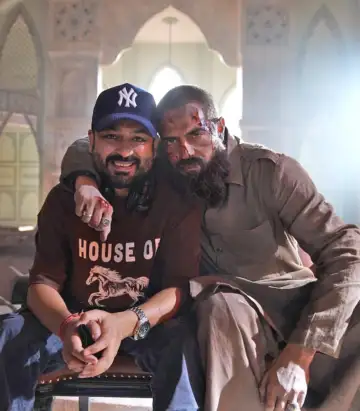
IMAGE: Aditya Dhar and Arjun Rampal on the sets of Dhurandhar The Revenge. Photograph: Kind courtesy Arjun Rampal/Instagram
Mass consumption
At the end, what Dhurandhar firmly establishes is that India needs a strong leader to fight Pakistan's proxy terror war, and the sudden currency ban (external link) was indeed a masterstroke by Modi and Home Minister Amit Shah to break the back of Pakistani elements behind the Fake Indian Currency Network.
As an audience, watching these links emerge in Dhurandhar, you almost feel bad for complaining about the hardships faced during demonetisation.
If Hamza can stake his life at risk in Karachi to eliminate the anti-India gang, can we Indians not even stand in the bank queue for a few hours? The consequences of an unplanned currency ban, causing panic among the poor and general public and economic chaos (external link), did not make it to the movie's storyline.
Nor the follow-up reports that the circulation of fake currency notes had surged to 102 per cent and continues to pose challenges, almost a decade later.
In a post-truth world, objective facts are peripheral truths and less influential in shaping public opinion than emotional appeals and political rhetoric.
The Dhurandhar movies are produced for mass consumption. In Mumbai, the sequel, released in March, is running round-the-clock (6 am to 12.15 am) across cinemas with over 1,200 shows a day.
The nostalgic 1990s music and explicit violence seem tailored to appeal to millennials and Gen Z viewers, nudging them out of political apathy and drawing them to view Modi as a favourable leader.
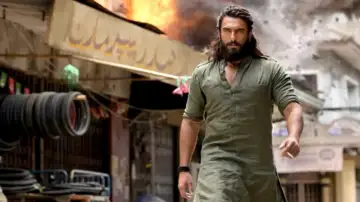
IMAGE: Ranveer Singh in Dhurandhar.
The Dhurandhar movies will undoubtedly shape the minds of the audience much more than news reports, court investigations, books and documentaries.
But it is worth remembering that Pakistan's irridentist claims against India's national security have succeeded due to strategic planning, diplomacy, and the unsung heroines and heroes across government agencies, not due to a single maverick leader.
As a piece of cinema, Dhurandhar has pulled off a stunning feat by compelling audiences to the theatre to watch the 7.5-hour-long epic.
Ranveer's acting chops, as a long-haired, broody and sensitive Hamza, are A+, the songs are bangers, and the visual effects are spectacular.
On technical grounds alone, the Dhurandhar duology is in league with the high-end production of Hollywood's war dramas.
But at its heart, Dhurandhar's lengthy storyline remains committed to recounting the success of the ruling BJP government and glorifying the sitting prime minister, which no Bollywood movie has done in the past.
Dhurandhar is not rooting for India, but for the ruling establishment, and it pulls the dagger proudly while sporting the cloak sponsored by the BJP.
Shweta Desai has worked as a research consultant with the ministry of external affairs and as a research associate with the Centre for Land Warfare Studies in New Delhi, focusing on counterterrorism, armed conflicts, terrorist groups, and regional security.
Feature Presentation: Aslam Hunani/Rediff