





'That is why they are taking gold loans, they are taking other loans...''Except for the wealthy people and the upper middle class, the rest are all suffering.' 'The reality is, we are growing only at 0% or 3%.'
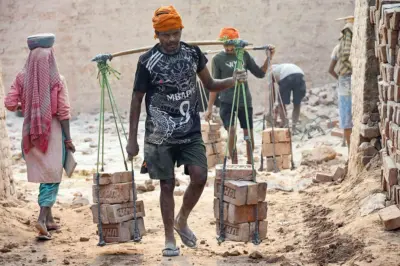
IMAGE: Labourers work at a bricks factory in Patna. Photograph: ANI Photo
Key Points
- 'Even if you assume that the projection from last year to this year is okay, the growth will only be 3%. But if you say that this projection itself is incorrect, then the rate of growth will be close to 0%.'
- 'Our GDP could not have been rising at a fast pace in April and May.'
'Things started to normalise in June but had not fully normalised.'
'There's no way April-May could have been growing at a record rate of 7.8%.' - 'You are masking the real problem that the workers face, the farmers face. Farmers, workers, the youth, all of them are in distress. Then you are claiming that you have a very high growth rate.'
- 'The crisis in the life of the average person will not be visible in the data.'
When the ministry of statistics and programme implementation (MoSPI) announced that the country's GDP was growing at a stunning rate of 7.8% in Q1 2026-2027, ordinary people wondered why they were not feeling the same buoyancy in their daily lives.
This number is in comparison to the growth of 6.9% in Q1-2026.
Many economists questioned the methodology used by the government's statistical agency and argued that the GDP did not grow at 7.8%.
Professor Arun Kumar, retired professor of economics at JNU, and author of many books on the Indian economy, debunks the claims of the government
"The prime minister said, don't travel abroad, don't buy gold, etc. This was exactly what he said in March when there was a crisis. The question is, why is he saying it now if the economy is doing so well? It means he is admitting that the economy is not doing well, just like it wasn't doing well in March when he said all this," the professor tells Rediff's Shobha Warrier.
With an unemployment rate of around 5.1%, job losses, inflation of more than 4% and no wage growth, people in general do not have enough money to spend.
But the government says the country's GDP grew at 7.8%. Like the Congress says, is it 'statistical gymnastics' and a 'distorted picture'?
You are right. The GDP data that has come for Quarter one 2027 showing 7.8% growth rate is actually not a correct depiction. It does not cover the ground reality.
As you pointed out, workers are in trouble and they were protesting.
This quarter contains April and May of 2026. In those two months, the West Asia crisis was quite severe. Crude oil wasn't coming, gas wasn't coming and the government had imposed a cut on availability of gas to many companies. Fertiliser was in short supply. Aluminium was in short supply. and the prices of these items had risen.
Cooking gas was available in the black market. A cylinder of Rs 1,200 was available for Rs 4,000 in the market.
For a worker earning Rs 10,000-11,000, a Rs 3000 price increase meant 30% inflation.
That's why they were protesting everywhere.
So, our GDP could not have been rising at a fast pace in those months, especially in the months of April and May.
Things started to normalise in June but had not fully normalised.
So, there's no way April-May could have been growing at a record rate of 7.8%.
You must realise that the methodology that is adopted makes projection based on the previous year to this year.
So, the Quarter 1 of 2025-2026 is projected to 2026-2027.
And the data is not available for 2026-2027 Quarter 1.
What is projected is the 2025-26 data for 2026-27.
If this quarter is bad and the last quarter was good, then your projection will show good data for this quarter also.
It means the methodology will always show you a wrong figure when there is a crisis in the economy, or when there's a shock in the economy.
For example, during the demonetisation year also, the government data showed an 8% growth rate. But everybody saw that the markets were closed, people were not having income, and workers were not getting work for five months.
In my book, I showed that the rate of growth had become -2% during that period while the government data showed 8% growth rate.

IMAGE: Security personnel deployed following a protest by employees demanding a salary increment in Phase-2, Noida, April 13, 2026. Photograph: ANI Video Grab
Many economists criticise the methodology used by the government...
You should understand that the methodology used by the government document says that the quarterly data is a projection from previous year to this year.
So, if this quarter is a bad quarter and the same quarter last year was good, you'll get to show good growth. That's the methodology.
And this has been taken from the IMF 2017 document.
What I am saying is, the method has not been changed, it remains the same.
The methodology that is given in IMF 2017 is used by the Indian GDP calculation.
And that method is a projection from last year to this year.
My point is, therefore, we are overestimating the GDP.
The second thing is, you see that the GDP for the unorganised sector is not looked at separately; it is proxied by the organised sector data.
And it is the unorganised sector that gets hit hard during any economic shock.
So, there's a double error.
If the organised sector is doing well, it will show that the unorganised sector also doing well.
The third thing is, when you are projecting from the previous year to this year, how do you do it?
You use what is called high frequency data.
High frequency data is the car purchases, the GST, airline travel, railway freight, etc. And all this is represented in the organised sector, and not in the unorganised sector.
A car purchase is not by someone in the unorganised sector. The unorganised sector person cannot buy a car.
Similarly, the unorganised sector person doesn't do air travel.
First, the data that is used for projection is not there.
Next, the way you project it is also incorrect because you take only the organised sector into account.
Therefore, you are bound to show a high growth rate.
So, the crisis in the life of the average person will not be visible in the data.
All you can say is that the 7.8% growth represents only the organised sector.
Also, it is from last year, and not this year.
When the number does not reflect the reality, is it shown only for the government to gloat?
The projection is to show the government in good shape.
Look at what the prime minister said. He said, in spite of the bottlenecks, in spite of supply side problems, in spite of global problems, we are doing very well.
They are claiming that they are very good in governance. All governments do propaganda. This is the propaganda of the government that they are doing very well, in spite of all the troubles.
He also asked people not to buy gold, not to travel abroad, not to spend more. If the country is doing so well, why so many restrictions?
Yes, the prime minister said, don't travel abroad, don't buy gold, etc.
This was exactly what he said in March also when there was a crisis.
The question is, why is he saying it now if the economy is doing so well?
It means he is admitting that the economy is not doing well, just like it wasn't doing well in March when he said all this.
In fact, the prime minister is contradicting himself.

IMAGE: A child helps women farm labourers transplant rice seedlings in a paddy field at Kanhadevi village in Parseoni taluka in Nagpur. Photograph: ANI Photo
If it is a distorted picture, what is the real picture according to you?
The real picture is this rate of growth only represents the organised sector at best, and even that also not fully.
The organised sector is 55% of GDP. So, this represents only the growth of the 55%.
It does not represent the growth of the unorganised sector, which is 45%.
So, if you make the correction saying that the organised sector is rising by say 7.8%, then your growth rate will come to only 3%.
That too, only if you assume that the organised sector is going well, and the projection is all right.
If the projection is not all right, then our growth rate would be close to 0%.
Even if you assume that the projection from last year to this year is okay, the growth will only be 3%.
But if you say that this projection itself is incorrect, then the rate of growth will be close to 0%.
If the organised sector is doing well, and the unorganised sector is declining, it means less jobs. That is because the organised sector is highly automated and mechanised, and it doesn't generate jobs.
Therefore, the unemployment problem will increase because the bulk of the employment is in the unorganised sector.
And if the unorganised sector is declining, then you will have a problem of unemployment, and income generation.
People in the unorganised sector form 94% of the workforce.
If they have low income, then the demand in the economy will be less.
This data also makes you doubt because it says the services sector was growing very fast. But in March, April and May, you saw that the restaurants had closed down as they did not have gas. Air travel was less. And there were job losses.
So, the services sector could not have grown at a fast rate.
In the manufacturing sector, you saw many businesses closing down or not operating fully. So, manufacturing also could not have grown at 9%.
Then they say that capital investment has shot up. How can capital investment shoot up when there was so much uncertainty in the economy, when the foreign portfolio investment was going out?
In fact, FDI was close to zero when the stock market was down.
The rupee was declining.
Everything shows there was so much uncertainty in the economy.
So, this projection is all wrong.
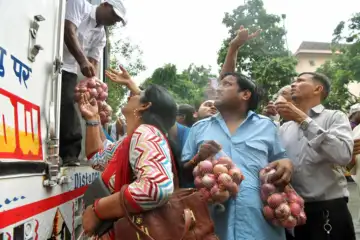
IMAGE: People buy onions after the launch of trucks carrying onions for retail distribution at Krishi Bhawan in New Delhi, August 27, 2027. Photograph: Naveen Sharma/ANI Photo
So, you feel this number masks the real crisis in the economy?
Yes. See, you are artificially boosting the economy.
By projecting from last year, you are artificially showing a high growth rate.
Therefore, you are masking the real problem that the workers face, the farmers face...
So, the farmers, the workers, the youth... all of them are in distress.
Then you are claiming that you have a very high growth rate.
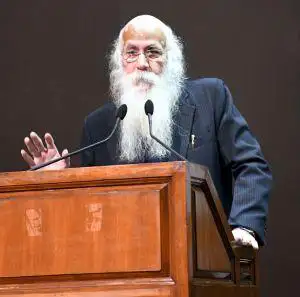 IMAGE: Professor Arun Kumar
It is said that Indians are taking more and more loans and also pledging gold. Are we heading towards a debt-fuelled crisis?
It shows the crisis of the lower middle class, the middle class and the poor people in the unorganised sector. They are forced to take loans, pledge their gold, etc
But the well-off segments, the corporate sector is doing well. The upper class is doing well.
In India, growth is for the top 3%-4% of the population only. The remaining 96% are suffering.
That is why they are taking gold loans, they are taking other loans...
Except for the wealthy people and the upper middle class, the rest are all suffering.
The reality is, we are growing only at 0% or 3%.
At this rate, it will take much longer for India to become a $5 trillion economy.
By projecting a 7.8% growth rate, the government is trying to hide its deficiency.
Feature Presentation: Aslam Hunani/Rediff