





'When we start describing somebody as an enemy that is the start of politics and emotion after which no business can take place.' 'We need to get out of this, allow Indian businessmen to do business with China.'
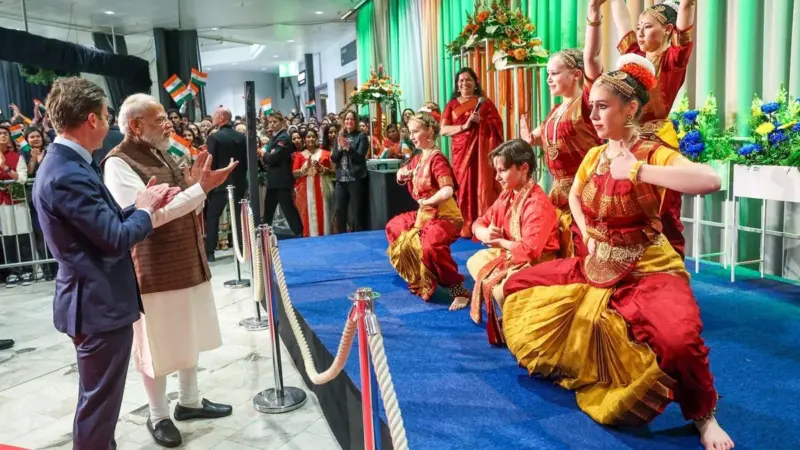
IMAGE: Prime Minister Narendra Modi and Sweden Prime Minister Ulf Kristersson watch a cultural performance in Gothenburg on Sunday, May 17, 2026. Photograph: Narendra Modi Photo Gallery/ANI Photo
Key Points
- 'There was lots of calls for boycott of Chinese goods after the Galwan Valley clash in 2020. Did that stop? India's imports from China have gone up in the last five years.'
- 'Think of Air India today. It is cancelling flights because it cannot run a profitable route on its international flights because it cannot bypass Pakistani territory. So who will take this business? This business will be taken by foreign airline companies.'
- 'You may have 'n' number of schemes but if you cannot solve the basic problem of technology, then modern technology cannot come to India for production or generation of investment.'
Prime Minister Narendra Modi's 7-step austerity measures, announced last week to minimise the pain from the Iran war, has set off alarm bells ringing about the state of the Indian economy.
Flowing from his appeal, curbs have been imposed on the import of gold and silver, fuel prices have been increased, and elected representatives and government officials all over have announced a scaling down of their travel and security details.
"Our energy problem, both gas and oil, at this moment can be solved by a pipeline that can go right from Iran to Pakistan and straight into India. But we have created a villain of Pakistan," former Union finance secretary Subhash Chandra Garg tells Syed Firdaus Ashraf/Rediff in the concluding segment of a two-part intervew.
Do you think there is policy paralysis?
I call it policy status quo. We have gone into a very bad policy lock zone on everything that matters, like electric vehicles. India has only 2 percent of electric vehicles. We don't want Chinese companies to come and make electric cars. We cannot get companies like Tesla. Therefore, this situation is not going to change very soon.
Is the current economic situation in 2026 less severe than the 2013 taper tantrum crisis or more severe?
In 2013 we were coming from a situation of past 5 to 7 years of very heavy investments. Lots of foreign investment had come and our reserves had gone up, but our import requirement also rose sharply. So there was an investment boom.
(Note: When then US Federal Reserve chairman Ben Bernanke in 2013 suggested that the Fed would soon reduce, or taper, its massive Quantitative Easing or bond-buying programme initiated in the wake of the 2008 global financial crisis, markets turned volatile, with the dollar gushing back to the USA.
This created a temporary situation where there was enormous pressure on the Indian rupee and the currency of other emerging economies like Brazil, Indonesia, South Africa.)
It was not because of any fundamental reasons. Investments did not get effected. There was no issue of technology, imports and other things as our exports too were rising. When that temporary period passed, and though I won't recommend it, the FCNR (B) deposit scheme was brought in which created a temporary supply of dollars.
(Note: In late 2013, facing a severe currency crisis and a depreciating rupee, the Reserve Bank of India under then governor G Raghuram Rajan introduced a special concessional FCNR(B) dollar-rupee swap window.
By subsidising hedging costs for banks, the RBI mopped up about $26 billion, which stabilised the rupee and bolstered forex reserves.)
I think that crisis went away.
Today, we have an energy problem, at that time we had no energy problem. We have a new economy problem today, which was not the case then. We have fundamental problems unlike in 2013 where we had temporary problems only.
Why could the government not succeed with programmes like Make in India which were launched with such fanfare? What went wrong?
Whether it is 'Make in India' or production linked incentives, all of them are based on the single premise that some Indian company should produce the required goods, whether it is battery, solar cells, smart phones, or a foreign company must come and invest in India.
In all these things Indian companies don't have basic technology. Even if they want to make it, they have to collaborate with foreign companies.
There was investment flow from China and we have stopped that flow completely so this Make in India and Production Link Incentives (PLIs) don't succeed. You should go and find out why a simple battery PLI failed in India. It failed because we do not have battery technology in India.
We are not allowed to have those basic technologies because it is with China. So you may have 'n' number of schemes but if you cannot solve the basic problem of technology, then modern technology cannot come to India for production or generation of investment.
In this scenario all these programmes like Make in India and all may sound good but will actually not help to achieve its goal.
Why would the Chinese share their technology with India?
This is the problem with the pharmaceutical companies too who do business with Western countries. Those Western countries may not give their best to you until they trust you.
But then China has transferred its production to many other countries like Vietnam. Those countries have removed restrictions imposed against China as China transferred production to those countries. Unfortunately, we did not take advantage.
Whenever politics take over business this is what happens. In India politics has taken over business, therefore this has happened.
When we start describing somebody as an enemy that is the start of politics and emotion after which no business can take place. We need to get out of this, allow Indian businessmen to do business with China.
It is bizarre when you can buy solar modules from China, but our businessmen are not allowed to set up solar module factories in India with Chinese help.
These are the problems that we created ourselves. We need to get out of these things. Not only China but we must also learn to do business with Pakistan.
Our energy problem, both gas and oil, at this moment can be solved by a pipeline that can go right from Iran to Pakistan and straight into India. But we have created a villain of Pakistan.
But Pakistan is an enemy country.
This is the fear of the weak. In today's technology world who is watching whom, you don't know.
If Israel can penetrate and kill the Hezbollah chief sitting 100 metres beneath the ground you have no idea which country has what information about you.
If a solar cell is made in India by China or if it is supplied by China then the same product may have spyware even if you import that product. And if you don't have any way to neutralise it, then you are not better off.
I understand what you said, this sounds blasphemous, but then either you do business or do politics.
If your domestic political constituency or domestic elections depends on such politics and if that is preferable to you than doing business...
Think of Air India today. It is cancelling flights because it cannot run a profitable route on its international flights because it cannot bypass Pakistani territory. So who will take this business? This business will be taken by foreign airline companies.
How can we ignore the Pahalgam attack where Pakistani terrorists killed 26 Indian tourists? How can you expect the Indian government to do business with Pakistan?
By crushing Pakistan economically can we stop the terror? If yes, do it. But, then, is there any evidence?
There was lots of calls for boycott of Chinese goods after the Galwan Valley clash in 2020. Did that stop? India's imports from China have gone up in the last five years (from $58.87 billion to $151 billion in 2025-2026).
I am saying these things because somebody needs to say this, otherwise foolishness persists.