





India's move to privatise PSLV rocket production through IN-SPACe has triggered debate over national security, ageing technology and the agency's role.
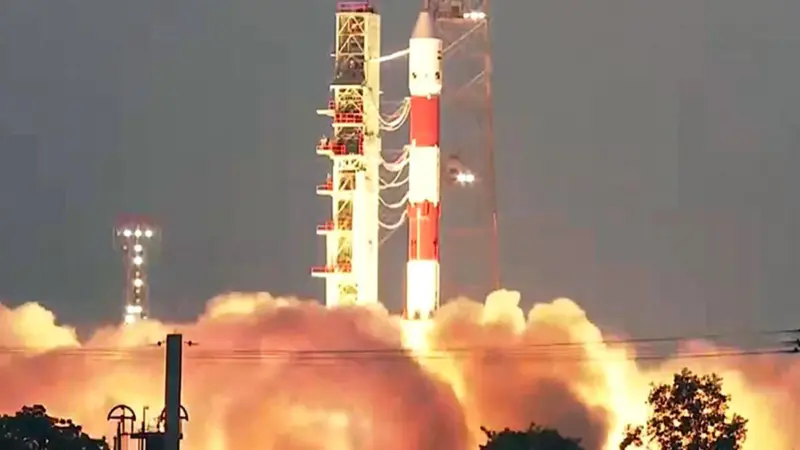
IMAGE: Indian Space Research Organisation launched PSLV-C61 carrying the EOS-09 (Earth Observation Satellite-09) into SSPO orbit from the Satish Dhawan Space Centre in Sriharikota, May 18, 2025. Photograph: ANI Photo
Key Points
- IN-SPACe's EoI for PSLV manufacturing mandates Indian ownership and control for participating non-government enterprises, a condition not previously seen for satellite constellation bids.
- Concerns are raised about the relevance of transferring 33-year-old PSLV technology when newer, more advanced rockets are being developed globally.
- Strategic experts welcome the Indian ownership stipulation, citing the dual-use potential of rocket technology for missiles and lower FDI limits for rocket manufacturing.
Indian space industry officials expressed mixed views on the Indian National Space Promotion and Authorisation Centre (IN-SPACe) inviting Expression of Interest (EoI) for making the Polar Satellite Launch Vehicle or the PSLV rocket.
What has surprised industry officials is the stipulation that the respondent and their consortium members (if any) participating in the EOI shall be a non-government enterprise under Indian ownership and control and registered as:
a. A company incorporated under the Companies Act, 2013, or
b. A partnership firm established under the Limited Liability Partnership Act, 2008, or
c. A Trust under the Indian Trusts Act 1882, or
d. An association of persons or body of individuals incorporated under relevant statutes in India.
Industry officials said this is the first time such a condition -- a bidding enterprise should be owned and controlled by Indian(s) -- has been introduced.
Such condition did not exist in the bid for constellation of satellites that was won by the Pixxel Space-led consortium sometime ago though satellites are more strategic in nature.
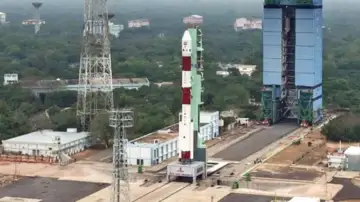
IMAGE: The PSLV-C62/EOS-N1 at the Satish Dhawan Space Centre in Sriharikota, January 11, 2026. Photograph: @isro X/ANI Photo
Questions Raised Over Timing and Technology Transfer
Officials also raised pertinent questions like a. What is the urgency for calling EoI when the PSLV Failure Analysis Committee's recommendations are still unknown and the extent of implementation required remains unclear?
b. Why IN-SPACe is involved in transfer technology of rockets when the public sector NewSpace India Limited (NSIL) -- which currently does not have a full time chairman and managing director -- is the nodal agency for carrying out PSLV production through Indian industry through a consortium route?
c. Who will be interested in a technology that is more than 30 years old when rockets with the latest technologies are being developed worldwide?
The 33-year-old PSLV is an expendable four-stage rocket that alternates between solid and liquid propulsion: The first and third stages use solid propellant while the second and fourth stages are liquid-fueled.
Strategic Concerns Behind Support for Indian Control
Welcoming the stipulation -- Indian ownership and control -- Tapan Misra, founder and chairman, Sisir Radar, said: "There should be also the condition that the bidder should also funded by Indian owned and controlled entities."
"The bidder should be Indian. It is good that it is being stipulated now," a retired ISRO official said, preferring anonymity.
Referring to dual use possibilities of rocket technology, Lieutenant General A K Bhatt (retd), director general, Indian Space Association, said: "Rocket technology is more sensitive strategically as it can be used for missile or rockets. It is always preferred that the controls are within the country."
While the FDI for manufacture of satellites is at 74% under automatic route, it is 49% in the case of rocket manufacturing.
Debate Over IN-SPACe's Role
Industry officials are of the view that IN-SPACe is not an agency to conduct technology transfer of ISRO's assets.
"IN-SPACe is basically an authorisation agency as the name suggests. ISRO has the technology and NSIL is mandated to exploit it commercially," a retired ISRO official said, preferring anonymity.
Added another former ISRO official: "IN-SPACe should focus on policies that would facilitate easy access to ISRO facilities for the private space sector players, faster frequency clearances and other aspects. Commercialisation of ISRO's assets should be done by NSIL."
IN-SPACe on its web site said: 'IN-SPACe, is responsible to promote, enable authorize and supervise various space activities of the NGEs (non-government enterprise) that include, among others, the building of launch vehicles and satellites and providing space-based services; sharing of space infrastructure and premises under the control of DOS (Department of Space)/ISRO; and establishment of new space infrastructure and facilities.'
IN-SPACe was involved in the transfer of technology of ISRO's another rocket Small Satellite Launch Vehicle (SSLV) for Rs 511 crore (Rs 5.11 billion) to Hindustan Aeronautics Ltd.
Venkatachari Jagannathan can be reached at venkatacharijagannathan@gmail.com
Feature Presentation: Rajesh Alva/Rediff