




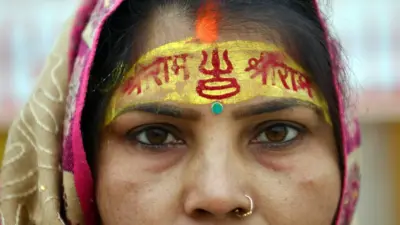

Nepal's Hindu groups have sought an all-party discussion on restoring Hindu-nation status within three months.
IMAGE: A devotee from Nepal at the Ram temple in Ayodhya.
Photograph: Rahul Singh/ANI Photo
In the first week of August 2026, Nepal's Home Minister Sudhan Gurung held talks in Janakpur with representatives of the United Hindu Front and Hindu Samrat Sena.
The groups submitted a 13-point memorandum to the government and receipt confirmed by local officials.
Its opening demand called for an all-party discussion, to be initiated within three months, on declaring Nepal a Hindu nation on the basis of its roughly 81 per cent Hindu majority (including Kirat and Buddhist self-identification).
The supplementaries included clarification on foreign funding of religious institutions and on citizenship processes.
Key Points
- Nepal Prime Minister Balendra Shah has ruled out restoring the monarchy or Hindu-state status, citing risks to federalism.
- Political and institutional figures from Nepal have repeatedly visited the Ram temple in Ayodhya since January 2024.
- Hindu identity is being rewritten through gradual reassertion of civilisational continuity rather than sudden official declarations.
Conversely, Nepal Prime Minister Balendra Shah had stated clearly that his government had no intention of restoring either the monarchy or Hindu-state status, arguing that the two issues were linked and that either step would risk federalism.
While the surface language of the executive remains cautious, political discussion on civilisational identity in the contiguous Madhes zone is a structural fact.
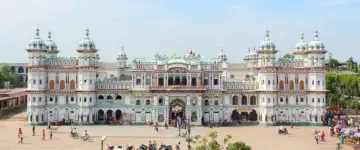
IMAGE: The Janki Mandir in Janakpur, Nepal. Photograph: Kind courtesy Abhishek Dutta/wikipedia.org/Creative Commons
Madhes-Janakpur-Ayodhya Continuum
This sequence aligns within a longer pattern of civilisational engagement that went under the radar in swirl of news cycles.
Ever since the consecration of the Ram temple in Ayodhya in January 2024, a series of political and institutional figures from Nepal have had their darshan.
In February 2024, then foreign minister Narayan Prasad Saud performed puja with his family.
In November 2024, Madhesh province Chief Minister Satish Kumar Singh led a cabinet delegation for the Tilak Utsav.
In December 2024, Nepal army chief General Ashok Kumar Sigdel concluded an official India visit with darshan at the temple.
In June 2026, Rastriya Swatantra Party Chairman and former deputy prime minister Rabi Lamichhane offered prayers at the temple with his family after meetings in New Delhi.
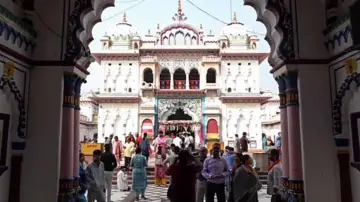
IMAGE: People worship at the Janki temple in Janakpur. Photograph: ANI Photo
India-Nepal Pragmatic Track
Interestingly, the official India-Nepal bilateral engagements over the same period have followed a different register.
Nepal Foreign Minister Shisir Khanal's June 2026 visit produced concrete outcomes: Launch of peer-to-peer linkage between India's Unified Payments Interface and Nepal's National Payments Interface, handover of completed post-2015 earthquake reconstruction projects, and progress on mutual legal assistance.
Discussions centred on connectivity, energy, trade, and digital infrastructure.
The pragmatic track of State-to-State business and the symbolic track of shared sacred civilisational geography have run in parallel.
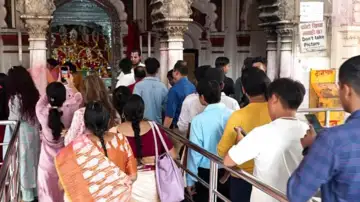
IMAGE: People queue at the Janki temple to offer prayers. Photograph: ANI Photo
Kautilya's Mandala Strategy
Classical Indian statecraft supplies a coherent frame for reading this geometry.
Kautilya's Arthashastra describes the political world as a raja-mandala -- a circle of States centred on the vijigishu, the aspiring ruler whose primary task is the security and consolidation of his own core domain.
Immediate neighbours form the first ring and are structurally competitive. The neighbours of those neighbours form the second ring and are potential allies.
Policy is calibrated through the six-fold instrument of sandhi (peace), vigraha (war), asana (remaining stationary), yana (marching), samshraya (seeking shelter), and dvaidhibhava (dual policy).
The insight in reading this is in sequential priority: Stabilise the periphery by cultural alignment (dharma, pilgrimage circuits) before consolidating the core to avoid dissonance in the contiguous zone as it raises governance cost.
In modern translation, the Madhes-Janakpur-Ayodhya continuum therefore represents the first circle of this civilisational space.
Formal discussion of the Hindu-nation status in that circle, however provisional, and the repeated elite visits to the Sri Ram Janambhoomi, operate as soft alignment.
Official statements that rule out immediate constitutional change can be read, in Kautilyan terms, as asana -- tactical stillness -- while the deeper work of cultural recognition proceeds.
The core (Bharat) does not need to announce a parallel project; movement in the periphery (Nepal) itself alters the operational strategic environment.
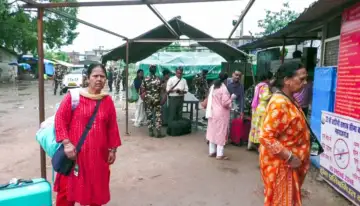
IMAGE: Security personnel check visitors at the India-Nepal border at Sonauli in Maharajganj, Bihar. Photograph: Video Grab/ANI Photo
Sanatan Diplomacy Takes Shape
Hindu identity is being rewritten through gradual reassertion of civilisational continuity rather than sudden official declarations.
When the periphery begins to discuss the recovery of a majority civilisational frame, the mainland is reminded that secular constitutional language and civilisational self-understanding have been working at cross purposes.
The Mandala logic suggests that a secure core is one whose immediate cultural neighbourhood is not permanently alienated.
The current episode in Nepal is therefore not peripheral noise. It is data within an older geometry of power and affinity that Bharatiya Upmahadweep statecraft has never entirely abandoned.

IMAGE: External Affairs Minister S Jaishankar launches the linkage between Indian UPI and the National Payments Interface of Nepal for facilitating cross-border personal remittances in New Delhi, June 6, 2026 along with Nepal Foreign Minister Shisir Khanal. Photograph: @DrSJaishankar X/ANI Photo
The outcome of the promised all-party process remains open.
A constitutional amendment requires a two-thirds majority and faces real domestic resistance.
Yet the opening of the discussion itself, set against the background of 'Sanatan diplomacy' and parallel pragmatic bilaterals, already illustrates the classical priority: Manage the outer ring, reduce friction through congruence, and only then consolidate the centre.
Bharat, as a Hindu Rashtra, then becomes feasible.
Feature Presentation: Ashish Narsale/Rediff