





I told my boss I would not apologise, not even verbally. If they wanted a fight, they could put it on paper. I knew it would make things worse.
But I was right.
Illustration: Dominic Xavier/Rediff
I survived my years in government service. Mostly.
I can talk about some of it now. The statute of limitations on bureaucratic absurdity must have run out by this time.
A government department is a ladder. You start at the bottom and climb. By the time you reach the top floor, people speak a different language altogether.
Today your smartwatch tells HR when your heart rate goes up. An employee vanishing in office hours sounds like a myth.
The CBI Raid That Went Wrong
In the early 2000s, people vanished all the time. And if you used the wrong word for it, you could lose your career.
Ironically that word is the most used word in India today. You will soon realise.
I was the go-to man for CBI raids. The law said they needed independent witnesses, and the requests landed on my desk.
I would pick two inspectors, any two, and send them off. Nobody ever complained. Nobody ever asked how I chose.
One morning, my two men did not turn up. The CBI called my boss, and they were not pleased. Without witnesses, a raid will not happen. Weeks of preparation will go to waste.
The missing men worked under Deputy Commissioner Johnny Mehta. I would rather not name people in these columns, but I must name him.
My story with him began badly and ended sweetly. He is no more now. May he rest in peace.
A Bureaucratic Battle Over Words
Mehta was a legend, mostly for the wrong reasons. His brother was the city police chief.
He yelled at you if you breathed too loudly. He smoked a pipe all day in his cabin. People swore there was a bottle of whiskey under his desk.
I never checked. These are rumours, maybe. Nobody went near him unless the building was on fire.
My boss was sweating. He did not want to call Mehta. So he sent me.
I walked across the road to the old insurance building. I wrote my name on a slip of paper and waited. Then I was called in.
I stood in front of the pipe and said my lines in one breath.
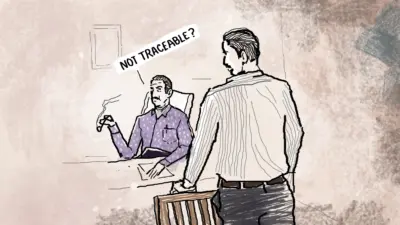
"Sir, we deputed two of your inspectors. They did not report. I checked. They are not traceable."
The pipe stopped moving. His face twisted.
"Not traceable?" he said. "Are they criminals, to vanish? What language is this? Apologise."
"For what?" I asked. "For saying traceable?"
"Yes. We use that word for criminals."
First I lost my body temperature. Then I lost my patience.
I told him four people were looking for these men. Nobody knew where they were. They had skipped duty. I kept my voice flat.
I already told you: 'Not traceable' has never been used as much as it is today. Thank SIR for that. In the great voter deletion exercise, the Election Commission has found millions of people 'not traceable'.
The odd thing is that most of them are still in their own neighbourhood, at the same address.
The Meaning Of 'Not Traceable'
Back to the room. I said plain English was not a violation of the civil service conduct rules. Then I walked out. It felt very brave at the time.
Back in my office, my boss asked what happened. I told him. He went pale. I became nervous.
Soon Mehta called him. He wanted my apology in writing. He wanted a formal memo issued to me.
I told my boss I would not apologise, not even verbally. If they wanted a fight, they could put it on paper. I knew it would make things worse. But I was right.
There was one small problem. I was still on probation. They could send me home with one signature.
I spent the weekend with the civil service rulebook. My mom brought me tea and asked if I was studying for an exam. Departmental one for promotion. I said something like that.
The Missing Inspectors And The Memo
By Sunday night I had my defence ready. I had decided I would rather lose my job than say sorry for a normal English word.
Monday morning, I had to fill in for the missing men. The CBI was laying a trap in Bareja, for a railway official who took bribes.
They told me to dress like a daily wage worker and sit at a tea stall. So I sat there and drank tea. No way I was looking like a daily wage labourer. If at all they had a uniform.
We waited for hours. The man did not come. I had a lot of tea.
The stall owner had no idea we were on a mission. He only knew this one customer was drinking an enormous amount of tea.
I could not ask him to tone down the sugar he was putting mercilessly in the tea. After all a daily wage labourer always drinks a sweet one.
He did not ask a single question. Better business means no questions.
Then the man showed up, and we caught him red-handed.
He had less than a year left before retirement. He lost every benefit for a small bribe.
It felt grim. Two grown men in the city were fighting a holy war over one word. And here was a poor man who had thrown away his whole pension for pocket change.
When A Senior Officer Said Sorry
Tuesday morning. Office.
My boss said the memo was ready. I said I was ready for the Supreme Court.
But the memo never came to me. I enquired who had typed it. Nobody knew.
Maybe it was never typed. I will never find out.
I waited all day. Evening came, and the office emptied out. Then my boss said Mehta wanted to see me.
I walked into that cabin again. The traffic outside was honking like mad. I was ready for another round of shouting.
He offered me tea instead.
He looked at me and said he was wrong. He said there was nothing wrong with the word. He said he liked that I stood my ground.
"I meet very few people like you," he said. "Everyone says yes. You did not. You seem to be from a different tribe."
I sat there stunned. This was not in the script.
A man that senior had just said he was wrong. Out loud. To a probationer.
In all the years after, I never met another person who could do that.
I walked back to my office. My boss was waiting. He took the memo from his drawer and tore it up.
It was a single sheet of paper. To this day I don't know if it was a real memo or just a plain blank sheet.
It takes a big person to say 'I was wrong', and I have tried to remember that on my own bad days.
Feature Presentation: Ashish Narsale/Rediff