





'For the rest of his tenure, people will start with the assumption that even Modi can be forced to bow down'
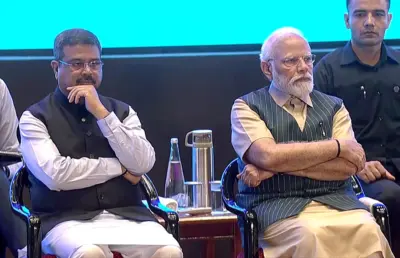
Prime Minister Narendra Modi with then Education Minister Dharmendra Pradhan at the inauguration of the Akhil Bharatiya Shiksha Samagam at Bharat Mandapam, New Delhi.
Photograph: ANI Photo
Education Minister Dharmendra Pradhan resigned on Saturday, July 25, 2025, handing the students massed under the banner of the Cockroach Janta Party their biggest win yet, after weeks of agitation over leaked entrance exams that had swelled into a wider Gen Z revolt over jobs, education reform and institutional accountability.
Key points
- 'He is a man who has never made comedowns, never taken a step backward, never bowed before public opinion or protest. So this is a first, and it sets a precedent.'
- 'This is a break from form. His natural instinct is not to budge.'
- 'The political message Modi wanted to send was that he does not bow to public pressure or protest.'
For senior journalist and author Nilanjan Mukhopadhyay, though, this is not just one minister's exit -- it may be the moment Prime Minister Narendra Modi's aura of invincibility finally cracked.
It would not be the first time his government has been made to retreat. In 2015, sustained backlash forced it to let a contentious land acquisition ordinance lapse. In 2021, a year of farmer agitation ended in the repeal of three farm laws. And this April, the Lok Sabha threw out a bill tying the long-promised Women's Reservation Bill to fresh delimitation -- the first defeat of a Constitutional amendment in Modi's decade in power.
Yet Mukhopadhyay argues Pradhan's resignation is a climb down of a different order, a genuine slap rather than a staged retreat, coming from a prime minister who, in his words, "has never made comedowns".
He points to a telling silence through it all -- even the ABVP, the RSS' student wing, said nothing as the protests raged. And he warns the fallout will not stay confined to Delhi, reaching into Uttar Pradesh and Punjab, where elections loom and cracks are already showing in Modi's standing with first-time voters.
In this conversation with Prasanna D Zore/Rediff, Mukhopadhyay unpacks what forced Modi's hand, why the Sangh Parivar's silence matters, and where the political reckoning goes from here.
'His image have taken a huge beating this past week or so'
Now that Dharmendra Pradhan has resigned as education minister, is this a genuine concession by Prime Minister Narendra Modi, or a calculated, face-saving exit?
Time will tell, but for the moment, it is definitely a major comedown -- and a slap in the face for him. He is a man who has never made comedowns, never taken a step backward, never bowed before public opinion or protest. So this is a first, and it sets a precedent.
For the rest of his tenure, people will now start with the assumption that even Modi can be forced to bow down.
That's very close to what CJP Founder Abhijit Dipke said: 'Jhukti hai duniya, jhukane wala chahiye' -- the world bends, but you need someone to make it bend.
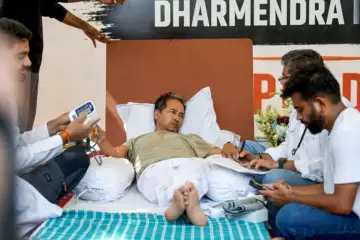
Environmentalist Sonam Wangchuk being attended by doctors on the 18th day of his indefinite hunger strike at Jantar Mantar in New Delhi as CJP Founder Abhijeet Dipke looks on. Photograph: ANI Photo/Rahul Singh
Yes. It's necessary for every ruler to know that people have the power to make them take a step back. But only if the people themselves are willing to make that mistake for the rulers.
Will this climbdown actually help Mr Modi defuse the crisis? Or has a period begun where his popularity starts to wane?
His popularity and his image have taken a huge beating this past week or so. That is not going to be recovered immediately. He will have to work at it -- and recover lost ground through humility, which is not a natural posture for him. He isn't a man known for humility.
Could the RSS have forced his hand? What factors might have gone into this decision?
Pradhan resigned, yes, but the RSS itself has said nothing through this entire period. What's actually been more striking -- someone pointed this out to me -- is that the ABVP, the country's largest student organisation and an official RSS affiliate, was completely silent throughout. Pindrop silence from the Akhil Bharatiya Vidyarthi Parishad.
So it wasn't just Modi; the entire Sangh Parivar was, in effect, a collaborator on the very issues that had the youth so angry.
'At least he has managed to defuse the crisis'
So what finally pushed Modi to act, given he would surely know his constituency would look down on him for buckling under pressure?
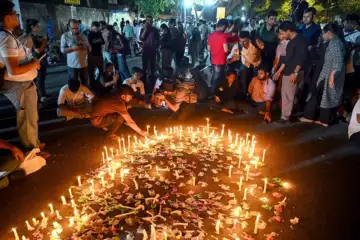
Cockroach Janata Party supporters light candles during the protest demanding Dharmendra Pradhan's resignation over the NEET (UG) 2026 paper leak in New Delhi. Photograph: ANI Photo/Jitender Gupta
At least he has managed to defuse the crisis. These boys and girls will go back from the various sites of protest within a day or two, once the formal commitments are made -- compensation for the families of those who died by suicide, and criminal cases being processed against the police officers involved.
Was this a measured, staged climbdown? The prime minister stayed silent for weeks, then offered fast-track courts and a bill in Parliament to deal with the leaks once and for all.
I think he believed those measures would work. When they didn't, there was no option left but to accept the core demand -- that Dharmendra Pradhan resign.
You have documented Modi's political career closely -- is this hesitation consistent with the pattern you've seen, or a break from it?
This is a break from form. His natural instinct is not to budge.
The last time he budged was over the three farm laws, the land acquisition bill...
That was 2021 and before -- but that came after a long stand-off, and he did eventually budge. In 2021 he also removed Harsh Vardhan from the health ministry, along with his deputy.
Even Ravi Shankar Prasad was asked to go.
Yes -- a whole set of ministers were eased out in what was the biggest reshuffle of that kind.
Given how important Pradhan was to Mr Modi and the BJP, why couldn't he have been asked to step down earlier?
I don't think it was ever really about Pradhan specifically -- it was about anybody whose resignation was being sought. The political message Modi wanted to send was that he does not bow to public pressure or protest.
But these protesters were largely Gen Z -- many wouldn't remember much before 2014. Has Modi's standing specifically with young, first-time voters taken a hit?
The BJP's older playbook of polarisation along religious lines has taken a real beating with first-time voters, and with those who backed Modi in 2024. Many of them aren't going to vote for the BJP easily in the next round of elections.
'I expect people to start vacating the protest sites'
With Uttar Pradesh and Punjab heading to the polls, will this have a major impact, especially in UP, where the BJP has so much at stake?
Yes -- and in UP, this will get layered onto the Ram temple donation theft issue as well. People there haven't forgotten it. It hasn't stayed in the headlines nationally, but in UP, it remains a live issue.
Would UP be Modi's biggest electoral challenge going forward?
UP, and Uttarakhand alongside it. Uttarakhand is smaller, of course, but it's still a fairly significant state, and the BJP has been in power there for a good while too.
Do you expect the protests to wind down within a day or two as the protesters vacate their sites of agitation?
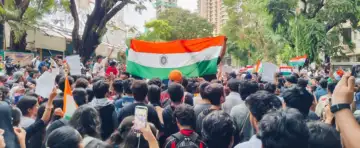
IMAGE: The protest at Mumbai's Shivaji Park, July 24, 2026. Photograph: Hemant Shivsharan/Rediff
I think so. The protesters have said they want formal commitments on the two remaining issues -- that's the position Abhijit Dipke has put out. Once that's done, in a day or two, I'd expect people to start vacating the protest sites.
A lot of Gen Z protesters in Mumbai and elsewhere -- beyond Delhi -- have also foregrounded the issue of unemployment, institutional accountability reforms in the education policy. This wasn't only about Pradhan's resignation, was it?
No, it wasn't confined to a hundred cities, or centred only on Pradhan. There was a deeper alienation at play -- demands for job creation, education reform, institutional accountability. It became, cumulatively, a much broader protest.
It does feel like India is having a 'million mutinies' moment right now.
That's right.
Will history remember this as the moment Modi's aura of invincibility cracked?
Yes. This is the biggest political setback of his career.