





If TVK MLAs and ministers are perceived as clean, or demonstrably cleaner than their predecessors, the credibility dividend will be enormous.
The voter will feel rewarded, points out Ramesh Menon.
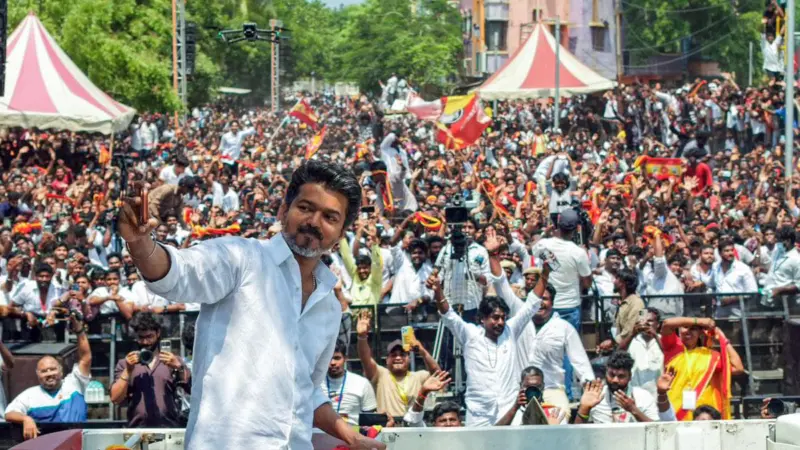
IMAGE: Vijay clicks a selfie during a roadshow for the Tamil Nadu assembly elections at Perambur in Chennai. Photograph: @TVKPartyHQ X/ANI Photo
Key Points
- Acting in nearly 70 films over three decades was easy; delivering justice and governance will not be so, as there is a web of challenges around him.
- As chief minister of Tamil Nadu, he has to work out how to manage a debt of over 9.6 lakh crore, accumulated over the past seven decades by previous governments through generous freebies before elections and misgovernance.
- In absolute terms, Tamil Nadu has the highest state debt in India, ahead of larger states like Maharashtra, Uttar Pradesh and Karnataka.
For over three decades, Vijay's films have established a remarkably consistent archetype of the righteous outsider who single-handedly takes on corrupt systems. He is always siding with the poor and powerless against the wealthy and well-connected.
His character breaks the system, he exposes it, or shames it to reform. As he goes about his role, the crowd crazily cheers and whistles. They are happy that someone is doing what they cannot.
For example, in the film Mersal, Vijay plays a doctor who exposes a corrupt health minister who runs fake hospitals that bleed the poor. Vijay tells a corrupt health minister: 'The government is supposed to protect its people, not loot them.'
He talks about the government's failure to provide universal healthcare. Everyone in the audience feels angry about how little India spends on healthcare.
There is a stark political subtext in his films. It was about corporate land grabs from poor farmers, multinational companies stealing agricultural land and water, and similar themes of how the marginalised get exploited by politicians and corporate lords.
Kaththi was a straightforward indictment of corporate land grabs from farmers. Master depicted a flawed but ultimately redemptive hero fighting a child-exploiting criminal system.
Individual moral courage in his films against institutional rot and paralysis got him the whistles.
In the film Bigil, Vijay is a football coach who battles corrupt sports administrators and leads a women's team to national glory. The villain in the film is the institutional rot in the country where selectors accept bribes, and officials fix results. But Vijay emerges triumphant because of his moral stand and refusal to compromise. Cheers in the theatres again.
The pattern in his films followed a clear script: The corrupt must be punished, the poor must be protected, those exploited must be rescued and rehabilitated, while the hero stands tall, never compromising.
No wonder Chandrasekhar Joseph Vijay is commonly known to 77 million Tamilians as Thalapathy, the Commander.
Now cut away from reel life to real life.
The cameras have been switched off, and real action has to follow. There are no doubles to help.
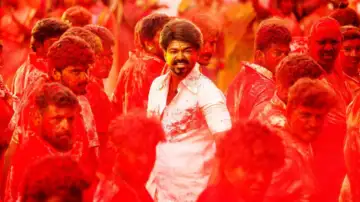
IMAGE: Vijay in the film Mersal.
New Role
As chief minister of Tamil Nadu, he has to work out how to manage a debt of over 9.6 lakh crore, accumulated over the past seven decades by previous governments through generous freebies before elections and misgovernance.
He has to balance the budget.
He has to manage a coalition partner who controls 12 seats.
He cannot tell the farmers who voted for him that he cannot grant loan waivers right now. He has to ask the central government to please release Tamil Nadu's share of central funds gracefully.
He has to fight corruption that is endemic in the state and treated as normal. He has to make the bureaucracy accountable.
He has to deal with a governor who will throw up hurdles if the central government wants him to, as was visible in all Opposition-ruled states.
He has to deal with New Delhi all the time, which is not going to make it easy for him to rise and shine, as it would delay the BJP's foray into the state.
Acting in nearly 70 films over three decades was easy; delivering justice and governance will not be so, as there is a web of challenges around him.
Vijay emerged victorious in one of the most dramatic elections in Tamil Nadu, breaking the state's 59-year-old Dravidian duopoly, in which the DMK and the AIADMK had alternated in power since 1967. It was unimaginable that any other party could come to power.
But here was an actor with absolutely no political experience who created a new party, the Tamilaga Vettri Kazhagam (TVK), just two years ago. No one had predicted that he would lead it to sweep the elections and even defeat the erstwhile chief minister, M K Stalin, along with fifteen of his cabinet ministers.
It was a digital campaign unlike anything India had seen at the state level, using WhatsApp, YouTube, Instagram, and Facebook. TVK's 85,000 fan clubs became political cadres overnight, creating an extensive grassroots network unseen by any debutant in Indian electoral history.
Vijay can now see that it was not just stardom that brought him to the chief minister's office. It was the voter who wanted to be rescued from dynastic politics, rampant corruption, a lack of opportunities for the unemployed, and rising prices.
All of a sudden, the voter had another option. Here was a larger-than-life hero who, in his films, was morally upright, fought institutional corruption, protected the poor from the powerful, and delivered justice single-handedly.
They just wished he would do the same if he had political power.
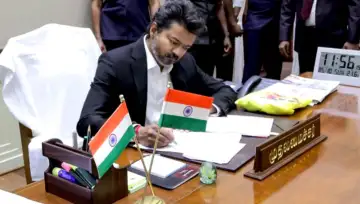
IMAGE: Vijay assumes charge as chief minister at the Tamil Nadu secretariat in Chennai. Photograph: ANI Video Grab
Calculated Move
In early 2024, he abandoned his flourishing acting career to found a political party, saying that people were yearning for a political movement that would pave the way for a selfless, transparent, visionary and efficient administration.
Vijay brought in political strategist Prashant Kishor to advise him and to design a meticulous, data-driven, and relentlessly youth-focused campaign. The party's rallies, social media content, and manifesto all spoke to a generation that had grown up on Vijay's films but was now seeking the same beyond cinema.
And he did not disappoint. One of the first things Vijay did was remove all liquor shops near educational institutions. In fact, they should not have been there in the first place.
He announced rewards for those who would provide his office with evidence of corruption, saying he was determined to root it out.
Vijay reached out to IAS officers known for their integrity and reform orientation, signalling his intention to prioritise a direct line to the bureaucracy and to bypass the political-broker culture that has historically slowed Tamil Nadu's administration.
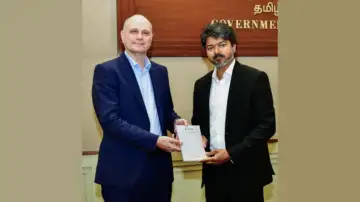
IMAGE: Thomas Dose, managing director, BMW Group Plant Chennai, calls on Tamil Nadu Chief Minister Vijay in Chennai, May 15, 2026. Photograph: @CMOTamilnadu X/ANI Photo
New Faces, New Expectations
His cabinet today has the most educated ministers any state can boast of. That is an excellent move, as we have seen the havoc uneducated ministers can cause in other states.
The most significant appointment was K A Sengottaiyan, TVK's high-level administrative committee chief coordinator, who brings substantial government experience. Sengottaiyan served as education and sports minister under AIADMK's Edappadi K Palaniswami and held portfolios under Jayalalithaa, with his career dating back to 1991. He will handle the finance portfolio.
His crossover to the TVK was one of the most visible defections from the AIADMK machinery, and Vijay has wisely given him a senior role.
Public Works Minister Aadhav Arjuna, TVK's firebrand general secretary for election campaign management, is another key figure. Young, combative and a digital native, he built TVK's online war machine. Vijay probably hopes the campaign's energy will now translate into governance.
The cabinet also draws on MLAs from sports, media, and even the civil services, which starkly contrasts with the intellectual capital of previous cabinets.
Vijay has leaned on experienced heads for bureaucratic management, but keeps the vision and communication firmly in his own hands.
It is a calculated bet. If execution fails, he has accountability without the shield of an old-guard cabinet to blame. But if it works, the credit is entirely his.
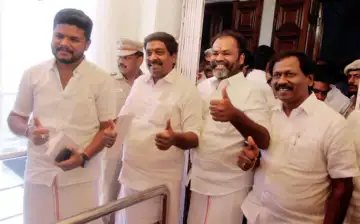
IMAGE: Tamilaga Vettri Kazhagam MLAs show the victory sign at the Tamil Nadu assembly in Chennai. Photograph: ANI Photo
Challenges Galore
One of Vijay's first challenges is to tackle the financial morass that his state has inherited.
In absolute terms, Tamil Nadu has the highest state debt in India, ahead of larger states like Maharashtra, Uttar Pradesh and Karnataka.
According to the Reserve Bank of India's study of state finances, Tamil Nadu's total outstanding liabilities stand at approximately Rs 9.52 lakh crore in revised estimates for 2025-2026, with the interim budget for 2026-2027 projecting this will cross Rs 10.71 lakh crore.
What it means is that every man, woman, and child in Tamil Nadu today carries a debt burden of roughly Rs 1.2 lakh on their shoulders.
How did Tamil Nadu, one of India's most industrialised and educated states, end up in this state? The answer is both structural and political.
Structurally, the Finance Commission has progressively reduced Tamil Nadu's share of central tax devolution from 7.9% to 4.079% today. The state's own finance department estimates that this has cost Tamil Nadu Rs 3.17 lakh crore over the decades, roughly a third of its current outstanding debt.
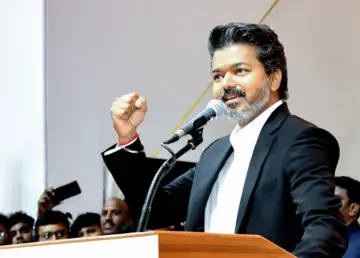
IMAGE: Vijay speaks after taking oath as the chief minister at the Jawaharlal Nehru indoor stadium in Chennai, May 10, 2026. Photograph: @CMOTamilnadu/ANI Photo
The Finance Commission gave Tamil Nadu only a 0.44% increase in its share, the lowest among comparable states. Karnataka received 13.27%, and Kerala 23.74%, both Opposition-ruled states.
Politically, all political leaders in power have stoked the financial crisis by fuelling a rampant freebie culture, to such an extent that it now defines Tamil Nadu's flawed political culture.
This began in the 1980s with MGR's revolutionary noon-meal scheme. It was genuinely transformative, as school attendance improved. The poor had access not only to food but also to quality education. We can see how it has changed Tamil Nadu.
It is not that all welfare schemes are bad. A school meal scheme, a women's stipend paid directly into bank accounts, and a student loan that enables higher earnings all have documented multiplier effects on consumption, human capital, and productivity. They are investments in disguise.
However, with each successive election, there was a bidding war among parties to offer more freebies. Free televisions, mixers, bicycles, rice, electricity, and whatnot. In the 2021 elections, the DMK promised Rs 1,000 per month to women heads of household. By 2026, every party was forced to increase that amount.
There are schemes with other intentions, such as capturing votes. The gold-and-saree scheme, the blanket electricity subsidy, and the farm loan waivers are classic vote-harvesting freebies.
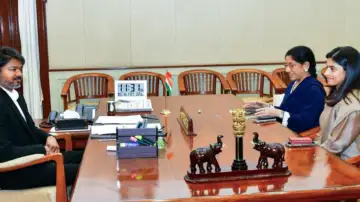
IMAGE: TAFE Chairman and Managing Director Mallika Srinivasan and TAFE Vice Chairman Lakshmi Venu call on Tamil Nadu Chief Minister Vijay in Chennai, May 15, 2026. Photograph: @CMOTamilnadu X/ANI Photo
Dangerously High Debt
Interest payments on Tamil Nadu's debt now account for a dangerously large share of government revenue. The state plans to borrow an additional Rs 1.79 lakh crore in 2026-2027 alone.
Borrowings that should ideally fund productive infrastructure are being diverted to subsidies, salaries, and recurring welfare expenditure. Capital investment that can generate jobs and multiply tax revenues is petering out.
Vijay also resorted to offering freebies before the election: A Rs 2,500 monthly stipend for every woman head of household; Rs 3,000 per month for senior citizens, widows, and persons with disabilities; 200 units of free electricity; six free LPG cylinders annually; 8 grams of gold and a silk saree for brides from families earning below Rs 5 lakh; a full waiver of cooperative farm loans; and collateral-free student loans of up to Rs 20 lakh.
The Rs 2,500 women's stipend alone, expected to cover over 10 million eligible households, would cost the exchequer thousands of crores of rupees annually. Add the electricity subsidy, LPG support, pensions, and farm waivers, and the cumulative recurring burden becomes staggering. These are permanent liabilities.
Vijay, who criticised his predecessors' freebie culture during the campaign, must now find a way to implement his welfare promises selectively, phasing out pure populism while preserving genuine welfare investment.
The political cost of doing so will be enormous, but the cost of not doing so could be bankruptcy.
Vijay promised to make Tamil Nadu a $1.5 trillion economy by 2036, to create an AI ministry and an AI university, and to deploy artificial intelligence across public service delivery. While ambitious and forward-looking, this promise sits uneasily alongside a welfare bill that threatens to overwhelm the state's fiscal capacity.
Extraordinary Opportunity
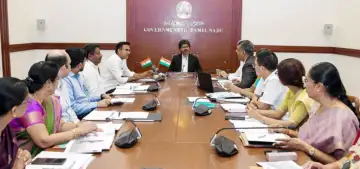
IMAGE: Vijay meets with officials of the health and family welfare department at the secretariat in Chennai. Photograph: @CMOTamilnadu X/ANI Photo
Having said that, Vijay has an extraordinary opportunity of a lifetime to change the political culture of Tamil Nadu, but it would take courage.
Tamil Nadu's economy is among the most dynamic in India. The state's GDP is estimated at approximately Rs 35.68 trillion (around $380 billion) for 2025-2026, making it the second-largest state economy after Maharashtra.
Real GDP growth was 11.2% in 2024-2025, the highest among major Indian states. Manufacturing contributes 33% of GDP.
Tamil Nadu leads India in electronics exports, accounting for 41% of the national total, and is the country's top producer of auto-components.
Vijay has a unique advantage in being genuinely outside the system. He owes nothing to the construction lobby, the sand-mining mafia, or the liquor-baron network that has historically oiled Tamil Nadu's political class.
The window of opportunity to do things is now.
Things To Do
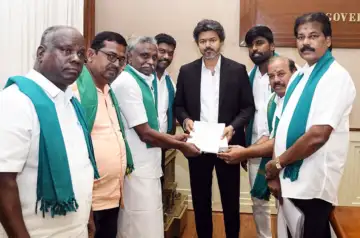
IMAGE: Vijay with State Cauvery Farmers Association General Secretary P R Pandian and other members during their meeting in Chennai. Photograph: @TNDIPRNEWS X/ANI Photo
One of the things to do is to seize the moment to make Tamil Nadu India's manufacturing export hub. The state already has industrial corridors such as the Tamil Nadu Defence Industrial Corridor, the Chennai-Bengaluru Industrial Corridor, and the Chennai-Kanyakumari Industrial Corridor.
Besides, Apple's supply chain deepening in Chennai, Samsung's expanded presence, and a growing semiconductor ecosystem can further that dream.
Vijay's white paper on finances is an opportunity, not merely a political manoeuvre. The people of Tamil Nadu deserve to know how such a large debt accumulated over the past few decades, who is responsible for it, and, more importantly, what can be done to stop the damage and repair it.
He should use it to propose a genuine fiscal consolidation roadmap that reduces the revenue deficit, rationalises subsidies, and establishes a Tamil Nadu Fiscal Responsibility framework with credible targets.
He has to ensure that the state's ratio of own-tax revenue to GSDP increases.
Property tax reform in urban areas, rationalising stamp duties, and cracking down on the shadow economy in the sand and gravel sector could significantly broaden the revenue base.
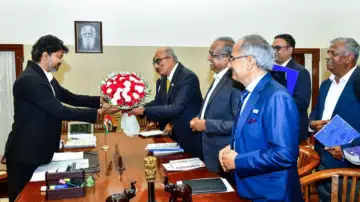
IMAGE: Tamil Nadu Chief Minister Vijay meets Chairman of CII's southern region P Ravichandran and other executives in Chennai, May 15, 2026. Photograph: @CMOTamilnadu X/ANI Video Grab
Vijay has consistently positioned himself as an opponent of the BJP's centralising tendencies, yet governance requires pragmatism. He badly needs central funds and must engage constructively and diplomatically to secure them.
Tamil Nadu enjoys a high literacy rate and has a large pool of engineering graduates, yet it faces persistent mismatches between skills and employment. If genuinely implemented, Vijay's promise of an AI university could be transformative.
But even more impactful would be upgrading the state's 36 government engineering colleges, polytechnics, and ITIs to produce graduates who are actually employable by the industries seeking to set up shop in the state.
The Cauvery dispute will never fully go away, but Tamil Nadu faces a deeper challenge: groundwater depletion, erratic monsoons, and a coastal urban belt comprising Chennai, Pondicherry, and Coimbatore, which is increasingly vulnerable to climate-related stress. No Chief Minister other than Jayalalithaa has treated water as the existential issue it is for the state. Vijay must seize this opportunity and get his machinery to harvest every raindrop as it falls.
Perhaps the most valuable thing Vijay can do is demonstrate that his government does not engage in theft. Tamil Nadu's road tender system, sand-mining regulations, liquor distribution, and education admissions are all riddled with corruption, which directly inflates costs and undermines the quality of governance.
If TVK MLAs and ministers are perceived as clean, or demonstrably cleaner than their predecessors, the credibility dividend will be enormous. The voter will feel rewarded.
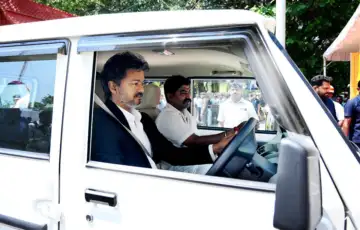
IMAGE: Vijay drives a new vehicle after flagging off 40 new vehicles for use by the directorate of medical and rural health services at the secretariat in Chennai. Photograph: @TNDIPRNEWS X/ANI Photo
Vijay could select three or four signature governance reforms and drive them relentlessly. Tamil Nadu's sand-mining mafia has looted rivers for decades. A serious crackdown, with visible arrests and prosecutions, would signal that the rules have changed. Transparent tendering for public works, published online in real time, would be another powerful signal.
He must engage with the domestic and foreign private sectors. Global manufacturing companies are eyeing Tamil Nadu. They need land, power, logistics, and a responsive government. It would be foolish to let this opportunity slip away.
He must manage the Centre. The next Finance Commission award, the GST devolution formula, and the pending Central approvals for the Chennai Metro and the water projects require a working relationship with New Delhi.
The state he inherits is remarkable: Ambitious, industrious, educated, culturally proud. It produces some of India's best engineers, its most disciplined factory workers, and its most cosmopolitan entrepreneurs. It contributes roughly 9% of India's GDP from just 4% of its land. Its potential, genuinely unleashed, could make it one of Asia's great economic success stories.
But it also carries a debt it did not fully consent to, a fiscal structure that rewards populism over productivity, and a political culture that has conditioned voters to expect more from their leaders than those leaders can honestly deliver.
The people of Tamil Nadu were so desperate for change that they handed the reins to a man who had never stood for election before.
The Thalapathy who now sits in Fort St George must prove he can write a new script, one in which Tamil Nadu can step into a different future.
Ramesh Menon has written seven books and is an award-winning journalist and documentary filmmaker. He is the author of Modi Demystified: The Making of a Prime Minister.
Photographs curated by Manisha Kotian/Rediff
Feature Presentation: Aslam Hunani/Rediff