
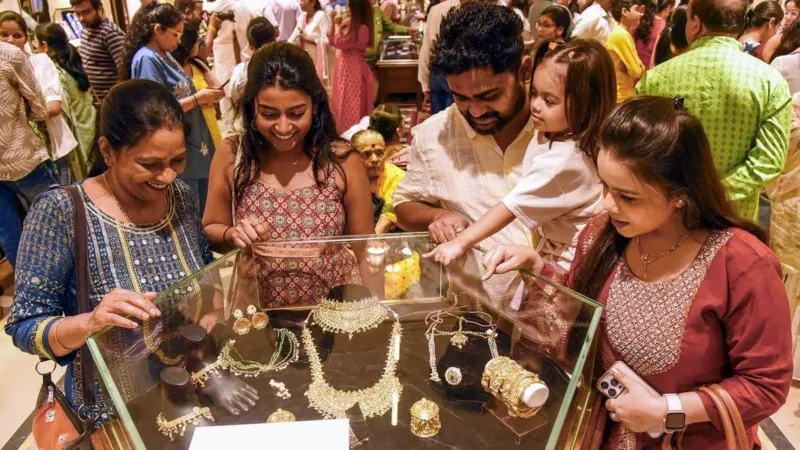

'What exactly is on the prime minister's mind, we do not know. But it feels like the government wants the country to be prepared for unseen challenges ahead.'
Kindly note that this image has only been posted for representational purposes.Photograph: ANI Photo
Key Points
- Prime Minister Modi urges Indians not to buy gold for a year to safeguard foreign exchange reserves.
- India's high gold imports, exceeding $72 billion, put pressure on dollar reserves amid global economic uncertainty.
- Jewellers express mixed reactions, acknowledging the economic rationale but noting the strong cultural attachment to gold.
- The jewellery industry warns of potential economic consequences, suggesting the monetisation of household gold as a solution.
Prime Minister Narendra Modi on Sunday urged Indians not to buy gold for a year to protect the country's foreign exchange reserves amid global economic uncertainty due to the US-Israel-Iran war and closing of the Strait of Hormuz.
Addressing a Bharatiya Janata Party rally in Hyderabad, Modi told citizens to avoid buying or gifting gold jewellery for one year -- even during weddings and festivals -- arguing that the country must prioritise economic stability over luxury spending.
This appeal was among seven Modi issued on Sunday -- which included paring down fuel consumption, putting off foreign travel, working for home, etc.
The statement has generated mixed reactions among jewellers and people who buy gold as they consider gold as a financial security net in their old age.
The Impact of Gold Imports on India's Economy
India remains one of the world's largest consumers of gold, importing more than 90 per cent of its requirement.
The country consumes around 700 to 800 tonnes annually while domestic production remains negligible at just 1 to 2 tonnes.
According to government estimates, India's gold imports surged to a record $72 billion in FY 2025-2026, marking a sharp rise from $58 billion in the previous financial year.
Many jewellers that this corrspondent spoke to agree with the prime minister's statement.
"What Modi is saying is economically correct. When we import gold, we pay in dollars and valuable foreign exchange leaves the country. At a time of war and global uncertainty, every nation must preserve its dollar reserves," says Anil Agarwal, who owns a jewellery store in Matunga, north central Mumbai.
While the appeal makes economic sense, Agarwal says changing public behaviour would be difficult.
"Emotions and traditions attached to gold are very strong," explains the jeweller. "Indians do not stop buying gold easily."
Balancing Gold Demand with Essential Imports Like Petrol
Experts say rising crude oil prices also place an enormous pressure on India's import bill.
Another jeweller based at Zaveri Bazar, which is known as the gold hub of Mumbai, said the government's concern is understandable.
"We need petrol more than gold right now. Oil reserves and dollar reserves are both under pressure. The prime minister's statement is essentially a cautionary note to prepare the country for uncertain times."
A report on MoneyControl.com quoting Reserve Bank of India data stated that India's forex reserves stood at around $690.7 billion for the week ended May 1, 2026.
While the reserves remain among the largest globally, they declined by nearly $7.8 billion during the week, 'reflecting pressure from global market movements and possible intervention by the central bank to stabilise the rupee'.
The reserves currently provide import cover for more than 10 months, which economists consider to be a relatively comfortable buffer.
However, policymakers remain cautious because prolonged high oil prices can rapidly increase dollar outflows from the economy, especially since the Iran war continues to keep economies on the edge.
The suddenness of the appeal by Modi has also sparked speculation among citizens.
"The urgency sounded like one of those emergency mobile alerts on May 3 that everyone got on their phones from the government as a real time warning system," says Ravi Jain, another jeweller from Zaveri Bazar,
"What exactly is on the prime minister's mind, we do not know. But it feels like the government wants the country to be prepared for unseen challenges ahead," adds Jain.
Tradition Versus Economic Needs: The Role of Gold in Indian Weddings
Despite the appeal, jewellers believe demand may slow temporarily but will not disappear -- particularly during the wedding season.
"There may be some immediate impact," says jeweller Anil Agarwal. "But families with weddings at home cannot avoid buying gold. It is part of our social fabric."
Gold prices have continued to rise sharply over the years, yet demand has remained resilient.
"People bought gold when it was ₹75,000 per 10 grams, and they are still buying even after prices crossed ₹1.5 lakh," points out Agarwal. "For Indians, gold remains the safest investment."
"Earlier people focused mainly on jewellery," explains bullion dealer Ankit Shah. "Now many are purchasing gold coins as investments and holding them long-term. Coin sales have risen significantly over the last three years."
Jewellery Industry's Concerns and Potential Solutions
The jewellery industry is watching the developments closely.
"What the prime minister said about gold is right in the national interest," says Chairman of the All India Gem and Jewellery Domestic Council Rajesh Rokde, "But gold is deeply embedded in the Indian culture."
Rokde suggests the prime minister may have been referring specifically to investment-driven buying rather than cultural purchases.
"More than one crore (10 million) people depend on this industry for employment. A sudden fall in demand can impact livelihoods," cautions Rokde.
Rokde also revived discussion around the government's Gold Monetisation Scheme, under which dormant household gold could be brought into the formal economy.
"Indians are estimated to hold between 40,000 and 50,000 tonnes of gold privately. If even 10 to 20 per cent of that is monetised, India may not need to import gold for the next decade," he says.
India's Ongoing Efforts to Reduce Gold Dependence
India's attempts to reduce dependence on imported gold are not new.
The government launched the Sovereign Gold Bond scheme in 2015 with ambitious expectations.
However, the response remained muted. Against a target collection of ₹25,000 crore, only ₹4,769 crore was mobilised during the first 20 months of the scheme.
Jewellers say the deeper challenge lies in India's emotional relationship with gold itself.
"For millions of households, gold is not merely an ornament or luxury purchase," says bullion dealer Ankit Shah. "It is seen as security during crisis, a family asset passed across generations, and a trusted hedge against inflation."
That sentiment, jewellers believe, may ultimately determine whether Modi's appeal becomes a short-term pause -- or simply another warning that Indians acknowledge but choose not to follow.