





The US' renewed reliance on Pakistan as a mediator in the Iran crisis reflects both strategic necessity and enduring Cold War habits, observes Rup Narayan Das.
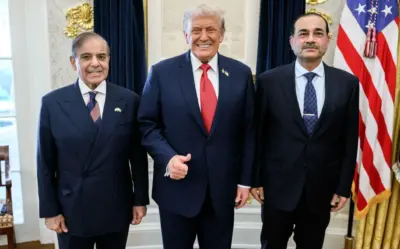
IMAGE: Pakistan Prime Minister Shehbaz Sharif and Field Marshal Asim Munir with US President Donald Trump at the White House last year. Photograph: White House
Key Points
- The US has historically mentored Pakistan in West Asian diplomacy, despite Iran's distrust of Pakistan's intent due to its strategic entente with the USA.
- The US-Pakistan strategic ties date back to the Cold War, with Washington aiming to contain Communism and later to balance power in South Asia.
- India maintained a non-aligned stance until the 1962 war, after which the US provided limited military aid, carefully avoiding actions that could be used against Pakistan.
- The US policy in the subcontinent has consistently sought to establish political and military parity for Pakistan with India, despite India's significantly larger size and resources.
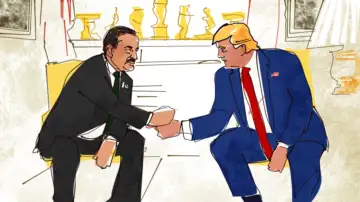
Illustration: Dominic Xavier/Rediff
The US attempts to mentor Pakistan in the West Asian crisis after the joint US-Israel attack on Iran is intriguing.
Repeated initiatives of the Pakistani military junta to convene meetings between the USA and Iran on Pakistani soil and the US support for such efforts in spite of failures conceal more than they reveal.
Although there had been historic animosity between Iran and the US, it reached alarming proportions when President Trump unleashed the blitzkrieg in February, which brought in its trail human misery and suffering the world over including in India, besides death and devastations in Iran and in the Persian Gulf.
Caught in the whirlpool and domestic criticism, Trump wants to wriggle out of the mess and tries to make virtue out of necessity by mentoring Pakistan in brokering a truce.
Given the strategic entente between Pakistan and USA, Iran doesn't fully trust Pakistan's intent.
Undeterred by diplomatic glitches, Trump continues his attempts to engage Pakistani cohort and has volunteered to go to Pakistan to clinch a deal.
Earlier, Trump claimed that he brokered the peace between India and Pakistan during the Pahalgam attack in May last year.
India did not take cognisance of Trump's claims and asserted that the truce was achieved bilaterally between the two countries without any third party intervention.
US-Pakistan Strategic Alignment
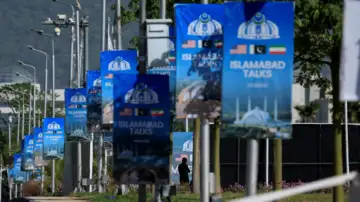
IMAGE: A man stands next to posters reading 'Islamabad Talks' in Islamabad, April 22, 2026. Photograph: Akhtar Soomro/Reuters
Trump hosted then General Munir at a private lunch at the White House in June last year.
Later on, the USA invited both Munir and Pakistan Prime Minister Shehbaz Sharif in September last year to discuss plans for US investment in Pakistan's critical mineral sector.
The US and Pakistan signed a memorandum worth $500 million in Islamabad. Washington clearly has a sinister design to belittle India diplomatically and retard the trajectory of India's growth and development.
The strategic ties between the USA and Pakistan goes back to the Cold War precisely after the birth of Communist China in 1949.
In the civil war between the Chinese Communist party and the nationalist KMT led by Chiang Kai-shek which was supported by the USA, the KMT was defeated and its leader Chiang Kai-shek fled to Taiwan and proclaimed the Republic of China in Taiwan. The USA continued to recognise Taiwan in the United Nations till 1971.
Cold War Dynamics and India's Non-Alignment
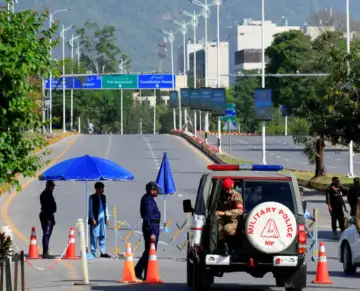
IMAGE: A check point on a road leading to the Serena Hotel as Pakistan prepared to host the US and Iran for the second phase of peace talks in Islamabad, April 22, 2026. Photograph: Akhtar Soomro/Reuters
When the Korean War broke out in the Korean peninsula, then US secretary of State John Foster Dulles pursued the policy containment of Communism.
The Communist bloc including the USSR and China were pitted against the USA. The US had no diplomatic relations with China.
In September 1950, when US forces crossed the 38th Parallel in Korea, then Chinese premier Zhou Enlai invited K M Panikkar, then Indian mbassador to China, to his residence and told him categorically that the Chinese would not remain passive while its neighbours were invaded and asked Panikkar to convey the message to the American side.
Panikkar passed on the message to the US interlocutors. Then US President Harry S Truman, however, did not take the Chinese premier's message seriously believing that Panikkar played the game of the Chinese Communists fairly regularly.
In December 1950 after the Chinese routed UN forces in North Korea, a State Department policy review of South Asia made it clear that Washington's main concern about India was that the country not to be 'lost' the way China was.
'With China under Communist domination', Soviet powers now encroach along the perimeter of the Indian sub-continent. India has become the pivotal state in non-Communist Asia by virtue of its relative power, stability and influence.'
Thus, it is clear that much before President Barak Obama unveiled his Asian Rebalancing policy in 2010, the USA had recognised India's Pivot to Asia policy.
Prime Jawaharlal Minister Nehru, however, until Chinese invasion in 1962, didn't acquiesce the USA.
Shifting Alliances and Regional Impact
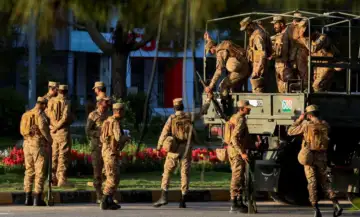
IMAGE: Pakistani soldiers disembark from a truck as they arrive at D Chowk near the President's House in Islamabad. Photograph: Akhtar Soomro/Reuters
When the USA overtures were spurned by India, the USA turned towards Pakistan which obliged the USA in joining anti-Communist outfits like the South East Treaty Organisation (SEATO) and Central Treaty Organisation (CENTO). These pacts were extension of NATO in the Asian theatre.
In order to pave the way for alignment with Pakistan, the USA pressurised Turkey to form an alliance with Pakistan.
Turkey was reluctant for after all what did Pakistan had to do with Turkey's defence and vice-versa?
Under Washington's pressure, Turkey signed the Pact of Mutual Cooperation with Pakistan in February 1954.
This was followed by the establishment of the ragtag Southeast Asia Collective Defence Treaty in September 1954, subsequently known as SEATO, comprising the USA, Australia, France, Great Britain, New Zealand, Pakistan, the Philippines and Thailand.
The sole objective of the motley grouping was to roll back the 'tidal mud' of Communism in which Pakistan was the conduit.
India steadfastly maintained its non-aligned stance until the 1962 War when Nehru approached US President John F Kennedy to supply arms and fighter aircraft.
In a measured way, the USA supplied some vintage weapons, but not the fighter aircraft lest they were used against Pakistan.
The next turning point in the triangular relationship came during the Bangladesh crisis in 1971, when the US despatched the aircraft carrier USS Enterprise to the Bay of Bengal to deter India.
It was the Indo-Soviet Treaty of Peace Friendship signed in August 1971 that prevented further movement of the Seventh Fleet.
- ALSO READ: How the Soviet Union Helped India Win the 1971 War
Contemporary Geopolitics and India's Nuanced Approach
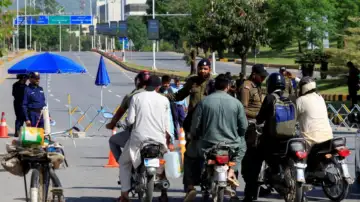
IMAGE: A Pakistani police officer divert bikers from a road leading to the Serena hotel, as Pakistan prepared to host the US and Iran for the second phase of peace talks in Islamabad. Photograph: Akhtar Soomro/Reuters
Interestingly when the Bangladesh troubles began, the USA reached out to China with Pakistan's help .
The then US secretary of state Henry Kissinger surreptitiously visited Beijing from Pakistan to normalise America's relationship with China ahead of then US president Richard M Nixon's visit to Beijing to sign the historic Shanghai Communique to normalise the relationship with China making Taiwan as the sacrificial goat.
This was the time which witnessed the strategic convergence among the USA, China and Pakistan much to India's chagrin.
Now when China challenges the US, Washington attempts to co-opt India in the Indo-Pacific architecture to checkmate China.
India, however, adopts a nuanced response to the Indo-Pacific architecture, which is now couched in Prime Minister Modi's emphasis on Security and Growth for All in the Region (SAGAR) with focus on the Indian Ocean.
Prime Minister Modi articulated India's nuanced approach to Indo-Pacific in his Shangri-La address in 2018 with China in mind. Be that as it may, the USA continues to mentor Pakistan in South-Asia.
The US policy in the sub-continent has been to acquire a position of political and military parity of Pakistan with India, which is four times larger in size, population and resources.
Rup Narayan Das, a former senior fellow at the Manohar Parrikar Institute for Defence Studies and Analyses, is currently Consulting Editor, Journal of Parliamentary Information. The views expressed are personal.
Feature Presentation: Rajesh Alva/Rediff