





Some decades are worth remembering exactly as they were, unfiltered, because that's the only way the people who survived them get to be seen at all, points out Binu Alex.
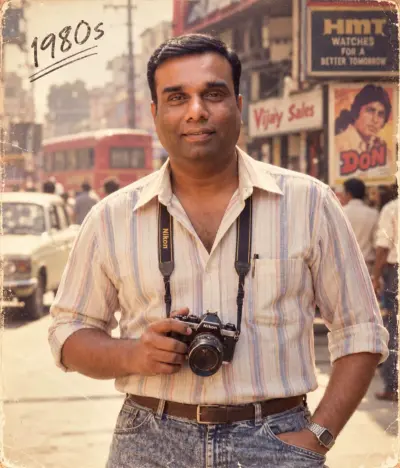
IMAGE: Rediff's Hemantkumar Shivsharan goes into 1980s mode.
Key Points
- AI-fuelled nostalgia is recreating an idealised 1980s that many Indians remember very differently.
- For poorer families, the decade meant cramped homes, limited clothing, shortages and persistent financial constraints.
- Milk, cooking oil, telephones, gas connections and scooters were governed by scarcity, restrictions and lengthy waiting periods.
- Technology and consumer choices were limited, with colour televisions, VCRs and other conveniences available only to wealthier households.
Everyone is suddenly back in the 1980s.
Instagram, TikTok, X -- all flooded with soft lighting, big hair, and that warm mall-studio glow. Even people who have the real photographs are choosing to recreate fake ones with AI.
I did not enjoy the 80s the first time. I am in no hurry to enjoy them again.
I was just entering my teens then. Life at that point was less a montage and more a long walk uphill, carrying something heavy.
I suspect the people celebrating had a different version of the decade. Hollywood-style pictures. Real trips to American mall studios. Family albums with proper spines.
I had none of that.
What I had were the photographs other people clicked. Once a year, if that, we went to a studio ourselves. No bouffant. No retro fashion. No warm lighting. Just us, standing straight, trying not to blink.
I don't remember owning more than two sets of clothes meant for going out. We lived in one room with a kitchen attached -- not a 1BHK, just a room and a kitchen, side by side. There wasn't a wardrobe to speak of, and even if there had been, there was nothing to put in it.
That is also, incidentally, why we lived in a place that small. Money decides the square footage.
I still remember the milk. Glass bottle, aluminium foil for a lid, and a strict two-bottle limit per person. Groundnut oil worked the same way, until Dhara arrived from the Amul stable and changed things a little.
The newspapers back then loved explaining why. Supply shortages. Thin foreign exchange reserves. Import restrictions. Price controls to stop hoarding. Everything done by hand, and everything took forever.
None of this changed overnight in any particular year people like to argue about. It changed slowly, as economies tend to, once they're allowed to breathe. Nations move forward on their own, mostly despite their governments, not because of them.
The only car on the road, as far as I could tell, was the Ambassador. Maybe a Premier Padmini if the family was doing well. Anything imported meant someone important was sitting inside it.
Those are the people who should be celebrating the 80s. They're the ones who actually had one.
I'm not complaining about having nothing. Plenty of us had nothing. The stranger part is that even with a little money, there wasn't much to spend it on.
A tape recorder. Some cassettes. A VCR, if you were doing well. A colour television, if you were doing very well, and only after 1982. Movies that scratched every time you played them.
Technology has moved a great distance since then. And no, before anyone gets ideas, none of that progress needs crediting to any politician currently fashionable to praise.
Fewer vehicles then. Fewer roads too. But we also didn't feel this constant pull to be somewhere else, the way we do now. Give people more roads and somehow they find more reasons to be on them.
The 1980s Behind The Filter
I will not be recreating any of this for a filter. If I write about the 80s at all, it will be in my memoirs, in my own words, without a hairstyle involved. Which I do now.
For a lot of us who actually lived through that decade in India, it wasn't studio lighting and soundtrack nostalgia. It was systemic shortage, dressed up as daily life.
Most families I knew lived month to month. We were poor, and everyone around us was poor too, so it simply felt like the middle. We were, technically, the middle class.
We waited years for government housing once we'd applied. These days the government has mostly stepped out of that business altogether.
A gas connection took years. So did a telephone line. A scooter meant a long waitlist. Even a radio or a television needed a licence back then, which still makes me smile a little when I think about it.
Power cuts were routine, though we get plenty of those again now. Water shortages too.
I have never quite understood the impulse to romanticise a decade built on scarcity and worry. If you actually lived it, the shine doesn't come naturally. It has to be added afterward, like a filter.
Some decades are worth remembering exactly as they were, unfiltered, because that's the only way the people who survived them get to be seen at all.
Feature Presentation: Aslam Hunani/Rediff