




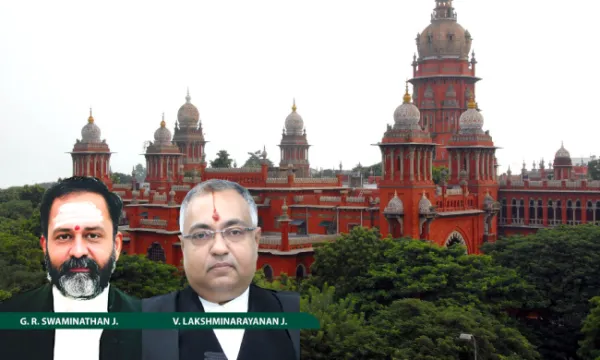

- There is no need to regard judges as holy cows!
- Madras High Court's important observation
Chennai (Tamil Nadu) - Corruption exists in the judiciary, and no one can turn away from this reality.
Therefore, there is no need to regard judges as holy cows, the Madras High Court observed. The Madras High Court dismissed a petition seeking a ban on the Tamil film Karuppu, which comments on corruption in the lower Courts. The decision was delivered by a bench comprising Justice G. R. Swaminathan and Justice V. Lakshminarayanan.
Advocate R. S. Tamilvendan had filed the petition. It was claimed in the petition that the image of the Court had been tarnished in a highly improper manner in the film, and that it amounted to contempt of the entire judiciary.
The points made by the Court during the hearing
Corrupt judges existed in the past and still exist today!
It cannot be denied that corruption exists in the judiciary. There were corrupt judges in the past, and there are corrupt judges even today. This does not mean that judges cannot be criticized. Justice is not something that can remain confined within closed rooms. Frank criticism made by common people within reasonable limits should, in fact, be welcomed.
Tamil cinemas do have melodrama!
Justice Swaminathan clarified that he had personally watched the film. The portrayal of the judiciary in the film is certainly exaggerated; however, such melodrama is common in Tamil cinema. It is true that the incidents shown in the film are exaggerated, but this is the usual style of Tamil films. On screen, a hero single-handedly defeats several goons.
Artists' freedom of expression must be respected
Artists have every right to present their stories in their own way, and this freedom must be accorded the highest respect. The background of the film is based on a fictional Court called 'Seven Wells Court'. The director has not portrayed the entire judiciary as corrupt. Just as 'Malgudi' in R.K. Narayan's stories is a fictional village, 'Seven Wells Court' too is fictional. Portraying a person in such a fictional Court as corrupt cannot invite penal action under the Contempt of Courts Act, 1971.