
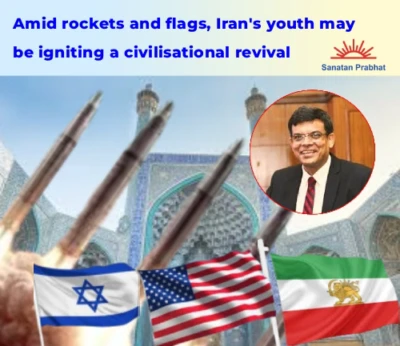

Sectarian Smokescreen : Propaganda Through Missile and Drone Strikes
The hard line clerical establishment in Iran knows the real danger to its survival is not Saudi Arabia or the UAE but the rationalist renaissance inside Iran.
Apostasy, secularisation and the rediscovery of the ancient Zoroastrian and Yazdanist traditions seem to be gaining moral and spiritual superiority amongst the masses, creating an existential threat to the current theological social structure which is now increasingly seen as intolerant, aggressive and incompatible with modern principles of freedom and equality.
To conceal this, the hard line clerical establishment deploys deliberate propaganda. It casts the uprising as a sectarian war - Shia against Sunni - and punctuates that narrative with missile and drone strikes on Abu Dhabi, Dubai and Saudi oil facilities. These attacks are not mere military operations. They are theatre, staged to divert global attention from the ex-Muslim movement within Iran and to persuade the world that the conflict is about regional rivalry rather than an impending civilisational awakening in their own backyard.
Analysts have noted this tactic. The hard line clerical establishment insists unrest is foreign engineered or sectarian while renaissance activists on the ground - many of them ex-Muslims - frame it as a nationwide uprising rooted in long standing grievances, from the denial of free speech to the suppression of religious choice and rational spiritual ways of life. The truth is clear in the surveys. Seventy to eighty per cent of Iranians oppose the Islamic Republic, mosques stand empty and the youth embrace secular or pre-Islamic identities (GAMAAN - An independent, non-profit research foundation).
Iran's external aggression is therefore not strength but fear. The missile and drone attacks are propaganda - a smokescreen to hide that the true revolution is being driven by ordinary citizens, rationalist in spirit and unstoppable in momentum.
 Mayank Jain
The Rationalist Renaissance in Iran
We must look at Iran not only through geopolitics - not simply as USA versus Iran, Israel versus Hezbollah, Saudi versus Shia - but through a deep understanding of its ideology. What is unfolding is a civilisational correction : A society rediscovering reason against dogma. It is a rare moment in history when a course correction moves towards a more fulfilling rationalist future, sometimes embedded in spiritual bliss and a broader respect for humanity.
Independent surveys confirm this shift. In 2020, GAMAAN polled more than 50,000 Iranians : Only 32% identified as Shia Muslim while nearly half described themselves as non-religious or atheist (GAMAAN 2020; The Guardian, 2023). By 2025, another GAMAAN survey of 77,000 respondents found that only 20% supported the Islamic Republic while 70-80% opposed the theocratic system, favouring secular Democracy or regime change. Other reports put dissatisfaction even higher - 92% of Iranians are unhappy with how the country is governed (Iran News Update, 2024). Even officials admit the collapse of faith, with tens of thousands of mosques standing empty (Iran Wire, 2025; Al Jazeera, 2026). Leaving Islam in Iran carries severe penalties, yet thousands continue to risk it. Apostasy here is not merely rejection of dogma. It is the rediscovery of reason.
Echoes of Martyrs of Reason
Protesters in Iran face beatings, detentions and executions under charges of 'enmity against Allah' (Amnesty International; HRANA, 2025-26). Yet they embody something timeless : The human desire for truth.
History reminds us of this lineage. Aleksandr Solzhenitsyn exposed the Soviet labour camp system in The Gulag Archipelago (1973-75), piercing the lies of totalitarianism (Britannica). Galileo Galilei defended heliocentrism against the Roman Inquisition in 1633, enduring trial and lifelong house arrest for science (History.com). Giordano Bruno proclaimed an infinite universe filled with countless worlds and was burned at the stake in Rome in 1600 for refusing to recant (Britannica). Socrates, accused of impiety and corrupting the youth, chose to drink hemlock in 399 BC rather than betray philosophy (Britannica).
Iran's protesters stand in this tradition. Their courage is not for bread alone but for the freedom to think, to question and to live by conscience and reason.
Stories of Suffering and Defiance
In Tehran's Labbafi Nejad Hospital, January 2026, a young doctor pleaded to save a protester's eye. Security forces ordered it removed. The patient - a 22 year old student shot with pellets while chanting for freedom - screamed in agony. His family was later compelled to falsify his death certificate as a 'Basij loyalist' just to reclaim his body (PBS Frontline, Jan 2026; HRANA, Feb 2026).
On New Year's Eve 2025 in Kuhdasht, Hessam Khodayarifard, a 28 year old father of two, shielded an elderly woman with his body. A bullet tore through his chest. His sacrifice turned terror into courage, inspiring dozens to press forward (Amnesty International, 2026; Iran International, Jan 2026).
At Yazd's ancient fire temple, a former IRGC soldier lit incense before the eternal flame. Once an enforcer of orthodoxy, he now whispered Avestan prayers rediscovered online. Around him, hundreds of ex- Islamists stood in quiet pilgrimage, reconnecting with pre-Islamic values of truth and responsibility (BBC Persian, Mar 2026; Catholic World Report, Feb 2026).
Each story is a spark. Alone they are fragments of pain; together they form a fire that no decree can extinguish.
A Civilisational Turning Point
This is not merely a revolt against a Government. It is a contest over civilisational identity. Beneath the confrontation lies a society reassessing faith, authority and historical memory after decades of enforced uniformity.
The rediscovery of Zoroastrian ethics, Yazdanist traditions and pre-Islamic Persian history is not nostalgia. It is civilisational memory returning, the soul of a people stirring after long suppression. As Ram Swarup foresaw, traditions silenced by dogma do not vanish; they lie latent, awaiting the hour of awakening. And as Sri Aurobindo wrote of Nations, there are moments when history itself bends - when societies turn from bondage towards a higher destiny. Iran may now be entering such a moment : A course correction towards a more fulfilling rationalist future, suffused with spiritual depth and a broader respect for humanity.
Ideologies and Their Victims
Indian historian Sitaram Goel warned that militant ideologies eventually devour the very societies they claim to defend by giving no space for free spirit and thinking. Iran illustrates this phenomenon. A regime that held monopoly over Divine truth and forbade deviation from its belief system did so by silencing dissent, suffocating intellect and denying freedom. The consequence is a generation detached from its foundations, estranged from the very faith the rulers sought to enforce.
It had become so obvious that even clerics were compelled to admit the collapse. Senior cleric Mohammad Abolghassem Doulabi noted that around 50,000 of Iran's 75,000 mosques had closed due to lack of worshippers (Iran International, 2025). The edifice of enforced belief is crumbling from within.
Those who endured suffocation may now become the architects of renewal. What was once proclaimed as Divine guardianship is revealed as fear, and what was once enforced as orthodoxy is yielding to the deeper currents of civilisational memory.
Who Are the Real Revolutionaries ?
The Islamic Revolutionary Guard Corps calls itself the guardian of revolution. In truth it has become the shame of the word. What is revolutionary about choking free speech with brute power, about silencing dissent with prisons and bullets ? Revolutions are not defined by battalions or decrees but by conscience.
The real revolutionaries are the unarmed citizens - women unveiling in public squares, students chanting in darkened streets, doctors refusing to falsify death certificates, shopkeepers striking in solidarity. These ordinary citizens embody the revolutionary impulse far more than any armed institution. They suffer persecution, yet their defiance carries the true spirit of change.
The International Ex-Muslim Movement
Iran's revolt is watched closely by the international ex -Muslim movement. The Council of ex-Muslims of Britain reports thousands of members across Europe. In France, estimates suggest over 15,000 ex-Muslims (CEMB, 2025). In the United States, Pew Research estimates around 100,000 Muslims renounce Islam annually (Pew, 2024). In India figures run into millions (Pew, 2025).
If Iran reclaims its civilisational identity, the ripple could spread at the speed of a nuclear chain reaction. Large swathes of Europe, North America and Africa could see intensified questioning of dogma while currents are already visible in Indonesia and Malaysia where underground rationalist networks quietly expand.
Bottom Up Versus Top Down Change
In our lifetime we have witnessed three ruptures :
- The collapse of the Soviet Union where ideology imploded under its own contradictions.
- The modernisation policies in Saudi Arabia and the UAE loosening restrictions through palace decrees.
- And now Iran - where change rises from the streets not the palace.
This distinction matters. Saudi and UAE reforms were top down. Iran's revolution is bottom up - conscience not decree. In late 2025, Iran's youth thronged the streets in defiance of dogma : Rejecting compulsory scarves and burkhas, breaking bans on music and dance and openly opposing straitjacketed ideologies.
Many were ex-Muslims and their defiance provoked fury in the Islamist clergy. The regime responded with brute force, determined to crush what had become an ex-Muslim revolution.
By January 2026, over 600 protesters had been killed and more than 20,000 injured in this crackdown, with security forces using live ammunition, shotguns loaded with metal pellets, tear gas and beatings against largely peaceful demonstrators (Amnesty International, 2026; HRANA, 2026; Iran Human Rights, 2026).
This is the heart of the conflict : Iranian Islamists versus ex-Muslims. And it is vital for the wider Islamic world to understand this because the data everywhere shows the stirrings of the same questioning. What is unfolding in Iran is not an isolated protest but part of a civilisational shift - a confrontation between dogma and freedom, between enforced orthodoxy and the irrepressible human spirit.
Oil Hegemony and the West's Dilemma
The United States has long viewed Iran through oil, hegemony and dollar politics. Yet what unfolds is civilisational revival. The modern Western state has sought to confront its own historical injustices - the dispossession of Native Americans, the suppression of Aborigines, the marginalisation of African tribes, the struggles of Maori, and the long shadow of slavery over Black communities - through human rights frameworks, democratic institutions and reconciliation efforts.
But woke elements within the West now rake up these wounds in unreasonable ways, less to heal than to provoke anarchy and chaos. If civilisational revival is embraced universally, it would demand not only that Iran confront its dogma but also that the West engage its buried fires with sobriety, acknowledging its past without weaponising it for present disorder.
The Circle of History
More than a thousand years ago, after relentless persecution under the early Islamic rulers of Persia, Zoroastrians carried their sacred fire from Iran to India (Qissa i Sanjan Chronicle). In exile the Parsis became one of India's smallest yet most influential communities - builders of steel mills, airlines, hospitals, schools and scientific institutions. Families such as the Tatas, Godrejs, Wadias, Petits, Shapoorji Pallonjis, Readymoneys and Jejeebhoys nurtured the fire of conscience in Bombay and Gujarat.
One can imagine a day when Parsi descendants from Mumbai or Navsari travel again to Yazd and Shiraz to honour their ancestors and to connect with the sufferings they endured, visiting those places for their own completion. In that moment the circle of history will close. The fire that left Persia to survive in India will return to Persia to illuminate a civilisation rediscovering itself.
A Civilisational Renaissance
Iran's uprising may represent the early stages of a civilisational renaissance. The rational spirit and scientific temperament - the same forces that dismantled twentieth century ideological systems - may now be stirring again within the Persian world.
History may yet record that Iran's deepest transformation was led not by generals or clerics but by ordinary citizens reclaiming the freedom to think, to sing and to choose. When a civilisation remembers itself, even the most rigid ideology begins to tremble.
(Courtesy : Article by Mayank Jain posted on hindupost.in; 6.3.2026)
(Mayank Jain is a TV journalist and filmmaker. Some of the famous films directed by him are : 'The Evidence-Meat Kills', 'The Bangla Crescent-ISI, Madrasas & Infiltration', 'Death Warrant'.)
| There are moments when history itself bends - when societies turn from bondage towards a higher destiny ! : Sri Aurobindo |