




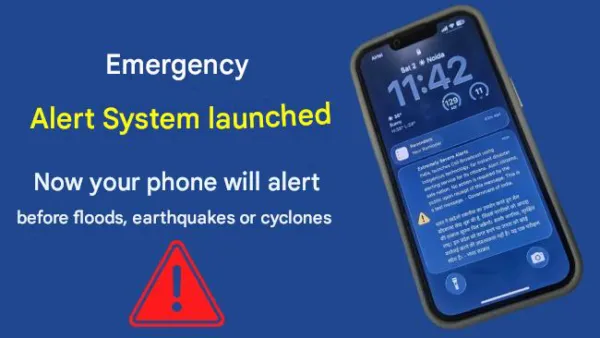

Indigenous 'Sachet' system used for emergency warning alerts
New Delhi - On 2 May 2026 at 11:45 a.m., an alert siren was simultaneously sounded on crores of mobile phones across India as part of a nationwide test.
The alert message was displayed in Hindi, English and 17 regional languages. After the siren, a voice message informed users that it was only a test and no action was required.
Two days prior to the test, the Union Government had sent SMS notifications advising citizens not to panic upon receiving the alert. The exercise was conducted as part of India's Cell Broadcast System, an emergency communication technology designed to deliver real-time alerts during disasters. India is among the countries that have implemented such systems for instant public warning.
1. Who sounded the siren ?
The alert was issued as part of a test coordinated by the National Disaster Management Authority (NDMA) in collaboration with telecom service providers.
2. People can be alerted at specific locations
The system is based on Cell Broadcast Technology, which enables authorities to send warning messages to all active mobile devices within a specific geographic area simultaneously. This allows the Government to issue real-time, region-specific alerts during emergencies.
Government warned people not to panic
The Government had already informed citizens through SMS that the alert was part of a test and there was no need to be alarmed.
'Sachet' system being developed and expanded
The Centre for Development of Telematics (C-DOT) has developed an integrated alert system known as 'Sachet', designed to provide real-time emergency alerts. It is based on the Common Alerting Protocol (CAP), an internationally recognised standard used by over 150 countries.
Countries such as the United States, Canada, Germany, Italy, Australia, Sri Lanka, Taiwan and the Philippines have used similar systems to issue warnings during natural disasters like tsunamis, floods and cyclones.