

Telescope reveals secrets of ancient 'Population III' stars dating back billions of years !
New York (USA) - The NASA has announced that its flagship telescope, the James Webb Space Telescope, may have detected some of the oldest stars in the universe.
Based on independent confirmations from multiple research groups, scientists believe this discovery could help unlock long-standing mysteries about the formation of the Earth and the early universe. This information was reported by noted science writer Marko Milanesi on the internationally recognized platform Space Daily.
Understanding the mystery of 'Population III' stars; the first stars of the universe:
'Population III' stars are believed by astrophysicists to be the very first generation of stars formed in the universe.
For decades, standard cosmological theories have suggested that the earliest stars formed from clouds composed almost entirely of hydrogen and helium. Until now, this remained largely theoretical.
The origin of the universe is attributed to the Big Bang, during which hydrogen and helium were the only elements present. These early stars burned intensely and had very short lifespans; lasting only a few million years. Their explosive deaths helped seed the universe with heavier elements.
Observing these primordial stars directly has long been beyond scientific capability. However, with the help of the James Webb Space Telescope, this has now become possible. These stars are located billions of light-years away, meaning the light captured from them represents conditions from the very early universe.
How were these ancient stars detected ?
The new evidence emerged from observations of a small object near the galaxy known as GN-Z 11, one of the most distant confirmed galaxies ever observed.
Researchers identified faint emission lines from this object. Using the telescope's advanced spectrographic instrument, these signals were analysed and separated into two distinct components. The results showed the presence of only hydrogen and helium, with no trace of heavier elements.
The absence of heavier elements (often referred to as "metals" in astronomy) is a crucial indicator. Later generations of stars contain such elements formed from earlier stellar explosions. The lack of these elements strongly suggests that these are indeed first-generation, or 'Population III,' stars; potentially being observed directly for the first time.
This finding gains further credibility as it is supported by independent research groups. One team detected helium signals and analysed their components, while others independently identified hydrogen emission lines from the same region of space.
The convergence of findings from different analytical methods focusing on the same small region of the sky provides one of the clearest pieces of evidence yet that 'Population III' stars truly existed. This marks a historic milestone, as the telescope is effectively observing light emitted when the universe was only a few hundred million years old.
What is the James Webb Space Telescope ?
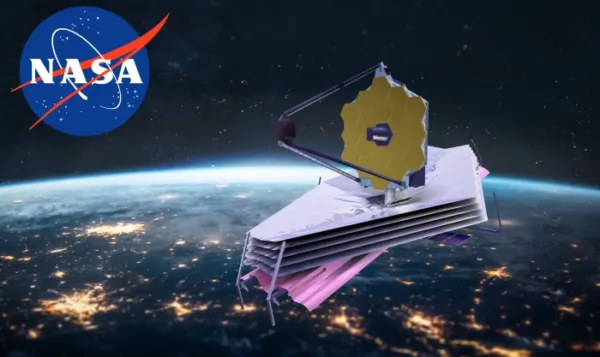
The James Webb Space Telescope (JWST) is an advanced space observatory developed by NASA. Positioned millions of kilometres away from Earth, it is designed to study the origins of the universe. The telescope was launched into space in 2021 and is currently exploring the earliest phases of cosmic history.