




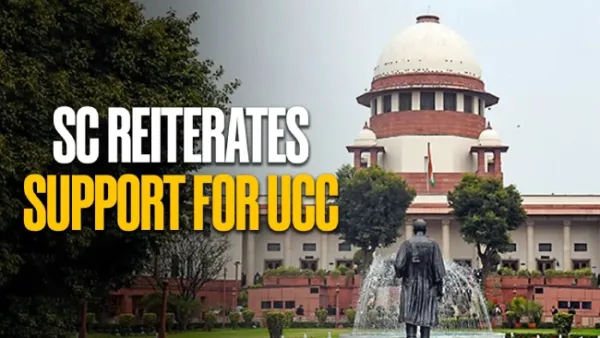

New Delhi - Directly invalidating personal laws could create a legal vacuum. Therefore, it may be more appropriate to leave the matter to the wisdom of the legislature so that Parliament can enact a separate law regarding a Uniform Civil Code, the Supreme Court observed during the hearing of a case.
If Muslim Personal Law is abolished, which law will apply ? - Court's question
In this case, the petitioners have challenged the Muslim Personal Law (Shariat) Act, 1937. It has been alleged that the law discriminates against Muslim women in matters such as inheritance rights. The Court stated that if this law is invalidated, an important question would arise as to which law would apply thereafter. It also asked whether such a move would create a legal vacuum.
The 1937 law could be declared unconstitutional : Advocate Prashant Bhushan
Appearing for the petitioners, advocate Prashant Bhushan stated that under Shariat law, women receive half the share in inheritance compared to men. To remove this discrimination, the 1937 law could be declared unconstitutional. If this law is invalidated, the Indian Succession Act would apply. Under this Act, men and women are given equal rights in matters of inheritance. He also argued that inheritance is a civil right and not a religious practice; therefore, it cannot claim protection under Article 25 of the Constitution.
The Court, however, adopted a cautious approach regarding immediate intervention. The Court observed that in excessive enthusiasm for reform, even the rights currently available to women could be lost. Therefore, a decision on this issue needs to be taken with careful consideration. The Court also advised the petitioners to amend their petition and suggest alternative remedies.