




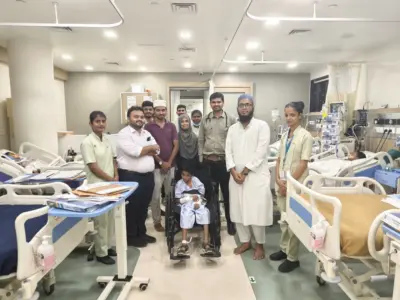

Child with Rare Epilepsy Syndrome Fully Recovers After Intensive Care at K J Somaiya Hospital & Research Centre
Life-threatening condition caused over 200 seizures in one day; doctors utilized a multi-step approach for stabilization
Mumbai : K J Somaiya Hospital and Research Centre, one of India’s leading multi-specialty and super-specialty hospitals, recently helped an 8-year-old boy survive a life-threatening condition known as Febrile Infection-Related Epilepsy Syndrome (FIRES). This rare neurological disorder has only about 200 reported cases worldwide, with an estimated incidence of 3.4–7.2 per 100,000 per year. .
The patient, Maaz Ansari, was admitted to the hospital with persistent seizures following what initially appeared to be a routine fever.
Life-threatening condition caused over 200 seizures in one day; doctors utilized a multi-step approach for stabilization
Mumbai : K J Somaiya Hospital and Research Centre, one of India’s leading multi-specialty and super-specialty hospitals, recently helped an 8-year-old boy survive a life-threatening condition known as Febrile Infection-Related Epilepsy Syndrome (FIRES). This rare neurological disorder has only about 200 reported cases worldwide, with an estimated incidence of 3.4–7.2 per 100,000 per year. .
The patient, Maaz Ansari, was admitted to the hospital with persistent seizures following what initially appeared to be a routine fever.
Recognizing the urgency, the medical team initiated intensive and specialized care. He was admitted to the Pediatric Intensive Care Unit (PICU), where he was treated with:
10 anti-epileptic medications
A medically induced coma
40 days of ventilator support
Nutritional support via a ketogenic diet
Diagnostic tests revealed elevated levels of IL-6, an inflammatory marker, in the cerebrospinal fluid (CSF), indicating severe inflammation. Appropriate anti-inflammatory treatments were administered both intravenously and intrathecally.
After nearly two months of intensive care—including prolonged respiratory support—Maaz’s condition stabilized sufficiently for discharge. He continues to be monitored through regular follow-up visits, and his condition remains stable.
Speaking about the case, Dr. Manisha Bobade, CEO of K J Somaiya Hospital & Research Centre, said:
> “In India, the number of rare diseases being reported is steadily increasing. These conditions pose significant challenges in both diagnosis and treatment. FIRES is one such rare disorder that requires highly specialized care. Our team demonstrated exceptional clinical expertise in identifying and managing this uncommon syndrome, enabling the child’s recovery. This case reflects our hospital’s commitment to providing advanced care for even the most complex medical cases.”
Providing medical insight, Dr. Irphan Ali, Paediatrician and Neonatologist at K J Somaiya Hospital & Research Centre, added:
> “FIRES is extremely rare and dangerous. Often triggered by what seems like a minor febrile illness—such as a cold or respiratory infection—it can lead to super-refractory status epilepticus, a form of seizure activity that resists standard treatments. Beyond the immediate challenges of diagnosis and therapy, long-term impacts on the patient can be significant. Given the high rates of morbidity and mortality, cases like Maaz’s are exceptionally challenging. We are proud of the medical and nursing teams who worked tirelessly to support his recovery.”
The team responsible for Maaz’s treatment included Dr. Irphan Ali (Chief Pediatric Intensivist), Dr. Ankit Pandey (Pediatric Neurologist), and pediatricians Dr. Deepika Shenoy, Dr. Santosh B., and Dr. Usman.
K J Somaiya Hospital & Research Centre continues to enhance its capabilities in managing rare and complex conditions while upholding a patient-centric approach to healthcare.