




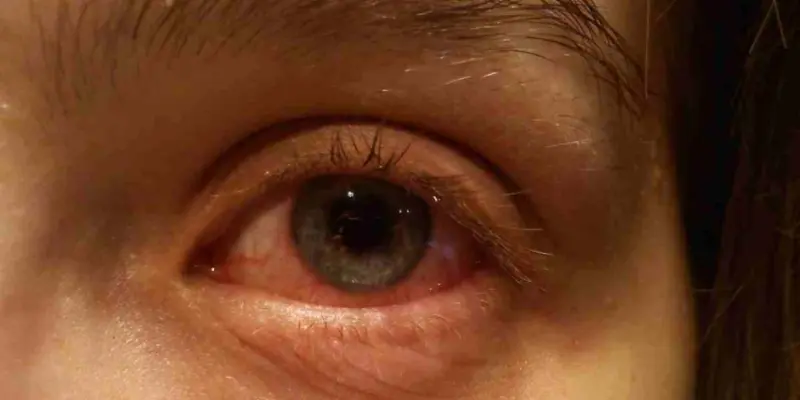

Synopsis: Across Tamil Nadu, doctors report a rise in conjunctivitis or Madras eye, a contagious eye infection causing redness and watering.
It spreads through contaminated hands and surfaces, making hygiene and early care important.
A red, watery eye may seem like a small irritation. But across Tamil Nadu, ophthalmologists say clinics are seeing a steady stream of patients with conjunctivitis, commonly known as the Madras eye or pink eye.
The infection is usually mild and clears within a few days. But because it spreads easily through touch, doctors warn that poor hygiene or ignoring symptoms can quickly infect entire households.
How does it spread?
Conjunctivitis is an infection of the conjunctiva, the thin membrane covering the white part of the eye and the inside of the eyelids. It can be caused by viruses, bacteria or other microorganisms.

Anatomy of an eye. (Cleveland Clinic)
Common symptoms include redness, irritation, watering, discharge and swollen eyelids. The infection usually begins in one eye and may spread to the other.
"It spreads easily when infected tears or secretions come into contact with hands or surfaces," Dr S Laavanyaa, Consultant - Ophthalmology, SRM Prime Hospitals, Ramapuram, Chennai, told South First.
Crowded places such as schools, buses and offices can make transmission easier, especially when people touch shared surfaces.
Why cases rise during summer
Ophthalmologists say conjunctivitis is most commonly viral, and cases tend to increase during warmer months.
"Earlier we mostly saw seasonal surges during summer, though now we do see cases through the year as well," said Dr Saraswathy K, Consultant Ophthalmologist, Dr Agarwals Eye Hospital.
Doctors also note that the infection spreads faster when people continue attending work or school despite symptoms, often sharing towels, pillows or personal items at home.
In many families, once one person develops conjunctivitis, others may follow within days.
"We often see the infection becoming more intense by the time it reaches the last person in the family," said Dr Saraswathy.
What you should do
● Wash hands frequently with soap and water
● Use hand sanitizer if washing isn't possible
● Keep personal items like towels, pillow covers and spectacles separate
● Wear glasses to reduce touching or rubbing the eyes
● Rest the eyes and limit screen exposure
What to avoid
● Do not rub or touch your eyes repeatedly
● Avoid sharing towels, kerchiefs, pillows or cosmetics
● Do not send infected children to school
● Avoid over-the-counter drops without medical advice
● Avoid home remedies like mother's milk or other substances in the eye.
Common myths
Myth: It spreads by looking at someone with red eyes
Fact: It spreads through contaminated hands and surfaces
Myth: All red eyes are conjunctivitis
Fact: Other eye conditions can cause redness and require different treatment
Myth: Old prescriptions or pharmacy drops will work
Fact: Treatment depends on the cause and must be prescribed by a doctor
Doctors say most cases settle with proper care, but a medical check is important to rule out complications.
"Plain conjunctivitis usually doesn't affect vision, but if the cornea is involved, treatment becomes more urgent," Dr Laavanyaa said, urging patients to avoid self-medication and consult an ophthalmologist if symptoms worsen or persist.
(Edited by Majnu Babu).