




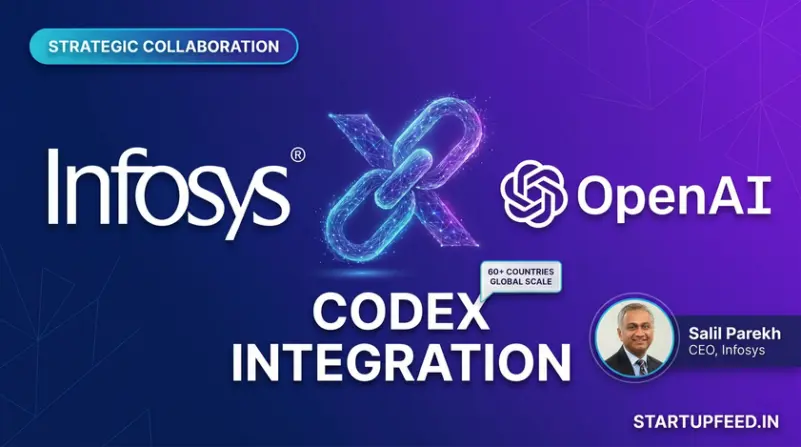

India's second-largest IT company is now OpenAI's enterprise deployment partner — integrating Codex into Infosys Topaz Fabric for enterprise clients across 60+ countries. Here is what this deal means, how it works, and why it matters for India's IT sector.
WHAT WAS ANNOUNCED — THE INFOSYS-OPENAI DEAL
Infosys and OpenAI Announce Strategic Collaboration on April 22, 2026 — Codex Into Topaz Fabric
On April 22, 2026, Infosys (NSE/BSE/NYSE: INFY) announced a strategic collaboration with OpenAI to integrate OpenAI's frontier AI models — including its coding AI system .Codex . — into .Infosys Topaz Fabric ., Infosys' purpose-built agentic services suite.
What the deal does: Helps large enterprises move from AI pilots — small experiments that prove a concept — to production-scale AI deployment that generates real business outcomes. The phrase Infosys and OpenAI keep using: "pilots to performance."
The four initial focus areas:
- Software engineering transformation: Using Codex to accelerate how enterprise software gets built
- Legacy code modernisation: Using AI to analyse, refactor, and migrate old codebases — COBOL, mainframe, outdated Java — to modern platforms
- DevOps automation: Infrastructure-as-code generation, CI/CD pipeline automation, test script creation
- E-commerce and other engineering-led domains: Applying AI across the full spectrum of enterprise engineering work
The quotes that define the deal:
"Generative and Agentic AI will redefine how enterprises operate and grow. Our collaboration with OpenAI establishes an operating model to unlock AI value at scale — uniting technology, talent, and transformation playbooks so clients can move decisively from pilots to performance, creating competitive advantage." — Salil Parekh, CEO, Infosys
"Codex is becoming a powerful workspace for managing agents across software development and business workflows. Infosys' deep expertise in large-scale software transformation enables enterprises to deploy Codex across legacy code modernisation, code review automation, vulnerability detection, and application migration." — Denise Dresser, CRO, OpenAI
WHAT INFOSYS TOPAZ FABRIC IS — THE PLATFORM AT THE CENTRE
A Multi-Layer AI Fabric Designed to Work With Any Model — OpenAI, Anthropic, Cognition. All of Them.
Infosys Topaz Fabric is Infosys' agentic services platform — built specifically for enterprise AI deployment. Understanding it is key to understanding why this deal is strategically significant for both companies.
What makes Topaz Fabric distinctive:
- Model-agnostic (poly-AI): Topaz Fabric is not built to use only one AI model. It integrates OpenAI (Codex), Anthropic (Claude), and Cognition (Devin — an autonomous software engineering agent) simultaneously. The right model gets deployed for each specific task within a client engagement
- Enterprise governance layer: Raw AI APIs lack the compliance controls, audit trails, and responsible AI guardrails that large enterprises require. Topaz Fabric adds this layer — making AI deployment actually usable in regulated industries like banking, healthcare, and insurance
- Agent-ready architecture: Designed from the ground up for agentic AI — systems that take multi-step actions with minimal human intervention. This is the direction all enterprise AI is moving in 2026
- Industry-specific: Topaz solutions are pre-configured for Infosys' core verticals — banking, retail, manufacturing, healthcare, telecom. Domain expertise built into the AI deployment
The competitive logic: Infosys is not betting on one AI winning. By being model-agnostic — and being the delivery partner that can deploy any model in a client's environment — Infosys remains valuable regardless of which AI model dominates in two years. The risk is that they need all the AI companies to succeed. The advantage is they cannot be displaced by any one of them changing strategy.
WHAT CODEX DOES — AND WHY IT MATTERS FOR ENTERPRISE IT
Codex Generates, Reviews, Refactors, and Migrates Code. In the Enterprise Context, That's a Major Cost Centre.
OpenAI Codex is an AI system built specifically for software development tasks. In the enterprise context Infosys is deploying it for, Codex can:
- Generate code from natural language: A developer describes what a function should do; Codex writes the working code. Accelerates feature development and reduces time-to-delivery
- Legacy code refactoring: Analyse old, often undocumented COBOL or mainframe code and produce modernised equivalents. This is one of the highest-value enterprise IT operations — and one that Infosys handles for dozens of global banks and manufacturers
- Automated code review: Scan large codebases for bugs, security vulnerabilities, and performance issues — at a speed and scale impossible with human reviewers
- Application migration: Assist with migrating applications between platforms, programming languages, and cloud environments
- DevOps automation: Generate infrastructure-as-code, automate CI/CD pipelines, create test suites
- Agentic workspace: Codex as a coordination layer for multiple AI agents working simultaneously across different parts of an enterprise software stack
Why this matters for Infosys clients: The average large enterprise has millions of lines of legacy code that need modernising. The traditional approach — deploying hundreds of Infosys engineers over years — is expensive and slow. Codex-powered modernisation, delivered through Infosys' frameworks and governance, promises to do it faster and more cost-effectively. If that promise delivers in production, it is one of the most commercially valuable AI use cases available to enterprises today.
THE BIGGER PICTURE — OPENAI'S CODEX LABS AND THE ENTERPRISE AI RACE
OpenAI's Enterprise Play: Partner With Every Major IT Services Firm at Once. Here's the Full List.
The Infosys deal is not OpenAI's only enterprise move on April 22, 2026. OpenAI also announced Codex Labs — a programme where OpenAI engineers work directly with enterprises to deploy Codex in production environments. The initial Codex Labs partners:
- Accenture — largest IT services company by revenue globally
- Capgemini — major European IT services player
- CGI — Canadian IT services major
- Cognizant — Indian-origin IT services major (previously partnered with HCLTech-OpenAI)
- Infosys — India's second-largest IT company; this announcement
- PwC — Big 4 professional services firm
- TCS (Tata Consultancy Services) — India's largest IT company
What this means: OpenAI is not trying to sell Codex directly to 10,000 enterprise clients. It is building a distribution network through IT services companies that already have those client relationships. Together, these seven partners have enterprise client relationships spanning virtually every large company in every industry globally. For OpenAI, this is the most capital-efficient route to enterprise market penetration — let the IT services companies handle the sales, implementation, and delivery; OpenAI provides the model.
The Indian IT angle: Three of the seven Codex Labs launch partners — Infosys, TCS, and Cognizant — are Indian-origin IT companies. This is not a coincidence. Indian IT firms have the deepest relationships with enterprise clients on software engineering transformation, which is exactly where Codex is most applicable. India's IT sector, which built $200 billion+ in annual revenue on software services, is now simultaneously the greatest potential beneficiary of AI-enhanced services and the most at-risk from AI automating the core work.
WHAT THIS MEANS — FOR INFOSYS, INDIA'S IT SECTOR, AND THE AI ERA
Is This Adaptation or the Beginning of the End? How Indian IT Is Navigating the AI Disruption.
The Infosys-OpenAI deal is the most visible sign yet of Indian IT's strategic response to AI disruption. Here is what it means at three levels:
For Infosys specifically: By partnering with OpenAI, Anthropic, and Cognition — all the major AI model providers — Infosys is positioning itself as the delivery and governance layer for enterprise AI, regardless of which model wins. If Codex becomes dominant in enterprise coding, Infosys is the delivery partner. If Claude dominates, Infosys has that too. If Devin's autonomous agent becomes standard, Infosys is deploying it. This is a calculated bet that the services layer remains valuable even as the model layer commoditises. Whether it succeeds depends on how much enterprise AI deployment can actually be standardised vs. how much requires the custom integration work that Infosys' engineers do.
For India's IT sector broadly: Indian IT companies built their businesses on labour arbitrage — large engineering teams at Indian cost structures, deployed for global clients. AI is directly compressing this model. Codex can do in seconds what a junior developer does in hours. The Indian IT majors are making a calculated bet: become the delivery partner for the AI companies doing the compression, rather than being displaced by it. TCS is in Codex Labs. Infosys is in Codex Labs. HCLTech already has an OpenAI partnership. The sector is adapting — but the question is whether the new AI-enabled services will be as margin-rich and employment-intensive as the old ones.
For enterprise AI broadly: The 'pilots to performance' gap is real and large. Most Fortune 500 companies have run AI experiments. Very few have achieved at-scale production deployment that generates attributable business value. The Infosys-OpenAI partnership is targeting exactly this gap — combining OpenAI's models with Infosys' delivery infrastructure to make enterprise AI deployment as systematic as IT outsourcing was in the 2000s. If it works, it accelerates enterprise AI adoption globally by years.
Stock market note: Infosys stock fell ~1.88% on the announcement. The market's read: this partnership validates the threat AI poses to traditional IT services, even as Infosys is adapting. The question the market is asking is whether Infosys' new AI services revenue will grow faster than its traditional services revenue is disrupted. The Topaz Fabric strategy is Infosys' answer. April 22, 2026 is when it got OpenAI's most important endorsement.