

Brazilian mining major Vale is turning its focus on India, betting on the country's growing steel demand even as China's output shows signs of slowing.
Considered as the world's top iron ore producer, it is looking to expand both its sales and operational footprint in India, where it expects shipments to rise by 50% this year to about 15 million tonnes. The company is also exploring opportunities to source and blend ore locally, positioning India as part of its broader trading network.
A major step in that direction is a new agreement involving Adani Ports and state-run NMDC Ltd (National Mineral Development Corporation).
Confirming the development, diplomatic sources told StratNewsGlobal, 'Vale, Adani and NMDC announced a $500 million agreement to blend iron ore in India. Vale will provide higher grade Brazilian iron ore, NMDC will provide lower-grade Indian iron ore, and Adani will build the port and blending facilities.'
The sources added that 'The complex will be built in Gangavaram Port in Andhra Pradesh, which will be expanded to handle Valemax vessels (the world's largest ore carriers). It will be the first port in India with this capacity. A dedicated Special Economic Zone will be established at the location for the blending, processing, and commercialization of iron ore.'
Diplomatic sources said that, 'This addresses a specific technical need in the Indian steel industry: Indian domestic ore is often lower in grade compared to Brazilian imports. By blending locally, Indian steel producers can improve efficiency while keeping costs competitive. It also marks a deepening of our strategic ties, focusing on mineral security and sustainable infrastructure. This will be the largest current investment of a Brazilian company in India.'
India's rising importance in Vale's global strategy comes at a time when growth in China, long the backbone of iron ore demand, is expected to flatten.
While China will remain a key market, India offers stronger long-term growth potential. Steelmaking capacity in India is projected to expand significantly over the coming decades, with estimates suggesting it could exceed 500 million tonnes by 2050.
'India won't be another China, but Vale will have a higher share,' a senior company official said.
Near-term projections also point to steady growth. India's steel output is expected to reach 184 million tonnes by 2027, up from 165 million tonnes last year, according to estimates from Australia's Department of Industry, Science and Resources.
In comparison, China's production is forecast to see only marginal changes.
Vale's India push builds on its existing global supply chain, which includes distribution hubs in Malaysia and Oman, along with long-term port arrangements in China. The company is looking to integrate India more deeply into its logistics and trading network, by adding blending capacity.
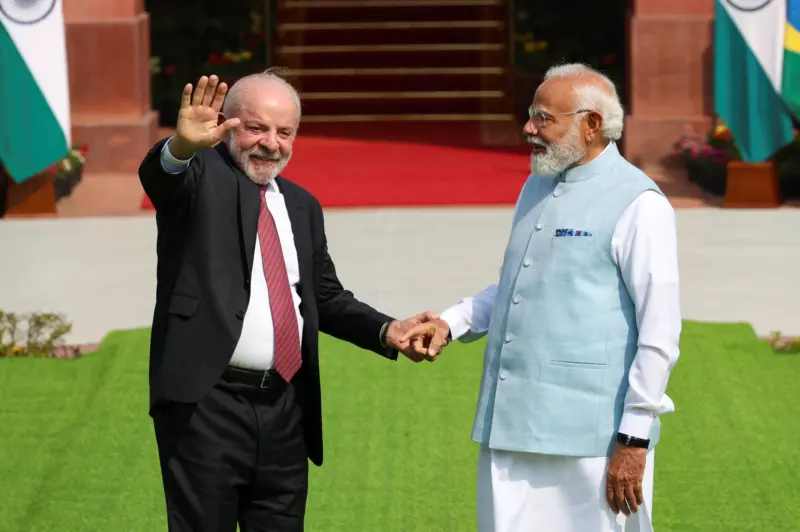
This is also in line with larger India-Brazil engagement in the minerals sector. As reported previously, during the Brazilian president's state visit earlier this year, the two sides highlighted cooperation in critical and rare earth minerals as a priority area, with an emphasis on strengthening supply chains and supporting clean energy transitions.