

China loves to accuse others of distorting history. It's far less comfortable when its own version is questioned.
Even less so when its favourite warning 'stop playing with fire' is turned back on itself.
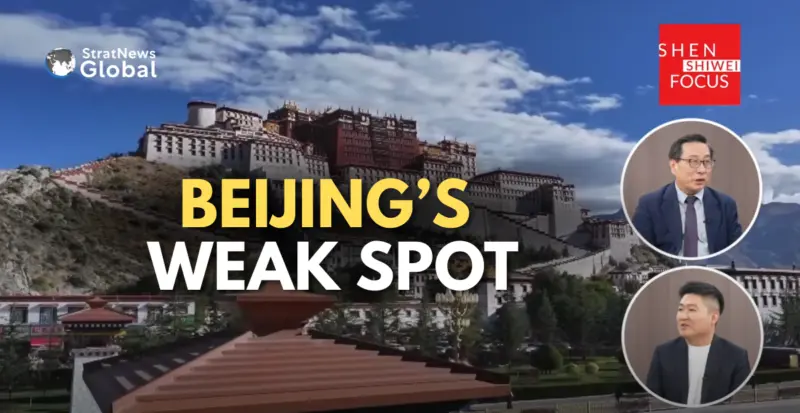
That hypocrisy was hard to miss in a recent interview featuring Victor Gao a former diplomat, aide to Deng Xiaoping, and now a prominent, English-speaking defender of Beijing's positions in global media. Gao is not a detached analyst; he is a polished advocate for the Chinese state's worldview, and he speaks with that authority.
The conversation was hosted by Shen Shiwei a state-affiliated journalist who has built a strong presence on social media amplifying Beijing's narratives for an international audience. His platform is less about probing questions and more about reinforcing a particular line.
Asked about India's position on the McMahon Line, Gao didn't just reject it he mocked it. If India can rely on what he called an 'illegal' colonial boundary, he argued, why shouldn't China draw its own line along the Ganges and claim everything north of it?
This isn't just rhetorical flourish. Gao has floated this idea before a deliberately provocative 'Victor Gao Line' that imagines vast swathes of Indian territory as Chinese. It's framed as tit-for-tat, but it reveals something more telling: a willingness to stretch historical logic to absurdity when it suits Beijing's narrative.
The interview opened with Tibet or 'Xizang,' as China insists on calling it.
The conversation quickly moved to one of the most sensitive issues: the succession of the Dalai Lama. Gao repeated the official line that reincarnation is not purely spiritual but requires state approval. Strip away the phrasing, and the message is blunt: the Communist Party reserves the right to decide a religious leader's rebirth.
He spoke of 'peace and stability' in Tibet, a phrase that sounds reassuring until you consider what it usually entails control first, consent later.
Then came the familiar pivot. Western criticism, Gao argued, is misinformation designed to undermine China's sovereignty. It's a well-worn defence: dismiss scrutiny as conspiracy, and you never have to answer the substance.
But the sharpest remarks were reserved for India. On Arunachal Pradesh which China calls 'Zangnan (Southern Tibet)' Gao stuck to Beijing's script: the McMahon Line is illegitimate, drawn without China's consent, and therefore meaningless today. India, he implied, should accept this reality and negotiate on China's terms.
That's the pattern. Reject existing boundaries. Reframe history. Push new claims. And when challenged, accuse others of provocation.
Yet the contradictions keep piling up.
Gao also tried to draw a stark contrast in military capability, claiming China builds everything while India does not.
That's a selective reading of reality. India's defence ecosystem is expanding steadily from the Tejas fighter to aircraft carriers, missiles, and space systems. Like every major power, India imports where it must and builds where it can. So does China, especially in areas like semiconductors and advanced aerospace.
The difference is strategic approach. India is working towards autonomy without pretending it already has it. China, meanwhile, projects self-sufficiency while quietly relying on global supply chains.
On the core issues, New Delhi has been consistent. Renaming places in Arunachal Pradesh does not change sovereignty. Drawing new lines on maps does not make them real. And the status of the Dalai Lama's succession remains a matter of faith, not state decree.
This is where Beijing's messaging starts to unravel. It demands that others respect its historical claims and sensitivities, yet shows little regard for those of its neighbours. It warns others not to escalate, even as it tests boundaries territorial, political, and ideological.
You can't have it both ways.
If China wants stability, it needs to stop treating history as a tool and borders as suggestions. Because the more it pushes these contradictions, the more its own warning starts to sound like a confession.
Stop playing with fire? That advice might be worth taking by Beijing.