
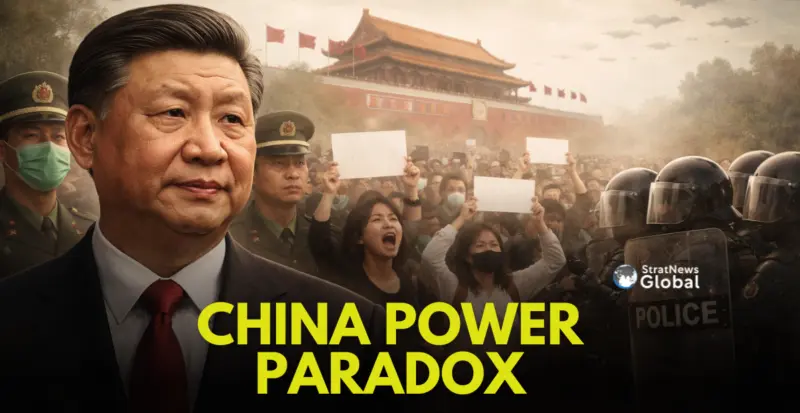

Whenever discussions about China's rise take place, the conversation often highlights its rapid economic growth, technological advancements, and world-class infrastructure.
Yet beneath this narrative lies a more complex reality, one shaped by political control, censorship, and an expanding global influence.
Speaking at a recent discussion at Jawaharlal Nehru University, journalist Cheng Lei argued that China's economic success is inseparable from its political system. Its centralized governance, she explained, allows the state to channel vast resources into priority industries.
'We all talk about China's prowess in manufacturing, whether it's solar panels or electric vehicles,' she said. 'But few actually understand the amount of subsidies that go into these industries.'
According to her, the Chinese leadership has the ability to 'throw all their economic weight' behind certain sectors; even when projects lose money. This capacity, she noted, is something democratic systems do not easily possess. However, it also creates inefficiencies and waste. Some projects, she said, become 'white elephants,' massive investments driven more by political ambition than economic logic.
Cheng also traced how China's social and political environment has evolved alongside its economic rise. From the reform era's openness and eagerness to learn, the country has moved toward a growing sense of superiority and assertiveness. This shift, she warned, risks translating into greater global aggression.
At the center of this change is a strong belief in putting the group first. 'Without the big family, there is no little family,' she explained, contrasting it with Western systems where 'without the individual, there is no state.' This mindset, she argued, helps explain why people tend to follow rules and believe that staying loyal to the country or government keeps things stable.
However, such cohesion comes at a cost. Repression, Cheng emphasized, is not limited to ethnic minorities such as Tibetans but extends across society. Individuals have lost jobs simply for expressing inconvenient truths.
China's expanding definition of national security further intensifies this environment. 'Everything from finance to culture, health, the Arctic, the ocean—it's all state security,' Cheng noted. Over the past decade, the scope has widened significantly, alongside increased spending on internal security, reportedly exceeding defense expenditure.
Cases involving national security are often handled behind closed doors, with restricted access to legal counsel or family members. 'You are utterly isolated,' Cheng said, describing detention conditions where even speech is tightly controlled.
She also pointed to a growing climate of surveillance and fear. Signs warning citizens to 'beware of foreign spies' are common, while suspicion extends into workplaces and daily life reflecting a deeper paranoia within the system.
Beyond its borders, China's influence can be increasingly seen in what Cheng described as coercion. 'By trading and engaging deeply with China, you become victims of coercion,' she said, citing instances where economic ties have been used to exert political pressure. This influence often leads to self-censorship among governments, institutions, and businesses wary of retaliation.
Cheng further highlighted the global reach of Chinese state mechanisms, including surveillance of dissidents abroad. She recounted accounts of operatives posing as businesspeople to infiltrate networks, gather intelligence, and facilitate arrests in third countries.
Despite its remarkable achievements, from high-speed rail networks to technological innovation, Cheng argued that China remains deeply cautious of dissent. 'It's quite unthinkable… that a country with so many wonderful things would be so paranoid and afraid of its own people,' she said.
At the same time, she noted a widening gap in global understanding of China. Restrictions on foreign journalists and declining media access have made it harder to report independently, while curated narratives dominate both domestic and international perceptions.
As a result, the image of efficiency and prosperity often hides deeper realities. Social media may show convenience and low costs, but it rarely reflects inequality and limited support for many people, Cheng noted.