
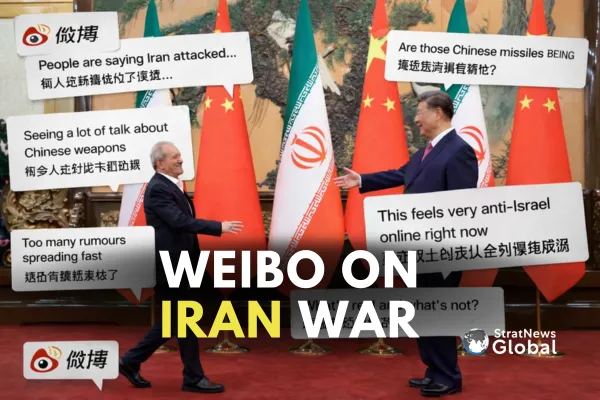

Chinese social media while state-controlled, often marches to its own drum. Witness these comments posted by users on the Israeli and US missile strikes on Iran.
One posted 'Please help us,' another 'People there have finally lived to see the end of a corrupt regime,' while a third posted rather ominously that 'The free world is on its way.'
These comments suggest views held by sections of the public contrast sharply from China's traditional diplomatic position, which has close ties with Tehran and for good reason: China buys 80% of Iran's oil exports, amounting to more than a million barrels per day.
Closure of the Strait of Hormuz announced by Iran's Revolutionary Guard could hit China's import of energy from the broader region. If oil prices surge towards $100 or $130 a barrel, China's industrial base would be squeezed as would growth. Reports are coming in of Beijing stepping up the purchase of discounted Russian oil as insurance.
Beyond politics, a more technical controversy emerged. Some Chinese users questioned why Iran's missile detection systems that included Chinese equipment failed to intercept Israeli and US missiles. Posts openly asked whether Chinese defence systems were inadequate. Since the start of the conflict, Chinese radar systems have faced criticism from some military observers, with reports that Iran is using China's YLC-8B anti-stealth surveillance radar, reportedly delivered earlier this year.
Chinese military bloggers also known as 'Little Pinks' (CCP loyalists) rose to defend their country's equpment. They said a missile getting through does not automatically mean the defence system failed since much depended on electronic interference, how the systems were positioned, and how different defence layers worked together.
The attack on Iran comes within two months of the US arrest of Venezuela's President Maduro, a China ally who had become a reliable supplier of oil. If the current conflict continues and Iran's clerical regime falls, it would be the second China ally to succumb to the machinations of President Trump.
China's state-run media has left the world in no doubt about its loyalties. On the ground reports from Tel Aviv by CCTV correspondent Liang Hui showed damaged buildings and destroyed vehicles following Iran's missile strikes. The footage spread rapidly across Weibo, reinforcing the anti-Israeli naarrative, drawing roughly 39 million reads on Weibo.
By repeatedly showcasing Iranian missiles hitting Israeli targets, state media projected an image of Israeli vulnerability while amplifying Iran's retaliatory capability. At the same time, placing a Chinese correspondent visibly on the ground served to strengthen domestic trust in the narrative, suggesting that Beijing was delivering unfiltered reality even as the framing of events appeared carefully selective.
Xinhua News Agency published a strongly worded commentary arguing that launching strikes during ongoing nuclear talks exposed a contradiction in US policy publicly promoting diplomacy while using force. It also criticised reported calls for regime change in Iran as a violation of sovereignty and principles set out in the United Nations Charter.
Cartoons portrayed Washington as reckless and destabilising, and reinforcing state media's criticism of what it described as American 'hegemony'.