
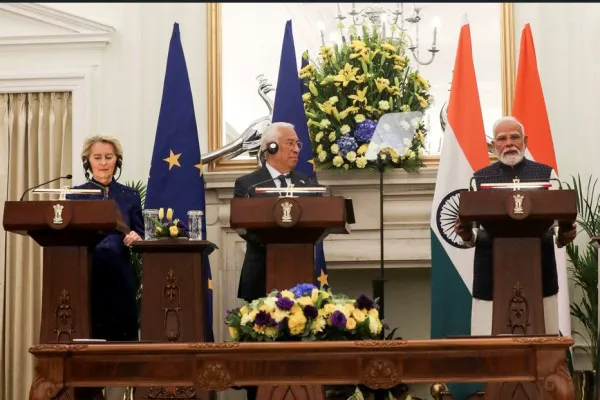

India's back-to-back trade agreements with the United States and the European Union, announced within days of each other, represent two different approaches to expanding the country's external economic engagement.
While both aim to deepen ties with major Western markets, their design and immediate effects diverge: the India-US deal is primarily about restoring competitiveness through tariff reductions, whereas the India-EU agreement is about securing large-scale, long-term market access.
The most visible feature of the agreement with the United States is a steep cut in American tariffs on Indian goods, from levels that had reached around 50% to about 18%. These higher tariffs had sharply reduced shipments of products such as steel and squeezed margins for exporters in pharmaceuticals, textiles and seafood. By lowering these duties, the deal seeks to revive trade flows that slowed after the tariff hikes and improve the price position of Indian goods in the US market.
Officials estimate that bilateral trade could rise well beyond pre-tariff levels and potentially cross $300 billion in the near term, assuming smooth implementation.
The sectors expected to benefit most from the US deal are labour-intensive manufacturing segments such as garments, footwear, leather, gems and jewellery, along with pharmaceutical companies, especially makers of generic medicines, and seafood exporters whose shipments had been affected by a mix of tariffs and dumping duties.
At the same time, several operational aspects remain unclear, including the precise start date for the new tariff regime, the timeline for India's reciprocal tariff reductions, and the scope of India's reported commitment to increase purchases of American energy and technology products. A joint statement outlining the first phase of the agreement is expected shortly, followed by a legal pact around mid-March.
The US deal has also attracted attention because of a claim by Donald Trump that India would stop buying Russian crude. Indian officials have not confirmed any such commitment. Data already indicate a gradual decline in Russian oil imports, partly due to sanctions and supply constraints, but analysts note that existing contracts, refinery compatibility and pricing advantages make an abrupt shift unlikely. Russian crude is therefore expected to remain part of India's energy mix in the near term, even as supplies from the US, West Asia and possibly Venezuela increase.
In contrast, the agreement with the European Union is framed as a comprehensive free trade agreement aimed at scale rather than short-term correction. Negotiated over nearly two decades, it promises near-complete duty-free access for Indian exports to Europe over time. Once fully implemented, almost all Indian goods entering the EU are expected to face zero tariffs, giving Indian exporters a structural advantage in one of the world's largest consumer markets.
Sectors such as textiles, leather goods, jewellery and engineering products are among the biggest potential beneficiaries. Various studies suggest that bilateral trade could grow by more than 40%, with the possibility of doubling within a decade after full implementation. In addition, the EU has committed financial support for India's green transition, linking trade expansion with climate-related cooperation.
India, for its part, has agreed to gradually lower high tariffs on selected European goods, including automobiles, wines and spirits, while securing transition periods intended to protect domestic producers. These tariff reductions are expected to be staggered over several years.
A common feature across both agreements is what they exclude. India has firmly protected its agriculture and dairy sectors, refusing to open them to imports from heavily subsidised producers in the US and EU. This reflects domestic political economy considerations as well as concerns about livelihoods and food security.
Taken together, the two deals reposition India in global commerce in complementary ways. One focuses on restoring competitiveness in a key market where tariffs had become a major obstacle, while the other seeks to lock in long-term access to a large, high-income market.
Rather than signalling a turn towards any single bloc, the agreements point to a more outward-facing Indian trade strategy built around selective, interest-driven partnerships.