


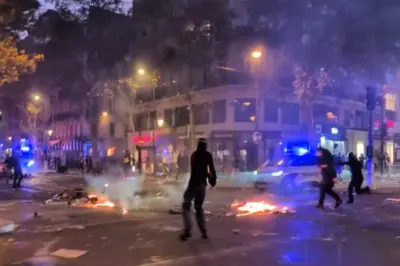

Europe's protests and riots offer India a chance to examine how economic discontent, youth anger and distrust of institutions can escalate into wider unrest.
Across Europe, specific grievances have similarly widened into challenges to political authority.
In France, student protests over teacher shortages, dilapidated classrooms and university admissions expanded to include demands over wages, pensions and living costs.
An investigation has alleged that the unrest involved a network of communist, socialist and Islamist groups, including labour unions and political parties, some reportedly linked to Shanghai-based billionaire Neville Roy Singham.
These allegations complicate the portrayal of the unrest as exclusively student-led, but do not establish that the protests were centrally directed or that the groups involved were responsible for all the violence.
In Spain, housing costs and evictions have fuelled demonstrations, while Portugal has faced similar anger over soaring property prices. In Milan, protests over public services and living costs escalated into looting and clashes with police, prompting the Italian government to announce the deployment of 500 additional troops.
The movements differ in their demands and political affiliations, but expose a common vulnerability: when education, housing and employment fail to provide the security people expect, frustration can spread from a specific policy failure to a wider loss of faith in government.
India's experience with the Cockroach Janta Party (CJP) provides a relevant, though not identical, comparison.
The youth-led movement began with protests over examination irregularities and culminated in the resignation of Union Education Minister Dharmendra Pradhan in July.
It has since turned to alleged irregularities in the revision of electoral rolls, demanding the resignation of Chief Election Commissioner Gyanesh Kumar. The Election Commission disputes allegations of wrongdoing.
The movement's latest demonstrations in Delhi have been met with heavy police deployments and detentions, raising questions about how the state responds to dissent.
the first lesson for India is that institutional credibility depends on transparency and accountability. Examination systems must be demonstrably fair, and electoral processes must inspire confidence.
When allegations arise, authorities need to address their substance and permit scrutiny. Dismissing concerns as politically motivated without providing convincing answers risks widening the credibility gap.
The CJP protests show how sustained public pressure can force political accountability. They also demonstrate how grievances can outlast their original cause when confidence in institutions remains in question.
The second lesson concerns the limits of coercion. European governments have responded to violence with arrests, curfews and security deployments.
Such measures may be necessary to protect lives and property; the right to protest does not justify looting or attacks. But restoring order is not the same as resolving the causes of unrest.
Authorities must prevent violence while protecting peaceful assembly. Disproportionate policing and restrictions on lawful protest can deepen alienation, turning demands for accountability into a prolonged confrontation between citizens and the state.
The test is whether governments can enforce the law without treating dissent itself as a threat.
Immigration offers a third lesson.
US President Donald Trump blamed France's unrest on immigration and urged the country to close its borders. Yet the protests began over education and living costs.
Reducing them to an immigration crisis risks diverting attention from public policy failures and the economic pressures facing ordinary citizens.
India's circumstances differ, but the danger of displacement is familiar.
Economic hardship, administrative failures and institutional distrust can be overshadowed by arguments about identity and belonging.
Such narratives may mobilise political support, but cannot substitute for functioning public services, fair procedures or accountability.
Religion can intensify these divisions. In France, disputes over Islam, secularism and national identity have become central to debates about immigration and integration.
Some nationalist movements portray immigration from Muslim-majority countries as a threat to Europe's historically Christian identity.
Allegations that Jewish-owned businesses were deliberately targeted during the Marseille unrest have also circulated, though deliberate targeting remains unsubstantiated. Such claims warrant investigation, not assumptions about the motives or religious identities of rioters.
The broader concern is that religious identity can become a vehicle for polarisation, obscuring the economic and institutional failures behind public discontent.
India should recognise this risk without equating its social tensions with Europe's.
In a diverse society, the politicisation of religion can turn legitimate grievances into communal antagonism. Governments must protect public safety while applying the law and standards of accountability equally.
The longer-term danger in Europe is that distrust becomes entrenched, weakening mainstream political institutions and creating space for movements offering simple answers to complex problems.
India faces different circumstances, but the principle holds: when citizens see institutions as unresponsive, the consequences extend beyond a protest or a minister's resignation.
The lesson is not that governments should fear every demonstration or tolerate violence.
It is that public order cannot be sustained through force alone while underlying grievances remain unresolved. Democratic resilience depends on credible institutions, accountability and a willingness to hear dissent.
For India, that matters more than the spectacle of burning streets.