





There is something almost endearingly earnest about a superpower discovering the Indian street.
Not the India of summits, strategic dialogues and carefully choreographed handshakes, but the India of honking traffic, dust, jugaad, and the auto-rickshaw that somehow appears at the exact moment you give up on finding one.
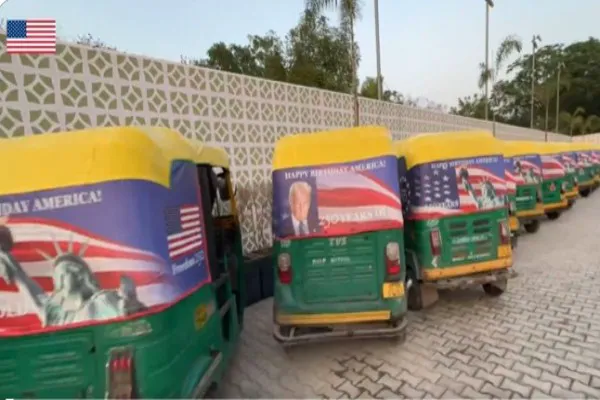
Into this theatre rolls the latest diplomatic spectacle: a fleet of 'Freedom Vehicles', auto-rickshaws wrapped in American iconography and the unmistakable visage of President Donald Trump, to celebrate 250 years of American independence.
If that sentence sounds like satire, it isn't.
The campaign, earnestly titled 'Freedom 250', launched by U.S. Ambassador to India Sergio Gor on April 16, seeks to take American public diplomacy out of the embassy compound and into the bloodstream of Indian daily life.
It is, on paper, a clever idea.
Why not hitch a ride on the most ubiquitous symbol of Indian mobility? Why not replace stiff speeches with something that moves, literally, through the chaos of the bazaar?
Freedom is on the move… literally! Ambassador Gor kicked off the #Freedom250 celebrations from New Delhi in the most iconic way, previewing vibrant autos that will be rolled out across the city, proudly featuring President Trump and iconic American images. This marks the… pic.twitter.com/LfxlzDImCn
And yet, somewhere between concept and execution, the whole exercise veers into the absurd. Because what we are left with is not just outreach, it is spectacle. Not just symbolism, but a personality cult, imported, laminated, and bolted onto three wheels.
The choice of the auto-rickshaw is inspired. And the execution is revealing.
Autos, after all, are democratic spaces. They are where India negotiates its differences over fares, routes, politics, cricket, and occasionally the meaning of life. They are messy, argumentative, stubbornly local.
To wrap them in the iconography of another nation's nationalism, complete with portraits of a single leader, feels less like engagement and more like appropriation.
Or perhaps imitation.
Because India, of course, is no stranger to the art of leader-as-logo. Long before these 'Freedom Vehicles' took to the streets, the face of Narendra Modi had already achieved a kind of administrative omnipresence.
It appeared on vaccination certificates, on ration cards, on welfare schemes, and yes, memorably, even on death certificates in some states—an administrative flourish that blurred the line between governance and personal branding.
In that sense, the American initiative is not alien at all. It is simply learning from the host country's own experiment in visual politics. Why stop at policy when you can put a face on it? Why rely on institutions when a personality will do?
Which brings us, inevitably, to the pun that writes itself.
The auto-rickshaw becomes the perfect metaphor for the age of the auto-crat.
The difference, one might argue, is only a hyphen.
The autorickshaw is chaotic, decentralised, unpredictable. The autocrat is the opposite: centralised, controlled, curated.
And yet here they are, fused into a single moving billboard, trundling through Delhi traffic, carrying with it a message about freedom that feels, at times, oddly prescriptive.
Freedom, after all, is a curious thing to advertise.
It does not usually require decals. It rarely travels well as a slogan. And it almost never benefits from being attached to a single individual, however powerful. The more you insist on packaging it, the more it begins to resemble the very thing it claims to oppose.
This is not to say that public diplomacy should remain confined to drawing rooms and policy papers. Quite the opposite. The instinct to engage at the grassroots level, to meet people where they are, is sound. But there is a difference between participation and projection.
What the 'Freedom Vehicles' risk doing is projecting a very specific, very personalised vision of freedom onto a public space that is anything but uniform.
It is one thing to celebrate a historical milestone: the 250th anniversary of American independence. It is quite another to do so in a way that foregrounds a contemporary political figure so prominently that the message becomes inseparable from the messenger.
History, in other words, takes a backseat to branding.
And branding, as India knows all too well, has a way of crowding out nuance.
The report itself speaks the language of strategy: 'grassroots engagement', 'shared democratic values', 'innovation and technical leadership'.
These are worthy goals. But the imagery tells a different story: one of strongmen, spectacle, and the subtle suggestion that democracy is best represented not by institutions or processes, but by personalities.
It is a curious export.
For decades, the United States has positioned itself as a champion of institutional democracy: the rule of law, checks and balances, the quiet machinery that keeps power in check. And yet, in this campaign, what travels across continents is not that machinery, but the aesthetic of personalised power.
There is, of course, an argument to be made that this is simply the language of our times. In an age of social media and shrinking attention spans, symbols must be bold, messages must be simple, and personalities must be larger than life. The auto-rickshaw, with its bright colours and relentless mobility, is merely the latest canvas.
But there is also a cost.
When diplomacy becomes spectacle, it risks losing its substance. When freedom becomes a slogan, it risks becoming hollow. And when leaders become the primary vehicle (pun fully intended) of political messaging, institutions begin to fade into the background.
The irony is hard to miss.
A campaign designed to celebrate 250 years of independence ends up showcasing a style of politics that often sits uneasily with the messy, decentralised spirit of democracy. The auto, that most anarchic of vehicles, becomes a carrier for a message that feels, at times, carefully controlled.
Auto meets autocrat.
And somewhere in that collision, the joke writes itself.
Perhaps the most telling detail is not the imagery or the slogans, but the setting. These vehicles will travel through Indian cities, weaving through traffic, stopping at red lights, negotiating potholes and pedestrians. They will be seen, photographed, perhaps even admired.
But they will also be absorbed into the background noise of Indian life.
Because India has a way of domesticating the grandest of gestures. What begins as spectacle quickly becomes routine. What is meant to stand out eventually blends in. The auto-rickshaw, after all, is not a pedestal. It is a workhorse.
And workhorses have a way of resisting grand narratives.
In the end, the success of 'Freedom 250' may not be measured by how many people notice the vehicles, but by how many simply treat them as just another auto in a city full of them. Another moving object in a landscape that is already saturated with messages, faces, branding and competing claims to attention.
And reality, unlike branding, cannot be controlled.
So let the Freedom Vehicles roll. Let them honk their way through Delhi, Mumbai, Bengaluru. Let them carry their messages of history, partnership, and shared values.
But also let them be what they inevitably will become: part of the great, unruly, unmanageable tapestry of Indian public life.
Because in the end, the auto will always have the last word.
Not the autocrat.