




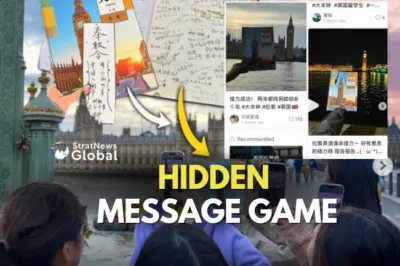

Call it a game or a treasure hunt for Chinese travelling or studying overseas, and it's inspired by geocaching, a game where people hide items for others to find using clues.
Chinese tourists are encouraged to look for items by checking out clues hidden in Mandarin-language posts on social media. It's spreading like wildfire drawing 700,000 views on Weibo with the hashtags #Chinese tourists' overseas book-hunting relay goes viral and #Global meetup plans by Chinese tourists and students trending.
Here's how it works: a traveller leaves a textbook near a landmark featured on its cover, shares hints online, and others follow, find it, write messages, and pass it on.
Near Big Ben, books have been found hidden between railings, behind bins, and along the riverside. Over time, the pages fill with notes, dates, and reflections, turning each book into a shared record of strangers connected by language and identity.
It's harmless and fun when you look at it, but is there something else at work? One line in this game makes an important point: 'English is the tool that got us here; Chinese is the bond that brings us together.'
The unifying bond is obvious, encouraging a shared identity along with a real-life experience and when Chinese are travelling overseas, in unfamiliar environments, facing communication issues, a game of this kind helps connect and provides support.
But as always with China, the state has its own compulsions. 'Study Abroad e-Link', is an app that reportedly offers cash rewards for attending pro-Beijing events, sharing personal data, and inviting others to join.
Critics say it may encourage political conformity by penalising behaviour deemed 'anti-China'. Promoted through Chinese Students and Scholars Associations (CSSAs), the scheme has sparked debate over surveillance and influence on UK campuses.
Some academics have also reported that students privately fear being monitored by peers, adding to wider concerns about academic freedom and student safety.
There is no direct evidence linking the textbook trend to the app or any coordinated campaign. However, taken together, these developments highlight how even simple cultural activities can carry wider implications particularly when they unfold across borders and within digitally connected communities.