
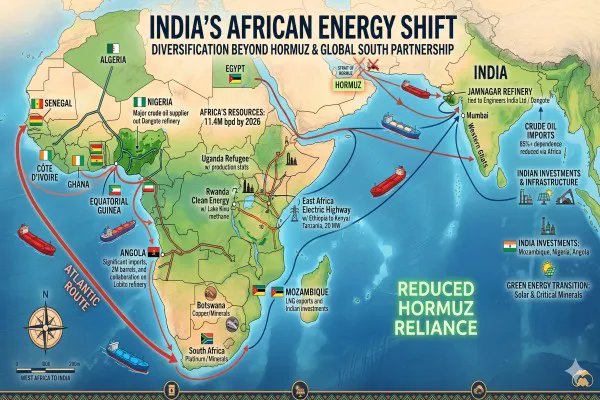

India is accelerating a strategic shift towards Africa as repeated crises in West Asia underline the vulnerability of global energy supply chains.
For a country that imports more than 85% of its crude oil, disruptions near the Strait of Hormuz are not abstract risks but immediate economic concerns.
This has pushed New Delhi to widen its sourcing network and reduce dependence on traditional suppliers. Africa is now moving from the margins of India's energy basket to a more central role, driven by both resource availability and logistical advantage.
The shift is expected to be a key focus at the upcoming India-Africa Forum Summit IV in New Delhi, where energy security will feature prominently.
India's existing energy relationship with Africa is already substantial. Nigeria remains its largest supplier on the continent, with Angola and Algeria also playing significant roles. At the same time, new partnerships are taking shape.
Countries such as Egypt, Equatorial Guinea, and Mozambique are gaining importance, particularly in liquefied natural gas and upstream exploration. Emerging producers like Ghana and Senegal, though smaller today, are being factored into long-term supply planning.
One of the key advantages Africa offers is geographic. Supplies from West Africa move along Atlantic routes that avoid the chokepoints that often disrupt shipments from West Asia. This reduces exposure to geopolitical tensions and lowers the risk of sudden supply interruptions.
India's approach is also changing in nature. It is no longer limited to buying crude. Indian companies are expanding their presence across the energy value chain.
Engineers India Limited is involved in work on Nigeria's Dangote refinery, one of the largest refining projects in the world. ONGC Videsh and Oil India have acquired stakes in upstream oil and gas assets in countries such as Mozambique and Nigeria.
These moves indicate a shift from transactional trade to long-term participation in production and infrastructure.
Parallel changes are underway within Africa. Several countries are investing in refining capacity to reduce dependence on imported fuel. Nigeria's Dangote refinery has already begun exporting fuel across the continent, while Angola is expanding its refining infrastructure. Botswana has shown interest in acquiring a stake in Angola's Lobito refinery as part of its effort to secure stable supplies.
East Africa is also becoming relevant to the broader energy picture. Uganda's refinery project, backed by significant reserves, is expected to alter its position in regional markets. Rwanda is working on methane extraction from Lake Kivu, and cross-border electricity projects involving Ethiopia, Kenya, and Tanzania are beginning to take shape.
These developments are strengthening regional energy systems and creating new opportunities for external partners.
Africa's importance extends beyond oil and gas. The continent holds large reserves of critical minerals such as cobalt, lithium, and rare earth elements, which are essential for clean energy technologies. South Africa's dominance in platinum production further adds to its strategic value.
As global demand for these materials grows, India's engagement with Africa is likely to expand into these sectors.
India's diversification efforts are already visible in its import data. The number of countries it sources oil from has increased from 27 to over 40, while dependence on Gulf suppliers has declined from 72% to about 63%. This gradual shift reflects a deliberate policy to spread risk and secure alternative supply lines.
Challenges remain. Infrastructure gaps, regulatory differences, and financing constraints continue to affect project execution across parts of Africa. Global supply chain volatility also adds uncertainty.
However, the direction of travel is clear. Africa is expanding its role from a raw resource exporter to a more integrated energy producer, while India is positioning itself as a long-term investor and partner rather than a distant buyer.
The broader significance of this shift goes beyond energy. It reflects a larger realignment within the Global South, where countries are seeking partnerships that offer greater balance and stability.
For India, Africa is no longer a fallback option. It is becoming a key component of its energy security strategy.