




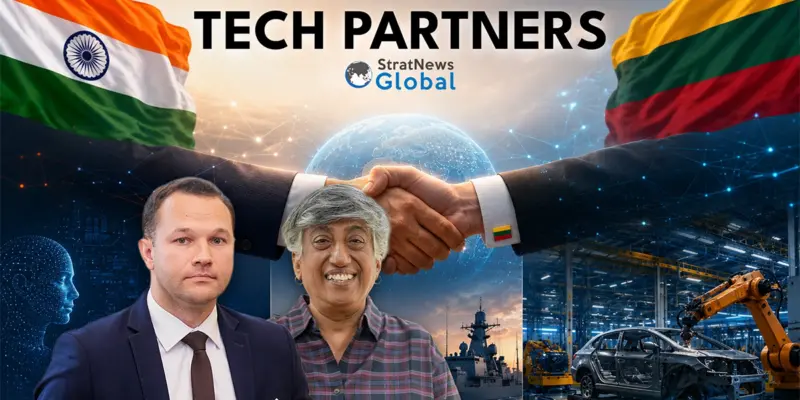

Lithuania is positioning itself as one of Europe's most technology-driven economies and sees India as a crucial long-term partner in emerging technologies, artificial intelligence, defence innovation and advanced manufacturing.
In an exclusive conversation with StratNewsGlobal in Vilnius, Lithuania's Minister of Economy and Innovation, Edvinas Grikšas, said his recent visit to India for the AI Impact Summit reinforced the enormous potential for deeper collaboration in high-tech sectors.
'India has tremendous capabilities in ICT and AI, with a very strong talent base. Lithuania, meanwhile, offers advanced technologies and access to the wider European market. Together, we can co-create globally competitive products,' he said.
The minister described the summit in New Delhi as 'highly productive,' particularly after meetings with Indian ministers and technology stakeholders focused on artificial intelligence and innovation partnerships.
Lithuania, despite having a population of under three million, is increasingly emerging as a specialised European hub for AI, cybersecurity, lasers, fintech and defence innovation.
'We are a country of 2.9 million people, but effectively part of a 450-million-person European market,' he said. 'Lithuania can serve as one of the best gateways for Indian companies entering Europe.'
He highlighted Lithuania's ambitions in AI, including the launch of one of Europe's earliest AI sandbox frameworks and the development of a national AI factory initiative.
With the India-European Union Free Trade Agreement expected to be ratified soon, Grikšas said emerging technologies cioud become a major pillar of future cooperation.
He stressed that Lithuania intends to play an active role in shaping Europe's technology agenda, especially as the country prepares for its presidency of the EU Council in the first half of 2027.
According to Griksas, areas such as biotechnology, artificial intelligence, cybersecurity, advanced manufacturing and space technologies present strong opportunities for India-Europe partnerships.
'Europe has a very strong innovation ecosystem, world-class universities and advanced industrial capabilities. India brings enormous scale, talent and digital expertise. There is natural complementarity,' he said.
Lithuania is rapidly scaling its defence innovation ecosystem as Europe increases investments in military capability and security infrastructure.
Grikšas pointed to initiatives such as MilTech Lab, operated under Innovation Agency Lithuania, which connects the military, startups, academia and industry to accelerate defence innovation projects aligned with the needs of the Lithuanian Armed Forces.
'Innovation must move from ideas to deployable capabilities quickly. That is our focus,' he said.
The Baltic nation has also been attracting major international investments in advanced manufacturing and strategic industries. Recent projects include a nearly €50 million investment in the Kaunas Free Economic Zone for Leopard 2A8 tank assembly and military equipment manufacturing.
The country has simultaneously positioned itself as a hub for global technology and financial companies, with firms such as Nasdaq, Revolut, Continental and Danske Bank establishing operations there.
The Lithuanian minister also identified space cooperation as an area of significant opportunity between India and Lithuania.
Lithuania is an associated member of the European Space Agency and has developed strong capabilities in small satellite manufacturing and aerospace innovation.
'There is strong potential for Indian and Lithuanian companies to jointly participate in European space projects and consortiums,' he said.
Grikšas also highlighted Lithuania's globally competitive laser and optoelectronics sector, describing it as one of the country's strongest advanced technology industries.
'Lithuanian lasers are exported to over 90 countries and used by organisations including NASA, NATO, CERN and the European Space Agency,' he noted.
The minister suggested these capabilities could support India's ambitions in semiconductor manufacturing and Industry 4.0 technologies.
Although bilateral trade between India and Lithuania remains modest, Grikšas said the potential for expansion is substantial.
India has already been identified as one of Lithuania's priority markets for exports and innovation cooperation.
'We have already begun discussions on how to significantly expand bilateral trade and innovation partnerships,' he said.
Lithuania's export-oriented economy has been among the fastest growing in the European Union, with sectors such as defence and security witnessing especially rapid growth.
'Our defence industry revenues alone grew by around 50 per cent last year,' the minister revealed.
The minister said a future India-EU free trade agreement would provide an important framework for accelerating cooperation, but added that bilateral initiatives between India and Lithuania would remain equally important.
'We need both the broader trade framework and direct bilateral agreements, joint programmes and innovation partnerships,' he said.