
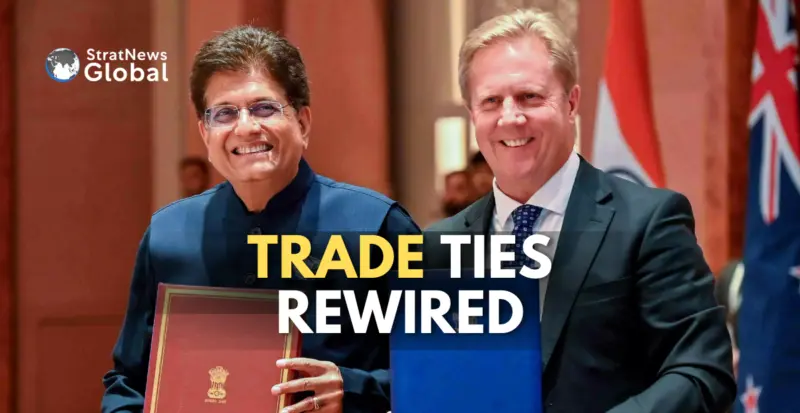

India and New Zealand on Monday signed a long-awaited free trade agreement, marking a decisive reset in economic ties after years of stalled negotiations.
The deal, signed in New Delhi by Commerce Minister Piyush Goyal and New Zealand Trade Minister Todd McClay, is being pitched as high-impact that could reshape trade flows between the two countries.
The agreement now heads to New Zealand's Parliament for ratification, a process expected to take several months. Once in force, both sides expect the deal to significantly expand trade volumes, with a stated goal of doubling bilateral trade to around $5 billion within five years.
New Zealand Prime Minister Christopher Luxon has already described the pact as a 'once-in-a-generation' opportunity, pointing to India's rapidly growing economy and the scale of its domestic market.
Talks for the agreement had remained inactive for nearly a decade before being revived in 2025. What followed was an unusually quick negotiation cycle, with both sides closing the deal within the year, an indication of shifting trade priorities in the Indo-Pacific region.
The timing is important. India has been actively expanding its network of trade agreements, while New Zealand has been seeking deeper access into large Asian markets beyond its traditional partners. The agreement is focused on market access.
New Zealand has agreed to eliminate tariffs across its entire schedule for Indian goods, opening the door for sectors such as textiles, pharmaceuticals, engineering goods and auto components.
In return, India has taken a more calibrated approach. Tariffs will be reduced or removed on selected imports such as wool, timber and coal, inputs that feed into domestic industries, while politically sensitive sectors like dairy, sugar and edible oils remain protected.
The agreement also moves beyond goods. It includes provisions for services, investment and mobility, allowing Indian professionals to access work opportunities in sectors facing skill shortages in New Zealand. A limited number of work and holiday visas will also be introduced annually.
Early reactions from industry suggest cautious optimism. Agneshwar Sen of EY India says 'Indian exporters now get full duty-free access across thousands of product lines. That removes a cost disadvantage, especially in labour-intensive sectors like apparel and leather.'
He noted that the agreement goes beyond traditional trade benefits. 'The mobility provisions and the fast-track route for food processing imports create new business models. It's not just about selling goods, it's about integrating into supply chains.'
Gulzar Didwania from Deloitte India pointed to a broader structural shift. 'This is less about short-term tariff gains and more about long-term alignment. Manufacturing, pharma, IT and professional services stand to benefit, but the real value lies in investment flows and productivity partnerships,' he said.
New Zealand's proposed investment commitment, estimated at up to $20 billion over 15 years, is being seen as a key pillar, particularly for sectors such as food processing, logistics and agri-technology.
The agreement has revived familiar concerns around dairy imports. Government negotiators have attempted to strike a balance.
Core agricultural sectors, including dairy, have been kept outside the main tariff reduction framework, though limited quotas and phased access have been introduced for certain products. Industry chambers say the agreement could have wider implications beyond immediate trade gains.
ASSOCHAM President Nirmal Minda described the pact as a 'milestone' in India's trade strategy. He highlighted its potential to boost MSME participation, improve connectivity, and deepen cooperation in digital and financial ecosystems.
There is also growing interest in how the agreement could reshape supply chains. A provision allowing duty-free import of New Zealand inputs for re-export by Indian manufacturers is being viewed as a step toward positioning India as a global food processing hub.
While the agreement has broad backing in New Zealand's political system, some leaders have raised concerns over investment commitments and immigration provisions, reflecting domestic sensitivities ahead of elections.
At the same time, the Indian diaspora, around 300,000 strong in New Zealand, is expected to play an important role in shaping both economic and political responses to the deal.