
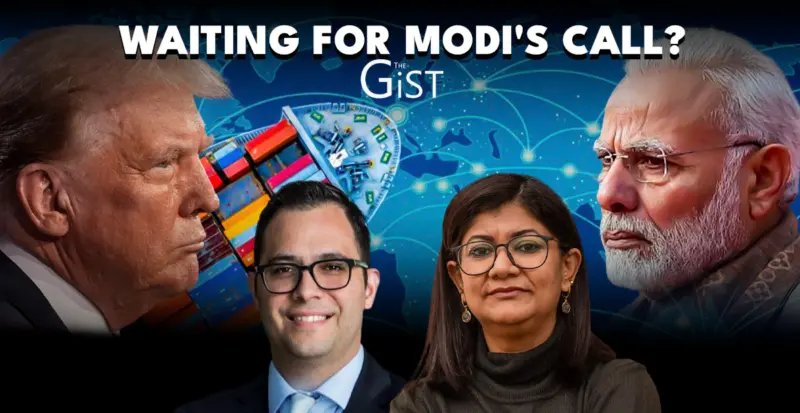

After a tumultuous period in 2025, the bilateral relationship between India and the United States may be headed for a reset in 2026, says Derek Grossman, Professor of International Relations at the University of Southern California.
In a conversation on The Gist, Grossman said 'On the BTA, my understanding is as of just a few months ago, there were still disagreements on agriculture … So, there may be some finer details in there that are yet to be hashed out, but, it sounds like those have been ironed out for the most part, and that the deal is ready to be signed, so long as leaders can agree that it's time to sign,' he said, adding that Trump was expecting that Prime Minister Modi would give him a call.
Earlier this month, US Commerce Secretary Howard Lutnick had mentioned in an interview that the conclusion of talks for the India-US BTA got stuck since Modi did not call Trump.
'Trump has to look like he's large and in charge, otherwise there can be no deals,' added Grossman, who has earlier worked at the CIA.
According to him, the reason why India could not host the Quad Summit, which was scheduled to be held in 2025 with New Delhi as the chair, because the US President wanted the BTA to be signed at that particular time.
'Trump first has to get not just a policy deliverable but also the acclamation, applause, respect before anything else can happen. And again, I'm not in favor of that approach, but that is the approach our current president has been taking,' Grossman said.
On Monday, the new US Ambassador to India Sergio Gor while assuming office said in New Delhi that India remains an 'essential partner' for the United States and that the talks for the BTA are still ongoing.
He also invited India to become a full member of the 'Pax Silica' initiative, which was launched in December 2025 in Washington DC.
'I think it's very significant that after a summer and a fall last year of complete turmoil in the US-India relationship, we're finally getting back to having a more cordial and productive relationship with India,' Grossman said.
He also added, 'Sergio Gor is a close confidant of the (US) President. So I believe he speaks credibly as to what the president is thinking and what he wants, in the relationship with India and so my impression of it is it's a very good sign that Washington is strenuously trying to reset the bilateral relationship.
'That said, there's still a lot of work to be done because it's not like a light switch that you can turn on and off,' he said.
On the invitation to join Pax Silica, Grossman said, 'Pax Silica is really about securing supply chains worldwide and the fact that India was not invited to begin with, it speaks more to the fact that this administration has been very discombobulated. The left hand doesn't really know what the right hand is doing.'
Pax Silica is a multilateral dialogue or working group that is aimed at securing supply chains around the world, focussing on semiconductors and chip production.
Tune in for more in this conversation with Derek Grossman, Professor of International Relations at the University of Southern California.