
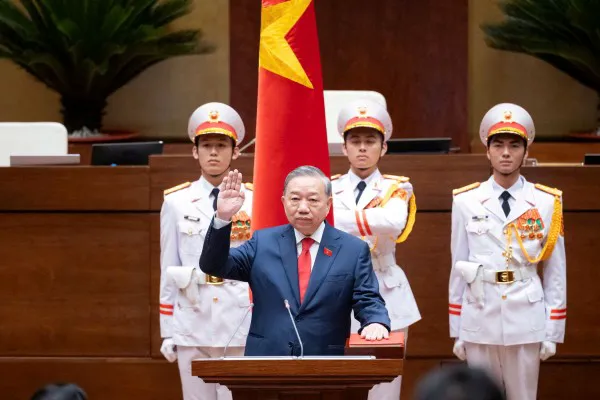

Vietnam's president and Communist Party chief To Lam begins his India visit with both sides under pressure to show results.
India and Vietnam have spent years building political trust, expanding engagement and raising the partnership to a comprehensive strategic level.
That phase is over. The next phase depends on whether the relationship can deliver on defence, trade and regional coordination in a more direct and measurable way.
The strategic setting is straightforward. Both countries are dealing with the rise of China. Vietnam faces constant pressure in the South China Sea, including disputes over maritime zones and resource access. India faces a wider challenge, balancing competition and engagement with Beijing while expanding its role in Southeast Asia. Neither country wants to be tied into alliances. Both want flexibility. That shared approach creates space for cooperation, but also sets limits.
Defence cooperation is the strongest and most consistent part of the relationship. India has trained Vietnamese military personnel for years, supported capacity building and extended credit lines for defence purchases. Naval engagement has expanded through port calls, exercises and exchanges.
The possible sale of BrahMos missiles remains the most visible test of how far this cooperation can go. If the deal is finalised, it will show that India is ready to export advanced systems and that Vietnam is willing to strengthen its deterrence in a way that carries clear strategic weight. It will also mark a shift in India's defence posture, from a cautious supplier to a more active one. For Vietnam, such a step fits its long-standing approach of diversifying partners to avoid overdependence.
Even if that deal does not close immediately, the trend is clear. Defence ties are moving forward in a steady, practical way. Training, maintenance support, maritime cooperation and institutional links are already in place, built on continuous engagement.
At the same time, the limits are clear and unlikely to change. Vietnam will not enter into a formal alignment. India will not act as a security guarantor. Both will avoid moves that lock them into direct confrontation with China. This keeps the relationship flexible but also caps its scale. The value lies in gradual capability building, not in dramatic shifts.
The economic side presents a sharper challenge. Trade between India and Vietnam has grown, but it remains below potential and uneven in structure. Vietnam's economy is deeply integrated with major partners such as the United States, China, Japan and South Korea. These relationships are backed by supply chains, investment flows and manufacturing linkages that India has not matched.
There is clear complementarity. India has strengths in pharmaceuticals, information technology, services and a large domestic market. Vietnam has a strong manufacturing base, export orientation and integration into global production networks. In theory, this should support deeper economic ties. In practice, progress has been slow. Projects take time, connectivity is limited and private sector engagement lacks scale.
This gap matters because a partnership that is strong on defence but weak on economics will remain limited in impact. Defence ties can build trust and capability, but long-term influence depends on trade, investment and production linkages. Without that, the relationship risks becoming narrow.
This visit needs to address that directly. Not through broad statements or new frameworks, but through specific outcomes. Investments in electronics, energy, digital infrastructure and supply chains are areas where progress is possible. Faster project execution, better logistics links and clearer business pathways are needed. Without these, economic ties will continue to lag behind strategic intent.
There is also a softer layer to the relationship. Cultural and historical links, especially through Buddhism, create goodwill and public familiarity. Visits to sites such as Bodh Gaya reinforce that connection. India has used these links to maintain a positive presence in Vietnam over time. But this is not a driver of policy. It supports the relationship, but does not define its direction.
The China factor shapes both opportunity and constraint. Vietnam maintains working ties with Beijing while expanding relations with other partners. India does the same in its own way. This allows both countries to cooperate without framing the relationship as being against China, but it also limits how far cooperation can go in overt strategic terms.
This balance is a deliberate choice. Both countries want to expand options without reducing autonomy. That means the relationship will grow through steady steps rather than sudden shifts. It also means expectations need to be realistic. There will be no alliance, no formal security pact and no rapid escalation. The gains will come through accumulation.
What gives the partnership value is consistency. Political trust is high. Engagement is regular. Areas of cooperation are clear. This reduces volatility. It also creates a platform for gradual expansion. The risk is not breakdown, but stagnation. Without new outcomes, the relationship can remain stable but underperforming.
That is why this visit matters. It is a point where intent needs to translate into action. The benchmarks are clear.
First, defence. Any concrete step that strengthens capability, whether through systems, training expansion or operational cooperation, will deepen the partnership. A BrahMos deal would be significant, but other forms of cooperation also matter.
Second, economics. Measurable progress in trade, investment or joint projects will show that both sides are serious about expanding beyond security. This is the area where the gap between intent and outcome is largest.
Third, regional coordination. Clear alignment on Indo-Pacific priorities, especially maritime security and a rules-based order, will add strategic clarity. This does not require new language. It requires consistent positions and follow-through.
If these areas move, the relationship enters a more operational phase. If they do not, it remains where it is, stable, friendly and limited in scope.
There is also a wider regional context. The Indo-Pacific is more contested, with multiple powers shaping outcomes. Middle powers like India and Vietnam are trying to preserve flexibility while expanding influence. Partnerships like this are part of that approach. They provide options without formal commitments. But for this to work, such partnerships must produce results. Or lose relevance.
India's Act East policy has long identified Vietnam as a key partner. This visit is a chance to show that the policy can deliver in practical terms. For Vietnam, deeper engagement with India adds another layer to its diversification strategy. Both sides have clear incentives.
The core issue is execution. The relationship has moved past the stage where new labels or declarations add value. What matters now is whether both sides can act on what they have already agreed. That means faster decisions, clearer priorities and sustained follow-through.
To Lam's visit will not transform the relationship on its own. But it will show direction. If it produces concrete steps in defence, economics and regional coordination, it will mark a shift from intent to delivery. If it does not, the relationship will continue on its current path, steady but limited.
India and Vietnam have built a strong base. The next phase depends on whether they are willing to use it.