




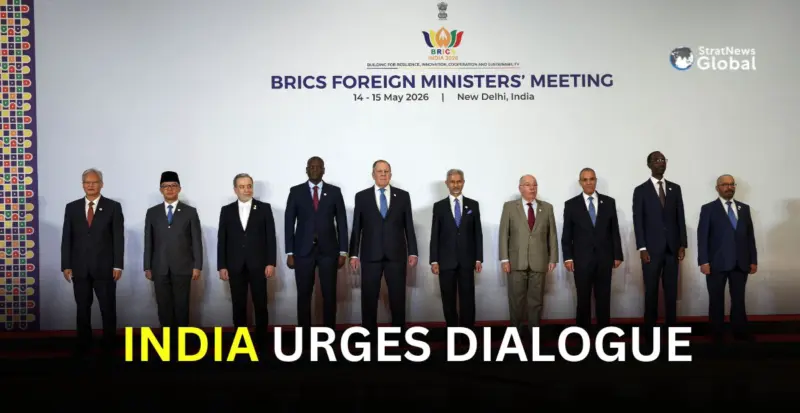

The first day of the BRICS Foreign Ministers' Meeting (FMM) in New Delhi was overshadowed by the ongoing Iran conflict, mounting energy concerns, and widening geopolitical divisions within the expanded bloc.
Hosted under India's 2026 BRICS chairmanship theme: 'Building for Resilience, Innovation, Cooperation and Sustainability' the two-day meeting brought together top diplomats from member and partner nations at Bharat Mandapam.
While the official agenda focused on economic resilience, healthcare cooperation, trade, and global governance reforms, discussions on the US-Israel-Iran conflict quickly emerged as the dominant issue on Day 1.
In his opening remarks, External Affairs Minister S. Jaishankar acknowledged the fragile global environment, saying the world was witnessing 'considerable flux in international relations' amid ongoing conflicts, trade disruptions, and economic instability.
'There is a growing expectation that BRICS will play a constructive and stabilizing role,' Jaishankar said, while stressing the importance of 'dialogue and diplomacy' in resolving conflicts. He also called for 'safe and unimpeded maritime flows' through international waters, a direct reference to the continuing disruption in the Strait of Hormuz.
Iranian Foreign Minister Abbas Araghchi urged BRICS nations to take a stronger position against Washington and Tel Aviv, calling the attacks on Iran 'unlawful aggression'. In one of the sharpest interventions of the day, Araghchi also indirectly accused the UAE of siding with Israel during the conflict.
'Your alliance with the Israelis did not protect you either, and reconsider your policy towards Iran,' he said, according to remarks circulating on the sidelines of the meeting.
The Iranian minister further alleged that the UAE allowed its territory to be used during attacks on Iran and criticised Abu Dhabi for refusing to condemn the military action against Tehran. The comments highlighted the growing internal tensions within BRICS, particularly between Iran and the UAE, both of which are recent additions to the bloc.
Prime Minister Narendra Modi held separate meetings with Russian Foreign Minister Sergey Lavrov and Iran's Araghchi on the sidelines of the summit, amid concerns over regional stability, energy security, and trade disruptions.
Araghchi's visit was his first to India since the outbreak of the Iran conflict earlier this year. India is walking a tightrope as it maintains strategic ties with Iran, builds on relations with Israel and the United States and continues its energy and defence partnership with Russia.
Another key takeaway from today's meeting was the absence of Chinese Foreign Minister Wang Yi, who skipped the meeting due to US President Donald Trump's simultaneous visit to Beijing for talks with Chinese President Xi Jinping.
China was instead represented by its ambassador to India, Xu Feihong. The timing of the BRICS meeting with the Trump-Xi summit added yet another dimension to the Delhi meeting with observers suggesting Washington may pressure Beijing to influence Tehran over the Hormuz standoff.
Energy security emerged as one of the central themes in informal discussions as disruptions in the Strait of Hormuz already impacting global energy supplies and pushing up oil prices. The crisis has directly affected major BRICS economies including India and China, both heavily dependent on Gulf energy supplies.
Officials and diplomats attending the summit repeatedly stressed the need for stable supply chains, uninterrupted shipping routes and reforms in global economic governance mechanisms.
Differences over the Iran conflict, Gaza, and relations with the West exposed visible fractures within the bloc, however, member countries continued to pitch BRICS as a stronger voice for the Global South. A joint statement is expected after the conclusion of the ministerial meetings on Friday.