
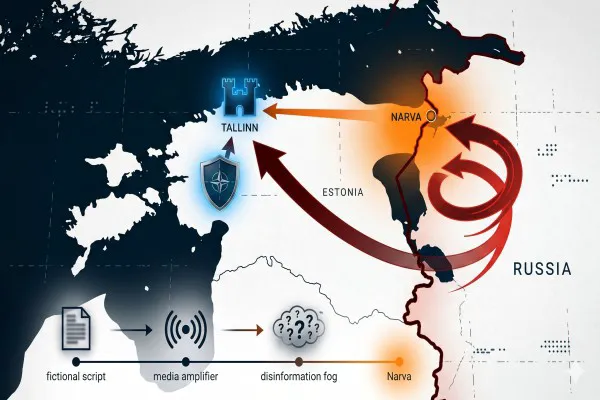

The story began as fiction—a loosely constructed narrative circulating online, hinting at unrest in Estonia's border regions.
But in today's volatile information landscape, even fiction can take on a life of its own.
What started as a fake Russian story soon evolved into something far more consequential, forcing Estonia to confront a familiar but evolving threat: disinformation that doesn't just distort reality, but actively reshapes it.
According to reporting by Politico and its journalists, the incident illustrates how modern propaganda ecosystems operate — blurring the lines between fabrication and plausibility.
The long-form, well-researched article details how a false narrative, amplified through online channels, suggested the emergence of a separatist movement in Estonia's northeastern city of Narva.
While untrue, the story gained traction because it mirrored real geopolitical anxieties and historical tensions in the region.
Narva, a predominantly Russian-speaking city near the Russian border, has long been viewed as a potential flashpoint. The fake narrative exploited this context, portraying the city as ripe for rebellion. As Politico notes, such narratives are often crafted to appear credible by anchoring themselves in existing social or political divisions.
The mechanics behind the story's spread were not entirely new. Researchers and officials have documented how Russian-linked disinformation networks create and distribute fabricated content through seemingly independent channels.
These networks often deploy fake personas, staged videos, and coordinated amplification to lend legitimacy to false claims.
What made this case particularly striking was how quickly the fabricated narrative began influencing real-world discourse.
Even though Estonian authorities dismissed the claims, the story still triggered concern among policymakers and analysts. It became a scenario that had to be considered—not because it was true, but because others might believe it was.
This dynamic reflects a broader shift in information warfare. Disinformation is no longer just about persuading audiences; it is about creating conditions in which falsehoods can generate real consequences.
As seen in Estonia, a fake story can prompt governments to respond, shape public debate, and even alter security calculations.
The Politico article highlights that Estonia is not new to such tactics. The country has faced repeated information operations, including cyberattacks and propaganda campaigns, often linked to Russia. These efforts typically aim to exploit societal divisions, particularly those involving the Russian-speaking minority.
In this context, the fake Narva story fits into a larger pattern.
By suggesting the existence of a separatist movement—even a fictional one—the narrative echoes strategies seen elsewhere, where disinformation is used to justify political or military actions. The goal is not necessarily to convince everyone, but to create enough ambiguity and tension to weaken trust and cohesion.
Crucially, the story also demonstrates how disinformation can 'bootstrap' itself into relevance. Once picked up by fringe platforms or discussed by commentators, it can migrate into mainstream awareness. From there, it becomes harder to ignore, even if it remains false. This process allows fabricated narratives to exert influence disproportionate to their origins.
Politico's reporting underscores that the response to such threats requires more than simple fact-checking. By the time a story is debunked, its impact may already be felt. Authorities must therefore anticipate how false narratives might evolve and prepare for their potential consequences.
One of the challenges is that disinformation campaigns often mimic organic discourse. As noted in broader studies of propaganda, networks of fake and real actors can interact in ways that make detection difficult.
This blending of authenticity and fabrication complicates efforts to identify and counter false narratives before they spread widely.
For Estonia, the stakes are particularly high. As a NATO member bordering Russia, the country sits at the frontline of geopolitical tensions. Any narrative suggesting internal instability—even if false—can have implications for regional security and alliance dynamics.
Yet the episode also reveals a degree of resilience. Estonian officials and analysts were quick to recognise the narrative as fabricated and to communicate that assessment publicly. This rapid response helped limit the story's impact, even as it continued to circulate in some corners of the internet.
Still, the incident serves as a warning. In the digital age, the boundary between fiction and reality is increasingly porous. A story does not need to be true to matter; it only needs to be plausible enough to be believed —or feared.
As Politico's account makes clear, the danger lies not just in the content of disinformation, but in its consequences.
A fake story about unrest in Narva did not spark an actual uprising. But it did something arguably just as significant: it forced a real country to reckon with a hypothetical crisis as if it might one day be real.
In that sense, the story achieved its purpose. It turned imagination into uncertainty—and uncertainty into a strategic problem.
And that is the new frontier of information warfare: not merely shaping what people think, but shaping what they believe could happen next.