





Saudi Arabia is recalibrating its position in the ongoing US-Israel war on Iran, says Dr Ausaf Sayeed, former ambassador to the desert kingdom in a conversation on The Gist .
'Saudi Arabia's role in the US-Israeli war against Iran has followed a clear, if reluctant, arc, from declared neutrality to logistical co-participation,' he said, noting that when the conflict started on 28 February 2026, Riyadh publicly opposed the strikes, refused to permit use of its territory for operations against Iran, and prioritised diplomatic de-escalation through GCC coordination and back-channel contacts with Tehran.
This initial caution reflected the Kingdom's deep interest in regional stability, the protection of its energy infrastructure, and the domestic and Islamic world sensitivities that any direct involvement would inevitably inflame.
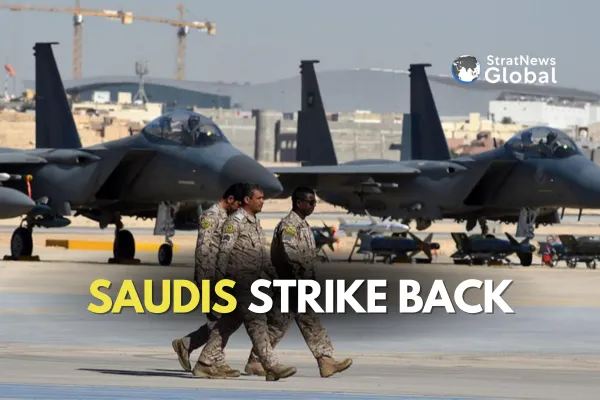
That position has since shifted. Saudi Arabia's most important decision has been granting US military forces access to King Fahd Air Base at Taif, a reversal of its earlier prohibition that significantly enhances the reach and tempo of coalition air operations across the Gulf.
'By opening Taif to American strike aircraft, aerial refuelling assets, and intelligence missions, Riyadh has crossed, at least functionally, from passive host to active enabler,' Sayeed said.
The shift comes amid an intensifying Iranian campaign targeting Saudi territory. Close to 600 drone and missile strikes have hit the Kingdom since 28 February, shutting down the Ras Tanura refinery, damaging desalination plants, and killing civilians in residential areas.
In early March, Riyadh invoked the clause of its Strategic Mutual Defence Agreement with Pakistan, signalling that 'any attack against either state shall be considered an attack against both'.
Saudi Foreign Minister Prince Faisal bin Farhan said Iran's 'trust with the Arab world is completely shattered' and warned that Saudi patience is 'not unlimited'.
According to Sayeed, 'By bombing the capital itself and targeting civilian infrastructure, Tehran demolished the diplomatic goodwill of the one major Arab state that had been actively seeking to preserve a dialogue, and in doing so, left the Kingdom with rapidly diminishing grounds for restraint.'
Even as it expands cooperation with the United States, Riyadh has stopped short of direct military involvement, reflecting a careful balancing act by Crown Prince Mohammed bin Salman.
Publicly, the kingdom remains committed to avoiding full-scale entry into the war, mindful that escalation could expose key economic ambitions, from Vision 2030 to the NEOM megaproject and Saudi Aramco's global standing, to sustained Iranian retaliation.
Privately, however, the calculus may be shifting.
'MBS has been reportedly urging President Trump to continue the war and pursue regime change in Tehran, calculating that a defanged, post-war Iran would remove the kingdom's most dangerous regional rival at a price paid primarily by US and Israeli military power rather than Saudi blood or treasure,' the former ambassador said.
The war has also upended earlier Saudi efforts to stabilise ties with Iran, according to regional experts.
'For Saudi Arabia, the US-Israel war on Iran has presented a serious challenge,' says Dr Muddassir Quamar of the Centre for West Asian Studies, Jawaharlal Nehru University in Dehi. 'Riyadh does view Iran as an expansionist power with regional hegemonic ambitions, and hence a geopolitical challenge.
'At the same time, it did not view Iran as an immediate security threat, especially since the two had started a process of rapprochement since March 2023.'
In his opinion, 'The ongoing war has changed this strategic dynamics with Iran posing a security threat to the Kingdom given the attacks. Nonetheless, Riyadh has shown extraordinary restraint by not directly joining the war and only deploying defensive capabilities to counter Iranian missile and drone attacks.'
'Saudi Arabia has also been circumspect in its criticism of Iran given the long-term implications of the war. It is also compelled to cooperate with the US because of the security dependence. Simultaneously, the dependence on long-term peace and stability for its economic sustainability means that it does not want to pick up the pieces of a war not of its making.
'The view in Riyadh is clearly antagonistic to Tehran, but there is a view that unceasingly sees Tel Aviv as a growing military threat to regional peace and stability. Hence, Saudi Arabia has neither completely joined the war but has inevitably become part of it,' Quamar added.
With the Strait of Hormuz under pressure and critical energy routes disrupted, the economic stakes are rising alongside the military ones, leaving Saudi Arabia navigating an increasingly narrow path between restraint and involvement.