




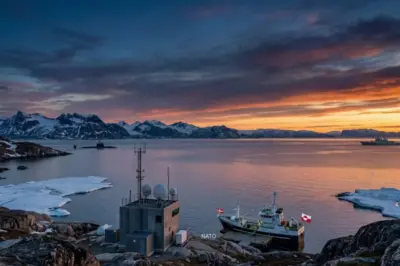

Greenland is no longer a remote, frozen outpost on the margins of global politics. It is now central to how major powers think about security, trade, and resources in the Arctic.
What was once a peripheral space has become a strategic hinge—linking North America, Europe, and Asia. The result is a quiet but consequential competition involving the United States, China, and Russia, each approaching the island with different tools and expectations.
A recent backgrounder titled Greenland: A New Frontier of Competition for the U.S., China and Russia?, published by the Institute for Security and Development Policy (ISDP), lays out this shift in clear terms. The authors argue that Greenland's importance rests on three converging factors: its role in Arctic security, its proximity to emerging maritime routes, and its large reserves of critical minerals.
At the core of Greenland's strategic relevance is geography. The island sits between the Arctic Ocean and the North Atlantic, placing it along the shortest routes for missiles and aircraft between Russia and North America. This makes it critical for early warning systems and surveillance.
The U.S. military presence at Pituffik Space Base reflects this reality. The facility supports missile detection, space surveillance, and monitoring of Arctic activity.
Greenland also lies near the Greenland-Iceland-UK (GIUK) gap, a key maritime chokepoint. Russian submarines moving from the Arctic into the Atlantic must pass through this corridor. Monitoring this movement is central to NATO's deterrence posture. The island therefore functions less as a frontline and more as an enabling platform for surveillance and control.
This security role has gained urgency since Russia's invasion of Ukraine in 2022. Moscow has expanded its military footprint across the Arctic, reopening bases and deploying advanced systems along its northern coast. At the same time, NATO has grown, with Finland and Sweden joining the alliance. This has tightened NATO's grip around Russia's northern flank, increasing the importance of Greenland within a broader defence network.
Yet security is only part of the story.
Climate change is altering the Arctic environment, opening sea routes that were previously inaccessible. The Northern Sea Route along Russia's coast, the Northwest Passage through Canada, and a possible Transpolar route across the Arctic Ocean could reshape global shipping.
These routes may reduce transit times between Asia and Europe, but they also introduce new geopolitical tensions over control and regulation.
Greenland does not sit directly on these routes, but it is positioned along their approaches. This gives it value in monitoring maritime traffic and projecting influence over nearby waters. As Arctic navigation becomes more viable, control over adjacent spaces will matter more, not less.
The third driver of interest is resources. Greenland holds significant deposits of rare earth elements and other critical minerals. These materials are essential for defence systems, electronics, and energy technologies. At a time when Western countries are trying to reduce dependence on China, Greenland appears as a potential alternative source.
However, the gap between potential and reality is large. Mining in Greenland is difficult and expensive. Most of the island is covered by ice, infrastructure is limited, and environmental regulations are strict. Only a handful of mines have operated historically, and just two are currently active. Even the most advanced rare earth projects are still in early stages.
Domestic politics further complicate resource development. Greenland has banned uranium mining, which affects several major deposits that contain both uranium and rare earths. Regulatory shifts and environmental concerns create uncertainty for investors. This means that while Greenland's resources are strategically important, they are not easily accessible.
China's involvement reflects this tension between ambition and constraint. Beijing has framed the Arctic as part of a broader 'Polar Silk Road' and has sought access to resources and infrastructure. Chinese companies have invested in mining projects and bid for infrastructure contracts, including airports and telecommunications systems.
Most of these efforts, however, have stalled or been blocked. Danish authorities have intervened in some cases on security grounds, and Greenland's own policies have limited others. As a result, China's direct economic footprint in Greenland remains limited. Its Arctic strategy has instead leaned more heavily on cooperation with Russia, particularly along the Northern Sea Route.
Russia, for its part, sees the Arctic as central to its national security. It has the largest presence in the region and has invested heavily in military infrastructure. But its focus remains on its own territory. Greenland enters Russian calculations indirectly, as part of NATO's northern posture and the U.S. presence on the island, rather than as a target of direct influence.
The United States has taken a more direct interest in Greenland, particularly under President Donald Trump. His repeated suggestions of acquiring the island—first floated in 2019 and revived more forcefully in his second term—have strained relations with Denmark and raised questions about alliance cohesion.
These proposals have been rejected by both Denmark and Greenland. They have also triggered a broader European response, including increased military presence and diplomatic engagement. Within the United States, there is limited public and political support for coercive approaches. This has constrained how far such ambitions can be pursued.
At the same time, Greenland itself is not a passive actor. It has significant autonomy within the Kingdom of Denmark and retains control over its natural resources. While there is support for eventual independence, economic dependence on Danish subsidies remains a major constraint. Public opinion reflects this trade-off: many Greenlanders favour greater autonomy, but not at the cost of lower living standards.
This internal dynamic is often overlooked in external discussions. Decisions about Greenland's future are not solely a matter for Washington or Copenhagen. Local politics, economic realities, and questions of identity will shape outcomes just as much as great power competition.
The emerging picture is one of layered complexity rather than simple rivalry. The United States sees Greenland primarily through a security lens. China views it as part of a longer-term economic and geopolitical strategy. Russia treats it as a secondary factor within a broader Arctic posture. None of these approaches has yet translated into decisive control or influence.
What is clear, however, is that Greenland's importance will continue to grow. Climate change will make the Arctic more accessible. Competition over resources and routes will intensify. And the island's strategic position will remain central to how major powers think about the region.
The risk is not immediate conflict but gradual tension—manifested in military build-ups, diplomatic disputes, and competing economic projects.
Managing this competition will require coordination within NATO, careful engagement with Greenland's own leadership, and a recognition that the Arctic is no longer insulated from global politics.
Greenland is not simply a prize to be contested. It is a space where global trends—security competition, resource scarcity, and climate change—intersect.
How those pressures are managed will test and shape not just the future of the Arctic, but the stability of relations between major powers.