

For decades, the United States government insisted there was nothing to see in the skies except weather balloons, the occasional Chinese spy balloon, misidentifications and overactive imaginations.
Then, quietly and with minimal fanfare, it created a bureaucracy for unidentified flying objects.
Today, visitors to the Pentagon's All-domain Anomaly Resolution Office and WAR.GOV's UFO portal can browse official case files, reporting procedures, unexplained aerial imagery and government terminology for what earlier generations simply called UFOs.
Somewhere deep inside the American security state, glowing anomalies now have workflows.
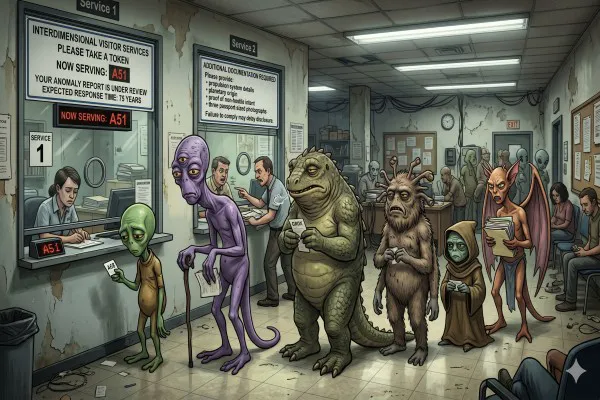
One almost imagines extraterrestrials standing silently beneath flickering fluorescent lights, waiting for their token number to appear on a government display board.
The modern UFO experience does not begin with eerie music or grainy footage. It begins with the digital equivalent of a waiting room. There are menus. Submission procedures. Reporting mechanisms. Resolution categories. Historical archives.
Visitors are invited to navigate the unexplained through the soothing language of officialdom, as though first contact has been outsourced to administrative processing.
The Pentagon no longer speaks about flying saucers. It speaks about 'UAPs' — unidentified anomalous phenomena. The terminology sounds less like science fiction than a compliance seminar.
And that may be precisely the point.
The world's most sophisticated military apparatus now publicly catalogues unidentified objects with the energy of a slightly overburdened sarkari office handling visa applications from another galaxy.
According to material published by AARO's reporting trends section, many reported objects fall into recurring shape categories: Orbs. Spheres. Cylinders. Triangles.
Yet behind the absurdity lies something serious.
The Pentagon's growing obsession with unidentified aerial encounters has less to do with extraterrestrials than with uncertainty itself.
In an era of drone warfare, hypersonic weapons, AI-assisted surveillance and Chinese reconnaissance balloons, anything unexplained inside restricted airspace automatically becomes a security concern.
Not every unidentified object is alien. But every unidentified object is a problem.
That distinction explains why UFOs have migrated from tabloid television into congressional hearings, defence briefings and intelligence workflows.
A grainy infrared clip emerges online. Fighter pilots describe impossible manoeuvres. Social media explodes into theories about extraterrestrial visitors and hidden technologies. Cable news panels debate disclosure. Podcasts spiral into speculation.
Then comes the official resolution.
• Birds.
• Airborne clutter.
• Commercial drone.
• Sensor artefact.
• Balloon. Weather-related or otherwise.
The suspense of the unknown collides with the crushing anticlimax of administrative review. Somewhere, one imagines an exhausted extraterrestrial being handed revised paperwork beneath fluorescent lighting.
Perhaps no phrase better captures the modern UFO era than the dry institutional language scattered across Pentagon documents: 'lack of sufficient data'. No proof. No denial. Just permanent unresolvedness.
And maybe that ambiguity is what keeps the entire machinery alive.
For most of human history, unexplained lights in the sky belonged to mythology. Angels, omens, divine warnings and supernatural visions occupied the space where modern societies now place extraterrestrials.
Today's UFO culture reflects something different: technological anxiety.
We live inside systems we barely understand: algorithmic surveillance, artificial intelligence, autonomous drones, classified aerospace programmes and information ecosystems that blur fact with fiction at an industrial scale.
Against that backdrop, UFOs become less about aliens and more about civilisation's fear that somebody, somewhere, possesses capabilities beyond public comprehension.
And the American government, perhaps unintentionally, has legitimised the entire ecosystem simply by institutionalising it.
After spending decades dismissing UFO culture, the American state now maintains portals, offices, archives and reporting structures dedicated to managing the unknown.
The extraterrestrial, once imagined as an invader, has effectively become an applicant standing patiently inside an infinite bureaucratic queue while the security state searches for additional documentation.
The US military lost wars in Afghanistan and Iraq, but its bureaucracy may finally defeat glowing triangles.
The flying saucer has entered the workflow.