




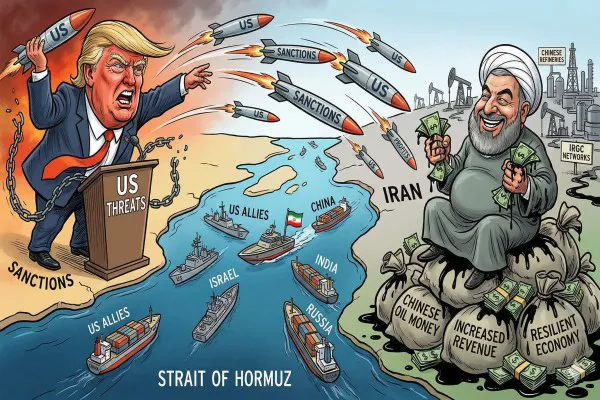

War was meant to choke Iran; it has made it richer.
Missiles are striking across West Asia, shipping lanes are disrupted, and about 15% of global oil supply is delayed or stranded.
The expectation was that sustained military pressure and sanctions would reduce Iran's ability to fund itself.
That has not happened. Oil exports remain steady at roughly 2.4 to 2.8 million barrels per day, and prices have risen. Iran is earning more per barrel and more overall.
The core reason is structural. Iran's economy depends heavily on oil, which accounts for about 70% of export revenue. The challenge has never been production but access—finding buyers under sanctions. That constraint has eased during the conflict.
Tehran has also shifted the balance at the Strait of Hormuz.
Passage is no longer neutral. Ships linked to the United States, Israel, and their allies face denial or restriction, while others continue to move. China, India, Russia, Iraq and Pakistan have regular access, with Bangladesh and Thailand also permitted and Malaysia negotiating entry. Iranian naval forces and the IRGC are enforcing compliance. The chokepoint is being used selectively, shaping who gets energy in a tighter market.
Demand has concentrated rather than fallen. China remains the primary buyer. As the world's largest crude importer, it absorbs most of Iran's seaborne exports—estimated at 60 to 90%—often routed through intermediaries or relabelled. Smaller independent refineries handle the purchases, allowing the oil to enter the wider system without exposing major Chinese firms to sanctions.
India's role is indirect but relevant. Iran cannot fully repatriate its earnings, so it spends abroad through intermediaries and shell entities. Some of that capital enters legitimate trade flows, including sectors linked to Indian manufacturing. The transactions are opaque but persistent.
Iran's export system is built to absorb pressure. Oil is distributed across intermediaries, many linked to the IRGC, rather than handled through a single state channel. Disruption shifts flows rather than stopping them. Shipping relies on evasion—tankers switch off tracking, alter identities and conduct transfers at sea. Backup terminals keep exports moving when primary ones are hit. Payments move through shell companies and smaller banks, routed across jurisdictions to reduce traceability. The system is inefficient but difficult to shut down.
The war has strengthened this model by tightening global supply. With fewer barrels available from other producers, prices have risen. Iran's earlier need to offer steep discounts has reduced. Revenue has increased without any rise in volume.
For the United States, particularly under Donald Trump, this exposes a gap between threats and outcomes. Strikes have not stopped exports. Sanctions have not stopped payments. Deadlines and warnings have not changed behaviour. The system moving Iran's oil and money remains intact.
Israel's military actions have imposed costs but face the same limit. Airpower can damage facilities but cannot dismantle a decentralised network spread across shipping, finance and end-buyers.
Gulf producers are more exposed. Their export systems depend on stable shipping lanes and predictable markets. Disruption reduces output and revenue. Iran operates outside that structure and benefits from its breakdown.
Escalation carries risk. A wider strike on Iran's energy infrastructure could trigger retaliation against Gulf oil assets—pipelines, refineries and export terminals. The region's energy systems are interconnected and vulnerable.
The global effect is already visible. Higher oil prices feed into transport, manufacturing and food costs. The impact extends well beyond the conflict zone.
This conflict exposes the limits of conventional economic pressure.
Sanctions are less effective when alternative networks exist. Military force is less effective against decentralised systems. Demand concentrated in Asia provides stable outlets outside Western control.
Iran's system is not efficient, but it is resilient. It controls access at a critical chokepoint, distributes risk across multiple actors, uses evasive logistics, and relies on steady demand from China. That system is functioning under sustained military pressure.
Tehran has not only called Trump's bluff; it has profited from it.