
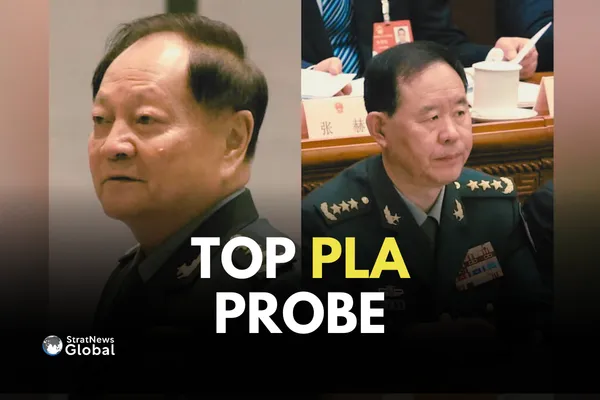

In a move that significantly alters the composition of the country's top military leadership, China has confirmed that Zhang Youxia, one of the most senior figures in the People's Liberation Army (PLA) and China's second-highest-ranking military officer, is under investigation for 'grave violations of discipline and the law.'
The Ministry of National Defence provided no details of the allegations, using language that in China is commonly associated with corruption or serious political wrongdoing. The ministry also confirmed that General Liu Zhenli, chief of staff of the Central Military Commission's Joint Staff Department. is under investigation. Their cases follow the expulsion of nine senior generals in October 2025, one of the largest publicly acknowledged crackdowns on the military in decades.
Soon after the announcement, the PLA Daily published an editorial titled 'Resolutely Winning the Tough and Protracted Battle Against Military Corruption.' The article described the investigations into Zhang Youxia and Liu Zhenli as a major political achievement, stating that anti-corruption enforcement in the armed forces would tolerate no 'restricted zones, exceptions, or ceilings.'
The editorial accused the two officers of betraying Party trust, undermining the Central Military Commission (CMC) chairman responsibility system, and damaging political discipline, unity, and combat effectiveness. It urged the entire PLA to align unconditionally with the Party centre and Xi Jinping.
Zhang and Liu were last seen publicly on 22 December 2025 at a CMC ceremony where several PLA officers were promoted to the rank of general. State media footage showed Zhang reading out promotion orders signed by Xi Jinping, a role that underscored his formal authority. Only days later, both men were absent from another high-level party event, prompting speculation about their status.
Zhang, 75, served as vice-chairman of the CMC, the Communist Party body that exercises absolute control over the armed forces, and was also a member of the 24-person Politburo. His father was a founding general of the Chinese Communist Party, and Zhang joined the PLA in 1968. He is among the few senior Chinese military leaders with combat experience.
With Zhang now under investigation, the CMC is effectively reduced from seven members to two: Xi Jinping as chairman and Zhang Shengmin, who oversees military discipline.
Bali Deepak, Professor at Jawaharlal Nehru University's Centre for Chinese and Southeast Asian Studies, said the confirmation of Zhang Youxia's investigation had 'ended the myth of Zhang usurping power in China,' reinforcing the view that authority remains firmly concentrated under Xi Jinping.
China analyst Manoj Kewalramani described the development as a 'bombshell' for Chinese elite politics. Initial reporting suggests the probe may involve Zhang's failure to rein in close associates and relatives, as well as shortcomings in identifying and addressing problems within party leadership structures under his watch, he said.
Kewalramani also noted that while some believe the purge was technocratic, linked to corruption and dissatisfaction with capability-building as the PLA works toward its 2027 centenary goals, another interpretation is more political, arguing that after earlier purges weakened other PLA factions, Zhang may have emerged as the last remaining power centre within the military.
Xi Jinping has repeatedly described corruption as the Communist Party's greatest threat, stating that the fight against it remains 'grave and complex.'
With Zhang Youxia's fall, that campaign appears to have entered a new and more unforgiving phase, one in which power is increasingly concentrated, trust is scarce, and even the closest allies can be swept aside.