

Delimitation will return. The debate around it asked how many MPs India should have. It never asked what they would do.
The anti-defection law may have hamstrung MPs' legislative powers, but an MP has more work than legislation.
Here's a look at how members of the legislature participate in the task of governance.
On a November afternoon in 2012, in a wood-panelled committee room in Westminster, Margaret Hodge, the Labour MP for Barking, leaned across a horseshoe table at executives from Amazon, Starbucks and Google and delivered a line that would reverberate through global tax policy for the next decade.
"We are not accusing you of being illegal," she told them, in her capacity as chair of the House of Commons Public Accounts Committee, "we are accusing you of being immoral."
The words travelled faster than any statute could. Within weeks, Starbucks had volunteered £20 million in additional UK corporation tax. Within three years, the Diverted Profits Tax had entered British law. Within a decade, the OECD's Base Erosion and Profit Shifting framework, now the global baseline for multinational tax, had begun its long march through ninety jurisdictions.
Hodge never drafted a line of primary legislation in that committee room. She did not need to. What she was doing was the work of a modern parliamentarian in its purest form: scrutiny, exposure, public shaming, moral agenda-setting. And it changed the behaviour of governments and corporations on three continents.
The Constitution (One Hundred and Thirty-First Amendment) Bill, 2026 was defeated on the floor of the Lok Sabha on 17 April. With it, the immediate political argument over delimitation has been put back on the shelf.
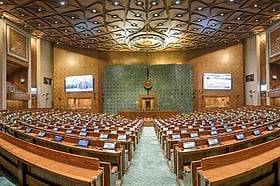
It will return. The constitutional freeze on seat allocation lapses with the first post-2026 Census. The new Parliament building was designed with chamber capacity for 888 members in the Lower House, and the defeated Bill had proposed a statutory strength of around 850. No serious observer of Indian politics believes the Lok Sabha will stay at 543 seats forever.
The defeat does, however, clear some air. It gives us room to step back from the political arithmetic, and from the partisan heat around it, and ask a question the debate itself never quite got to - if and when the Lok Sabha is expanded to around 850 seats, what will those 850 MPs actually do?
The most persistent complaint in the commentariat was never really about federal arithmetic or fiscal cost. It was the cynical one: that Indian MPs have no meaningful work to begin with. Why multiply, the critics asked, a cadre of glorified voting-machines whose hands are tied by the Tenth Schedule?
If the anti-defection law forces every MP to vote as the whip dictates, the reasoning runs, then Parliament is theatre, the debate is performance, and 850 rubber stamps are merely more rubber stamps. It is the kind of argument that sounds worldly-wise in a nine-o'clock television panel, and collapses within thirty seconds of contact with how legislatures actually function, whether in Westminster, Washington, Canberra or, indeed, New Delhi.
The mistake, at its root, is a conflation. The anti-defection law's whip binds an MP's voting hand on whipped motions on the floor of the House, and critics assume that the floor of the House is where parliaments do their work. It is not, and has not been for at least a century and a half.
Walter Bagehot, surveying the Victorian House of Commons in 1867, organised the work of a legislature into five functions: elective, expressive, teaching, informing, and, almost as an afterthought, legislative. He listed law-making last not out of rhetorical flourish but because he understood a basic truth about parliamentary systems. The executive drafts, the legislature scrutinises, and the real product of Parliament is not primarily statutes but the habit of accountability it imposes on the government of the day.
A century later, Philip Norton formalised this insight into a comparative typology. He classified most Westminster-tradition parliaments, including India's, as "policy-influencing" rather than "policy-making" legislatures. Their power lies in the capacity to modify, delay, expose, embarrass, and set agendas, rather than to substitute their own programme for the executive's.
Edmund Burke's 1774 address to the electors of Bristol, which every Indian law student still encounters on the first day of constitutional law, insisted that a representative "owes you, not his industry only, but his judgment". That conception of the MP's role extends far beyond voting correctly in a division.
None of this is Anglo-apologia imported into an Indian context. It is the intellectual substrate on which every serious parliamentary democracy, including ours, was built. The drafters of the Indian Constitution understood it exactly, and that is why they gave us twenty-four Departmentally Related Standing Committees, a Public Accounts Committee that actually predates Independence, an Estimates Committee, a Committee on Subordinate Legislation, a Zero Hour convention, a Question Hour, and a Private Members' Business slot on every Friday of session. We have simply stopped noticing the work this architecture was built to enable.
Consider Hodge's committee room multiplied across the democratic world, and across the Indian record itself. The same chamber's Treasury Select Committee, chaired through the post-2008 financial crisis, asked over nine thousand questions across 161 hours of evidence and rewrote British banking law through the Banking Reform Act 2013, including a new criminal offence of reckless banking.
In Canberra, Senate Estimates hearings, in which cabinet ministers and senior public servants are grilled for eight days per portfolio, three times a year, have exposed a succession of scandals from asylum-seeker misconduct to welfare-algorithm disasters. Each ended careers and forced policy reversals through oversight rather than legislation.
The Indian record on this score is thinner than it should be, but it is not empty. The Joint Parliamentary Committee on the Personal Data Protection Bill, 2019, chaired sequentially by Meenakshi Lekhi and P.P. Chaudhary, held over sixty-five sittings and recommended eighty-nine amendments. These included renaming the Bill itself and extending its coverage to non-personal data. The intervention was substantial enough that the Union government withdrew the Bill in August 2022 and returned with the narrower Digital Personal Data Protection Act, 2023. That is an outcome forced by committee scrutiny, not by any vote on the floor.
The Public Accounts Committee under Murli Manohar Joshi in 2010-11 produced the 2G spectrum report that reshaped public discourse around the Comptroller and Auditor General's ₹1.76 lakh crore estimated loss, and fed into the Supreme Court's 2012 cancellation of 122 telecom licences.
Jairam Ramesh's tenure chairing the Standing Committee on Science, Technology, Environment, Forests and Climate Change forced wider consultation on the DNA Technology Regulation Bill, and subjected several environment-related Bills to technical scrutiny that the executive, left to its own devices, would not have welcomed.
The underlying data is striking. PRS Legislative Research finds that parliamentary standing committees during the 17th Lok Sabha presented 691 reports, and the government accepted roughly 69 per cent of their recommendations. M.R. Madhavan of PRS rightly calls these committees "mini-parliaments". They are where the whip evaporates, where party lines blur, where dissent notes are filed as a matter of course, and where actual policy work happens.
If committees are where the real work gets done, what about the floor itself? Even there, the numbers tell a more complicated story than the rubber-stamp caricature allows. In the 17th Lok Sabha, 559 MPs asked questions, averaging roughly 165 per member. Asaduddin Owaisi and Imtiaz Jaleel topped the table at six hundred and forty questions each, and several first-term MPs outperformed their senior counterparts.
A rubber-stamp assembly does not produce these numbers. What we see instead is a parliament in which some members use the instruments of scrutiny with distinction, and others treat their seats as sinecures. Sonia Gandhi and Akhilesh Yadav asked zero questions; fourteen MPs never spoke in a single debate. The critique that "MPs have no work" collapses on contact with the evidence that some MPs evidently have a great deal of work and do it with skill. The real question is why we tolerate the ones who do not.
A less flattering picture sits alongside this. The 17th Lok Sabha had the fewest sittings of any full-term Lok Sabha, with 274 sittings averaging 55 per year, down from 135 per year in the 1st Lok Sabha. The share of Bills referred to committees fell from 71 per cent in the 15th Lok Sabha to roughly 16 per cent in the 17th. Thirty-five per cent of Bills in the 17th Lok Sabha passed with less than an hour of debate, and the entire 2023 Union Budget was voted without discussion.
The space for non-legislative scrutiny has narrowed precisely when India most needs it. The answer to shrinking committee reference rates, however, is institutional repair. An expanded Parliament is the vehicle for restoring the scrutiny architecture that was always its strength.
And yet even what floor scrutiny remains may be looking in the wrong direction. A fact buried in the plumbing of modern administration ought to reshape this entire debate. The United Kingdom produces roughly 1,500 to 3,500 Statutory Instruments every year against perhaps thirty or forty primary Acts. These are the regulations, rules and orders through which ministers legislate under powers delegated by primary legislation.
The United States Federal Register runs to around eighty thousand pages annually, producing three to four thousand final agency rules a year. India has no consolidated count, but every student of Indian administration knows that the real texture of governance lies in gazette notifications, executive orders and ministerial rules, rather than in the roughly sixty Bills that Parliament processes each session.
The MP who scrutinises delegated legislation is therefore influencing vastly more of actual governance than the MP who debates a primary Bill. The Committee on Subordinate Legislation in both Houses exists precisely for this purpose. The United Kingdom has a Joint Committee on Statutory Instruments. The United States Congress has the Congressional Review Act of 1996, used to overturn fourteen Obama-era rules in the first four months of the Trump administration alone.
This is the supervision of the legislation-by-regulation that constitutes the modern administrative state. The Hansard Society has argued, bluntly, that lax scrutiny here "undermines the constitutional balance between the executive and the legislature". None of this work requires an MP to break a whip. All of it requires an MP with time, training and research support. An expanded Lok Sabha is precisely the vehicle for the latter.
Consider, too, the much-maligned Private Members' Bill. Fourteen PMBs have become law in India since 1952, the last in 1970, a statistic always cited as proof that the instrument is a dead letter. The statistic proves the opposite.
Everywhere in the democratic world, the purpose of most Private Members' Bills is to set the agenda, not to become law in the present session. The United Kingdom decriminalised homosexuality, legalised abortion, and abolished the death penalty through three separate PMBs in the 1960s, each moved by a backbencher against the instincts of the government of the day, each reshaping British society for the next half-century.
India's own precedent is more striking than its critics acknowledge. Tiruchi Siva's Rights of Transgender Persons Bill, 2014, passed the Rajya Sabha by voice vote on 24 April 2015, the first PMB to clear a House of Parliament in 45 years, and it did so against the open opposition of the government of the day. It lapsed in the Lok Sabha, but forced the Union government to introduce its own Bills in 2016, 2018 and 2019, eventually yielding the Transgender Persons (Protection of Rights) Act, 2019.
Shashi Tharoor has used PMBs to put directly-elected mayors, marital rape criminalisation and abolition of the death penalty on the public agenda. Baijayant Jay Panda's CAG (Duties, Powers) Amendment Bill, and his more recent SHIELD Bill on children's social media access, have shifted the terms of debate even while languishing on the order paper.
The whip does not apply to Private Members' Business. An Indian MP who wants to move national discourse on mental health, disability rights, urban local bodies or anti-trafficking law has every instrument her British, Canadian or Australian counterpart has. She just needs to use them.
Outside the chamber and the committee room lies a third ecosystem that observers of Indian politics tend to miss entirely: the world of all-party groups, caucuses and cross-partisan issue work.
The UK Parliament has over 750 All-Party Parliamentary Groups. Building on the posthumous work of Jo Cox, the Labour MP murdered in 2016, the APPG on Loneliness persuaded the British government in 2018 to appoint the world's first Minister for Loneliness and fund a £20 million national strategy, since imitated in Japan.
A parallel APPG on Hunger produced a 2017 report on school-holiday food poverty. That report, alongside a celebrated footballer-led campaign three years later, forced a British government U-turn on school holiday meals.
The US Congress has around 800 Member Organisations. Of these, the Congressional Caucus on India and Indian Americans, with 145 members in the 118th Congress, is the institutional scaffolding of the India-US strategic relationship that successive Indian governments, including the Modi government, have cultivated with considerable skill.
India's own parliamentary forums are the early scaffolding of exactly the same kind of cross-party issue-based work: the more than sixty bilateral friendship groups Speaker Om Birla has constituted over 2024-25, the Indian Parliamentary Group that has served as India's IPU delegation since 1949, and the thematic parliamentary fora on population, water and children.
They operate entirely outside the anti-defection regime. An MP in an APPG-equivalent on urban mobility, solar energy, fisheries or semiconductor supply chains, who invites experts, commissions research and lobbies the relevant ministry, is doing precisely the kind of work the British and American systems have built careers on for decades.
Then there is representation itself, which serious political scientists have long recognised as a feedback loop rather than a retail performance.
Richard Fenno's Home Style, published in 1978, established what is now known as the Fenno Paradox: voters' connection to their own legislator is qualitatively different from their view of the legislature collectively. Americans routinely despise Congress while re-electing their own congressman. This matters because constituency work supplies the empirical input that makes policy work intelligent.
A typical congressman's office in an American district closes two to five thousand cases a year, with recent figures running into tens of millions of dollars recovered for constituents. Each case is a data point on where federal programmes are breaking: which Veterans Affairs system has collapsed, which immigration queue is stuck, which Social Security formula is miscalculating.
Indian MPs do a great deal of casework through janata durbars, recommendation letters, passport interventions, railway grievances and police follow-ups. But they do it informally, without dedicated caseworker infrastructure and without systematic feedback to ministries.
Separately, the Member of Parliament Local Area Development Scheme, restored in November 2021 at ₹5 crore per MP per year, gives them structured funding for local development, though utilisation hovers at only 53 per cent of released funds. The critic who dismisses MPLADS as mere pork misses that the United Kingdom has no equivalent at all, and that the United States Congress banned earmarks for over a decade precisely because they were politically valuable rather than because they were wasteful.
If India's MPs were better resourced on casework, in the way a US Senator's state office is resourced, with full-time caseworkers handling constituent service, their representation of industry interests would transform too: Surat's diamonds, Tiruppur's garments, Coimbatore's pumps, Ludhiana's bicycles.
This is not lobbying in the American pejorative sense. It is the legitimate representation of sectoral and constituency interests to an otherwise inaccessible executive, and it is how democratic governments learn what their policies look like on the ground. A Parliament of 850, with average constituencies of roughly 1.6 million rather than the current 2.5 million, is the precondition for this kind of representation working at any fidelity at all.
Beyond all of this sits parliamentary diplomacy, which operates on a plane of its own. Speaker-led parliamentary delegations, bilateral friendship group visits, the Inter-Parliamentary Union's annual assemblies, and the Commonwealth Parliamentary Association together constitute a permanent Track 1.5 diplomacy channel that governments routinely deploy.
For a rising power like India, parliamentary diplomacy is a soft-power multiplier. Opposition MPs travelling abroad can sometimes say things government MPs cannot, and friendship groups build relationships that outlast electoral cycles. The Modi government's cultivation of the US-India Caucus has paid strategic dividends. The same logic applies to the European Parliament, to ASEAN legislatures, and to the African Union's Pan-African Parliament. A larger Indian Parliament means more bandwidth for this kind of sustained engagement, not less.
The anti-defection law, it must be said, is narrower than its critics assume. The Tenth Schedule was inserted by the 52nd Amendment in 1985, and tightened by the 91st Amendment in 2003, which removed the one-third split exception that had allowed en-bloc defections to be laundered as legitimate splits. It is real, and it is binding.
The former Lok Sabha Secretary-General Subhash Kashyap has repeatedly pointed out that it has arguably failed on its own terms, with defections per year if anything increasing since 1985.
But critics routinely ignore the narrowing construction the Supreme Court applied in Kihoto Hollohan v. Zachillhu (1992). The Venkatachaliah-led bench held that the whip-based disqualification must be read narrowly. It applied principally to votes going to the life of the government: confidence motions, money bills, and matters forming part of the party's electoral mandate. The Speaker's decisions were also made subject to judicial review.
This narrower construction has been abused in practice, with three-line whips on ordinary legislation now common. But even that expanded whip stops at the chamber door. It does not apply in committee proceedings, where dissent notes are filed as a matter of course. It does not apply to parliamentary questions, Zero Hour, Special Mentions, Private Members' Business, cross-party caucuses, parliamentary diplomacy, or constituency representation.
Bangladesh's Article 70 is substantially stricter than India's Tenth Schedule; it permits no dissent at all on any matter, and Bangladeshi MPs still do serious committee and constituency work. Canada is widely regarded as having the most rigid party discipline in the Westminster family. It has nonetheless produced landmark Senate inquiries that created the country's Mental Health Commission, and opposition-led Private Members' Bills that rewrote judicial training on sexual assault law.
The trade-off between party cohesion and individual legislator agency is real, and thoughtful people can argue about where the line ought to sit. But it reshapes the MP's role towards committees, oversight, representation and agenda-setting rather than collapsing it.
Which brings us, at last, to the arithmetic that nobody in this debate seems to have done. India has twenty-four Departmentally Related Standing Committees, each with 31 members drawn from both Houses, supposed to scrutinise entire ministries covering vast swathes of central government activity. Committees of 31 cannot plausibly audit ministries the size of Defence, Railways, or Health. They are undermanned relative to their mandates, and the problem will only grow as the administrative state grows, as it must, for a country of India's scale and complexity.
A Parliament of 850 members, rather than 543, would expand the pool of available MPs by nearly 60 per cent. Each DRSC could grow its bench, specialise its sub-committees, and meaningfully audit the administrative state.
Sectoral sub-committees become possible: on semiconductors within IT, on MSMEs within Industry, on cancer care within Health. This is how the US House of Representatives organises its policy work, and the subcommittees are often where the actual expertise resides.
Ad-hoc Joint Parliamentary Committees on emerging issues such as AI regulation, climate adaptation and data governance can be revived without paralysing the regular committee system. The talent pool for parliamentary diplomacy expands, where India currently under-deploys relative to its aspirations as a civilisational power. More questions become askable per session, more constituency casework feedback flows to ministries, and more scrutiny becomes possible on the tidal wave of delegated legislation that central ministries produce each year.
And constituencies drop from roughly 2.5 million per MP to around 1.6 million. That ratio would still place India among the most extreme constituent-to-legislator ratios in any large democracy, but it is meaningfully closer to workable.
This opportunity requires, of course, the executive to be smart about it. A larger Parliament must come with real committee resourcing, serious parliamentary staff support, protected sitting days, and a credible reversal of the collapse in committee bill-reference rates.
It must come with meaningful scrutiny of delegated legislation, and with proper research infrastructure for every MP, of the kind that PRS Legislative Research and the LAMP Fellowship have tried, on a shoestring, to improvise for the last two decades.
Without these, 850 MPs will not be rubber stamps but something arguably worse: 850 frustrated, under-utilised representatives whose talents are wasted. The answer to that risk is institutional reform alongside expansion, not the abandonment of either.
Expanding the Lok Sabha to 850, when the political moment for it returns, is not a multiplication of rubber stamps. It is an opportunity to rebuild the Indian Parliament closer to what its founders intended, and what a civilisational power of India's scale now requires.
The real rubber-stamp risk does not lie in the number of MPs. It lies in the executive's willingness, or unwillingness, to treat them as the policy force-multipliers they can be. Get the architecture right, and 850 informed, engaged, well-resourced MPs become the most valuable institutional asset any Union government could ask for. Dismiss them as rubber stamps, and we will have earned, by our own low expectations, the Parliament we are warned against.