




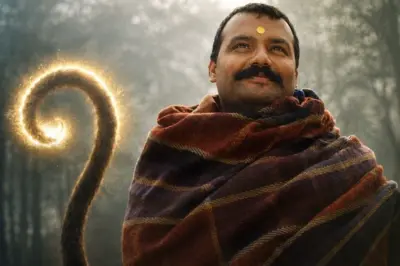

'Hanuman Ansh' rejects the spectacle and melodrama of mainstream cinema to portray Neeb Karori Baba's life and the enduring power of bhakti.
As the house lights came up for intermission, discreet attempts to brush away tears were visible across the cinema hall. The emotion was collective, cutting across demographic lines to visibly move even the so-called 'Gen-Z' viewers in the audience.
Directed by Vishal Chaturvedi, Hanuman Ansh, a biopic of Neeb Karori Baba, popularly revered as 'Neem Karoli Baba', achieves its resonance precisely by refusing the customary tropes of mainstream cinema.
It trades visual spectacle, melodrama, romantic subplots, and violence for quiet contemplation. The theatrical trajectory of the film itself mirrors this understated nature: after facing dismissive rejection from major streaming platforms and an initial sluggishness at the box office, it steadily gathered momentum through sheer word-of-mouth to become an unexpected phenomenon.
The film's restraint is deliberate. In an era dominated by CGI, adapting the life of a mystic celebrated for supernatural interventions presents an obvious temptation to lean heavily on visual effects. Chaturvedi largely resists this impulse. The production approaches its subject with distinct ethical discipline, announcing in a commencing card that the miracles should be treated more as the subjective experiences of devotees rather than objective, sensationalised events, and including explicit statutory disclaimers during historical depictions of child marriage, that child marriage is a social evil.
Throughout the narrative, Baba remains an outsider. One of the film's earliest and most compelling sequences addresses untouchability without any preaching or entering into identity- or victim-portrayal: Baba as a young lad distributes food that miraculously multiplies to children from communities considered lower in the social hierarchy, yet the narrative frames the true miracle not as the surplus of food, but as the quiet transformation in the hearts of the 'upper-caste' onlookers.
Free of swelling orchestral cues or polemical dialogue, the dismantling of social prejudice unfolds as organically as a bud breaking into flower.
Later, when village elders plot to exile the young ascetic, one pragmatically notes that a man who already resides beyond the village periphery cannot easily be cast out. By dwelling on the margins, Baba quietly transforms them in the centre.
The cinematic language relies on plain, grounded imagery to capture a young seeker dissolving into divine love. The result is an enduring sense of spontaneity. Rather than reducing bhakti to isolated ritual, isolated bhajan sequence or a highly dramatised single song, the film makes it the central string that runs through the whole movie. The movie brings out an India where devotion forms the fundamental fabric of everyday societal life, presented not through a lens of sepia-toned nostalgia, but as an abiding living tradition worth preserving.
Crucially, Baba's spiritual humanism is grounded in an unpretentious, practical modernism: he blesses the sick while strictly directing them to physicians; he confronts a bird-keeper prone to domestic abuse; and he cautions a stern father against breaking his son's spirit. The ethical imperative is woven into everyday interaction rather than preached from a dais or in overt melodramatic scenes.
Incidentally for this reviewer, the only moment the film stumbles from its rhythm is during the famous legend of the halted British Raj train, where the drama introduces a briefly amateurish and even a preaching derailing.
Yet, in the broader context of the film's achievement, and the innate shraddha that exudes through every frame, that flaw feels inconsequential or even pointing it out looks petty.
Any place in India has its own legends and Siddhas or mystics. Most of the experience of the miraculous by the devotees are very similar. Neem Karoli Baba was one such. The Hindu view is that these Siddhas even after their samadhis are a living presence. They operate in mysterious ways. Neem Karoli Baba definitely seems to have done exactly that.
The lore surrounding the production of the film carries its own serendipities. On the first day of principal photography, the lead actor fell abruptly ill. Rather than halt production, Chaturvedi held an impromptu five-hour audition with his second assistant director, Shobhinaw Satyaa. An FTII alumnus from Lucknow whom the crew had previously noted bore a striking resemblance to archival photographs of the young mystic, Satyaa stepped into the role.
His performance, marked by steady calm, playful detachment, and a quiet, ever subtle movement of his head affirming of all that life brings, anchors the entire film.
Among the film's quieter strengths is the voice of Sunil Lodhi, the visually impaired Bundelkhand singer who performs the traditional bhajan Maine Tere Hi Bharose. Lodhi is not a studio import; he spent years singing Hanuman songs with a tambura in village gatherings before a viral clip brought him to Mumbai, where director Vishal Chaturvedi heard him and kept the take.
The track does not try to sound like a polished film number. It arrives with the grain of folk devotion, untrained, unhurried, raw in its sincerity, and that natural shraddha is what makes it land. In a movie built on bhakti rather than craft spectacle, Lodhi's voice feels not like the soundtrack decoration but as the reverberation of that very primordial Nadha Brahmam that manifests through the voice and heart of every devotee.
While reports circulated online of audiences leaving their footwear at theatre doors and chanting the Hanuman Chalisa in unison, the atmosphere during my viewing in Thiruvananthapuram was defined by a shared, quiet reverence. The film succeeds because it is fundamentally an immersive experience, drawing the viewer into a steady, unadorned current of devotion mediated through the simple presence of Neem Karoli Baba.
Note:
--Do not go out of the theatre once the movie ends and credits start rolling. A story is told even in those credits. So please do wait.
--An earlier article on the role played by Neem Karoli Baba in the eradication of smallpox through his Jewish medical devotee Larry Brilliant can be read here.